
Insights
SEO guides for business owners, without the jargon
Plain-English SEO guides on local search, Google Maps, AI answers, websites, costs and choosing help. Each one answers a real question an owner asks, and cites its sources.
79 guides, each with a named author, the date it was last checked and a source for every figure.
Featured guide · Cost and budget
How much does SEO cost? Market rates, cost drivers and pricing models
In Ahrefs’ survey of 439 SEO providers, the most common retainer was $501–$1,000 a month. What SEO should cost you depends on scope, competition and speed.
Read the guide : How much does SEO cost? Market rates, cost drivers and pricing models11 min read
7 guides
Choosing an agency
How to compare agencies, freelancers and in-house hires, and when you don’t need one at all.
AI Agents vs a Done-For-You SEO System: When to Use Each
General AI agents are very good at research and one-off jobs. Running SEO every week needs more: locked keywords, safe changes, listings, reviews, leads and monthly proof. When to use each, and how they fit together.
8 min read · Updated
Marketing agency vs in-house vs freelancer, and when to hire none of them
Freelancers suit projects, employees suit ongoing roles, and a marketing agency suits specialist skills you need now and then but can’t justify hiring for.
8 min read · Updated
What does an SEO agency do, and is it worth paying for?
An SEO agency fixes what stops your pages being found, picks the searches worth winning, builds pages for them, earns links, then measures and adjusts each month.
11 min read · Updated
How to choose an SEO agency: proposals, case studies and contracts
To choose an SEO agency without being an expert, look past the pitch and check four things: the proposal, the case studies, who runs your account and the contract.
7 min read · Updated
Questions to ask an SEO agency, with strong and weak answers
Ask an SEO agency what it would not do for you, and why. That and fourteen more questions, each with a strong and a weak answer, need no SEO knowledge to judge.
7 min read · Updated
SEO agency red flags: practices that cost businesses money
The biggest SEO agency red flags are ranking promises, secret methods, accounts you don’t own and links sold per link. Any one should end the conversation.
8 min read · Updated
Marketing agency or software? What each is good at
Agency or software? Software is cheap at watching and good at repeatable work; deciding, and answering for it, needs a person. Split the work first, then choose.
5 min read · Updated
4 guides
Cost and budget
What drives the price of SEO and marketing, with sourced figures and our own prices.
Why Lifetime SEO Deals Stop Working (and What to Check)
A lifetime SEO deal is one payment against costs that never stop. The economics, the red flags to look for, questions to ask and a checklist to use before you buy.
8 min read · Updated
How much does SEO cost? Market rates, cost drivers and pricing models
In Ahrefs’ survey of 439 SEO providers, the most common retainer was $501–$1,000 a month. What SEO should cost you depends on scope, competition and speed.
11 min read · Updated
How much does a website cost? What drives a quote, and why quotes differ tenfold
Website cost depends on your brief: unique templates, content, integrations and migration drive the build price, and running costs carry on after launch.
7 min read · Updated
What drives a marketing budget, and how to set yours from your own numbers
Set a marketing budget from your own customer value, margin, close rate and payback period. A percentage-of-revenue rule only tells you what you can afford to lose.
8 min read · Updated
16 guides
Organic search
How Google search works, how to rank, and how long it takes.
What is SEO? A plain-English guide for small business owners
SEO (search engine optimisation) is the work of making your website and listings easy for Google to find, understand and trust, so you appear in the unpaid results when customers search for what you sell. You cannot buy those places: you earn them with a readable site, clear pages, a complete Business Profile and real mentions.
9 min read · Updated
Your first 90 days of SEO: what should actually happen
In the first 90 days of SEO you should see work, not big ranking jumps: a written check of your site and Business Profile and agreed target searches in month one, foundation fixes in month two, new pages and a first report against your starting point in month three. Google says SEO usually takes four months to a year.
9 min read · Updated
SEO vs PPC: which one should you pay for first?
SEO vs PPC comes down to time: PPC brings buyers in within days and stops when you stop paying, while SEO takes months, then keeps working.
8 min read · Updated
Local SEO vs national SEO: who you compete with and what changes
Local SEO competes with businesses near the searcher, including in the map pack; national SEO competes with every website on the topic, so the tactics and measures differ.
6 min read · Updated
How long does SEO take? Timelines and what changes them
How long SEO takes depends on what’s holding your site back: technical fixes can show within weeks, while authority in a competitive market takes months or more.
7 min read · Updated
How to do keyword research, step by step
To do keyword research, start from what you sell, collect your customers’ words, check each query’s results page, and write down what you leave out and why.
9 min read · Updated
Search intent explained, with examples
Search intent is the goal behind a query. To work it out, search the query and read what ranks: the results page shows what people want better than the wording does.
7 min read · Updated
Topical authority explained
Topical authority is the idea that sites covering one subject fully compete better on it. Google documents no such score; you build it with depth, links and expertise.
9 min read · Updated
How to get backlinks without breaking Google’s rules
To get backlinks safely, publish something only you can say, such as your own data or a useful tool, then tell the people who would cite it. Never pay for links.
10 min read · Updated
Digital PR vs link building: how to tell which you are buying
Digital PR pays for the chance an independent writer covers you. Link building, as usually sold, pays for a placement on a site that was paid. They are different purchases.
8 min read · Updated
What is technical SEO? Meaning, scope and limits
Technical SEO is everything that helps Google find, read and show your pages. It clears the path so they can compete; it won’t make them worth choosing.
7 min read · Updated
Core Web Vitals explained: what each metric measures
Core Web Vitals are three measures of how a page feels to use: loading (LCP), responsiveness (INP) and stability (CLS), judged on real visits at the 75th percentile.
8 min read · Updated
Website migration SEO checklist, by type of move
To migrate a website without losing SEO, find your type of move first. Each of the six carries a different main risk and needs different checks.
8 min read · Updated
JavaScript SEO: how Google renders a site, and what breaks
Google does index JavaScript, but in order: crawl, queue, render, then index. Almost every JavaScript SEO problem comes from a step in that order failing.
7 min read · Updated
Crawl budget explained: what it is and who it affects
Crawl budget is how much Google will crawl your site: what your server can handle plus how much Google wants to crawl. Most sites don’t need to manage it.
6 min read · Updated
The technical faults that cost traffic without triggering an alert
Uptime monitoring only tells you the server answered. Eight faults, from a form that stopped sending to a stray noindex, cost traffic silently. A monthly check catches them.
5 min read · Updated
12 guides
AI search
Clear definitions, and what you can and can’t measure in AI answers.
How to measure AI search visibility: a step-by-step method you can check
Measure AI search visibility as a rate: ask a fixed panel of buyer questions several times on a schedule, count mentions, citations and accuracy, and report the margin of error.
6 min read · Updated
AEO vs GEO vs SEO: clear definitions and where they overlap
AEO, GEO and SEO are mostly one job: AEO and GEO build on SEO’s foundations, and only four things change when an AI writes the answer.
7 min read · Updated
ChatGPT SEO vs Google SEO: the overlap, the differences and how to measure it
ChatGPT SEO and Google SEO share most of the work. The difference: Google ranks pages in a list, while an assistant writes one answer from passages, with no position to track.
9 min read · Updated
What is answer engine optimization (AEO)? A clear definition
Answer engine optimization (AEO) is making your content easy for AI answers, featured snippets and voice assistants to quote as the single correct answer.
7 min read · Updated
What is generative engine optimization (GEO), and how does it differ from AEO?
Generative engine optimization (GEO) is improving how AI assistants describe your business when they write an answer from several sources, not quote one.
6 min read · Updated
Will AI replace SEO? What changes and what stays the same
AI won’t replace SEO, because AI assistants read from the search index that SEO gets you into. What AI does take is a share of informational clicks.
8 min read · Updated
How AI assistants choose which sources to cite
How AI assistants choose sources is only partly documented. What you can influence is crawler access, clear answers and how consistently your business is described.
8 min read · Updated
AI Overviews and click loss: what the studies show
AI Overviews do reduce clicks where they appear: in Pew’s study of 900 US adults, people clicked a result on 8% of visits with an AI summary and 15% without.
8 min read · Updated
What is agentic AI marketing? Definition and meaning
Agentic AI marketing is marketing where software picks its own next task, does it, checks the result and adjusts, inside limits your team sets.
6 min read · Updated
Does ChatGPT know your business? A test you can run yourself
To find out whether ChatGPT knows your business, ask it ten questions your customers ask, record the answers and repeat monthly. The errors you find are what to fix.
6 min read · Updated
How to write pages an AI assistant can quote
To write a page an AI assistant can quote, answer first, use one question per heading, keep each qualifier with its claim, name things in full and show your sources.
5 min read · Updated
What an AI marketing agent should never do without asking
An AI marketing agent should watch and measure freely, ask before any visible change or spend, and stay off checkout, login, payment and legal pages by default.
5 min read · Updated
12 guides
Local search
Google Maps, reviews, listings, and the searches that lead to a phone call.
Do you need a website if you have a Google Business Profile?
Not to appear on Google Maps: a Business Profile can show and bring calls without one. But most local businesses still benefit from a small website. It gives Google more to judge what you are relevant for, gives careful customers somewhere to check you out, and gives AI answers something accurate to describe.
8 min read · Updated
SEO you can do yourself in an hour a week
Yes, you can do useful SEO yourself with no technical skills. In about an hour a week: reply to new Google reviews, ask a few recent customers for one, keep your Business Profile fresh, improve one page on your site and glance at Search Console. Here is the routine, with times, and what to leave alone.
9 min read · Updated
SEO vs Google Ads for a local business: urgent vs planned jobs
SEO vs Google Ads for a local business depends on the jobs you sell: ads win urgent work this month, while SEO and the map pack lower your cost per enquiry over time.
7 min read · Updated
Why my business isn’t showing on Google Maps: causes and fixes
A business missing from Google Maps usually has one of three problems: the profile isn’t live, its categories don’t match the search, or rivals are closer.
9 min read · Updated
Google Business Profile optimization: a field-by-field guide
Google Business Profile optimization means getting the few fields Google ranks on right: categories, services, location and reviews. The rest help customers pick you.
9 min read · Updated
Local SEO checklist: what to do, and in what order
Do local SEO in order: check what customers see, fix your profile basics, build one page per real location, then keep a weekly review habit. Skip the rest.
8 min read · Updated
How to do SEO for multiple locations, branch by branch
Google judges each branch on its own, so SEO for multiple locations works one branch at a time: one profile, one real location page and one review routine each.
9 min read · Updated
Local citations and NAP consistency: what to fix first, and what to leave alone
A local citation is any listing of your business name, address and phone number (NAP) outside your site. Keep them identical: fix old numbers first, claim before you create.
6 min read · Updated
How to respond to Google reviews, including the ones that break the rules
Reply to Google reviews for the next customer who reads them: thank happy reviewers specifically, answer complaints calmly, and report only reviews that break Google’s rules.
5 min read · Updated
Google Business Profile suspended: causes, appeals and next steps
A Google Business Profile is usually suspended for breaking a guideline, such as keywords in the name. Fix the profile, gather matching documents, then appeal.
7 min read · Updated
Why you rank at your own address and nowhere else
Map results depend on where the searcher is, so you rank near your own address and fade with distance. Measure where you stop appearing, then widen it.
5 min read · Updated
How to ask for reviews without breaking the rules
You can ask every customer for a review. You can’t pay for one or ask only happy customers. Ask everyone, soon after the job, with a one-tap link.
4 min read · Updated
1 guide
Diagnostics
Step-by-step checks for when your traffic, rankings or leads drop.
6 guides
Measurement
How to measure attribution, ad spend and conversion rates accurately.
Google Search Console for beginners: what to look at in 10 minutes
Google Search Console is Google’s free report on how your site appears in search. Set it up once, then check two screens each month: Performance, for the searches you appear in and how often you are clicked, and Pages, for which pages Google has and has not indexed. Here is how, step by step.
10 min read · Updated
How to measure marketing ROI accurately
Marketing ROI is return minus cost, divided by cost. To measure it, agree what counts as return and cost, match revenue to the month of spend, and check it against your accounts.
8 min read · Updated
Marketing attribution models: the six types compared
A marketing attribution model is a rule for sharing credit for a sale among the touchpoints that were recorded. None of the six shows which channel caused the sale.
8 min read · Updated
What is a good conversion rate? Why benchmarks don’t help
There is no universal good conversion rate: every business counts visits and conversions differently. A good rate is one that beats your own baseline by more than noise.
10 min read · Updated
The five numbers that belong in a monthly marketing report
A monthly marketing report should lead with five numbers: enquiries by source, qualified enquiries, cost per qualified enquiry, work won and time to first response.
5 min read · Updated
Why your marketing numbers never quite match up
Your ad platform, analytics and CRM disagree because each counts something different, over different dates and windows. Pick one number to quote and learn the gap.
5 min read · Updated
5 guides
Paid search and social
Where Google Ads and Meta Ads fit, and what to check when ads stop converting.
Google Ads vs Meta Ads: how to choose between them
Google Ads vs Meta Ads comes down to search demand: Google Ads reaches people already searching for what you sell, while Meta Ads reaches people who weren’t looking.
9 min read · Updated
Google Ads not converting: how to find the cause
Google Ads not converting usually means one of three problems: clicks that never enquire, enquiries you can’t use, or tracking that counts things that aren’t leads.
9 min read · Updated
Is Performance Max worth it? How it works, and the controls to set first
Performance Max is worth it when you set its controls first: brand exclusions, negative keywords and a full asset group. It trades placement control for reach across Google.
5 min read · Updated
LinkedIn Ads for B2B: what they cost, and when they earn their budget
LinkedIn Ads are worth it for B2B when you need to reach specific job titles precisely. Every campaign bids in an auction, so there is no standard cost per click.
5 min read · Updated
How to fix a Google Shopping product feed that keeps getting disapproved
To fix a Google Shopping product feed, open Merchant Center’s Diagnostics tab, fix the required attribute it names, and recheck after every bulk update.
5 min read · Updated
5 guides
Websites
Redesigns, rebuilds and launches, and how to keep the rankings your old site earned.
What your homepage needs so Google and customers understand you
A small-business homepage needs a title naming what you do and where, a first line a stranger gets in seconds, links to each main service, your phone number and areas, the same name, address and phone as your Google Business Profile, and real proof. It must also load fast on a phone. Here is each, with examples.
9 min read · Updated
Webflow vs WordPress vs Next.js: a three-way platform comparison
Webflow suits small teams editing without a developer, WordPress suits content-heavy sites, and Next.js suits sites that work like software. Choose by who runs it.
10 min read · Updated
Website redesign checklist: what to decide before design starts
A website redesign checklist starts before design: agree what the site must do, which pages to keep, who writes the content and who signs it off.
7 min read · Updated
Signs you need a new website, and when a fix will do
You need a new website when the problem is in its foundations: an unsupported platform, a structure that can’t fit what you sell, or pages only a developer can change.
8 min read · Updated
Traffic but no enquiries? What to check first
If your site gets visitors but no enquiries, first test that the form and phone deliver. Then fix what the page fails to say, cut friction and reply faster.
5 min read · Updated
4 guides
Brand
When a rebrand makes sense, and what it can cost you in search.
When to rebrand, when to wait, and what it costs
Rebrand when the name itself holds you back: a legal change, a name that describes the wrong business, or one that blocks a new market. Otherwise, a refresh costs far less.
8 min read · Updated
How to name a business, and check the name is free to use
To name a business, shortlist several names, then check each against the trademark register, the domain and the social handles before you design anything.
6 min read · Updated
What a brand style guide should include, and what most guides forget
A brand style guide should include logo rules, colours with exact codes, fonts, tone of voice and usage rules, so everyone applies your brand the same way.
5 min read · Updated
How to write a value proposition, with a simple fill-in-the-blank template
To write a value proposition, name the buyer, the job they need done, the alternative and why you beat it, in a sentence or two a stranger understands on first read.
5 min read · Updated
3 guides
Email, SMS and tracking
Getting email delivered, texting customers within the rules, and tracking the calls and forms that follow.
SMS marketing consent and opt-out rules in Canada, the US and the UK
Every marketing text needs its own consent; an email opt-in never covers it. Canada’s CASL, the US TCPA and the UK’s PECR set different bars, but all require a working STOP.
7 min read · Updated
How to set up conversion tracking for calls and forms
To track calls and forms as conversions, turn on GA4’s form events, mark real enquiries as key events, pick one call tracking method, and let one system own each count.
8 min read · Updated
Email deliverability basics: SPF, DKIM, DMARC and the inbox rules
SPF checks the sending server, DKIM checks the message is unaltered, and DMARC says what to do when either fails. Gmail and Yahoo require all three of bulk senders.
6 min read · Updated
Start with your question
Guides for the problems owners ask about most
Your site feels slow on a phone.
A bad review sits there with no reply.
One branch ranks and the others don’t.
You worry AI answers will take your clicks.
You have a small ad budget and one shot at it.
ChatGPT never mentions your business.
You pay creators and aren’t sure how to label it.
Your brand looks different everywhere it appears.
You are starting out and stuck on a name.
Your name or look no longer fits the business.
Editorial standard
How we write and check our guides
- Each guide answers a question you’d ask before spending money, in your own words.
- It adds something useful you won’t find on the pages already ranking for that question.
- Every figure and platform rule links to its source. If we can’t source a number, we leave it out.
- Zubair Afzal, our publisher and editor, answers for every guide here. Nothing goes live until he’s signed it off.
- We update guides whenever Google or the ad platforms change the rules they describe.
The full rules are in our editorial standards. Rather have it done for you? See our SEO services and AI search visibility work.
Why the gaps are uneven
Published when there is something to say, not when a date arrives
A publishing calendar guarantees volume and guarantees nothing else. The long gaps on this page are the system working, not failing.
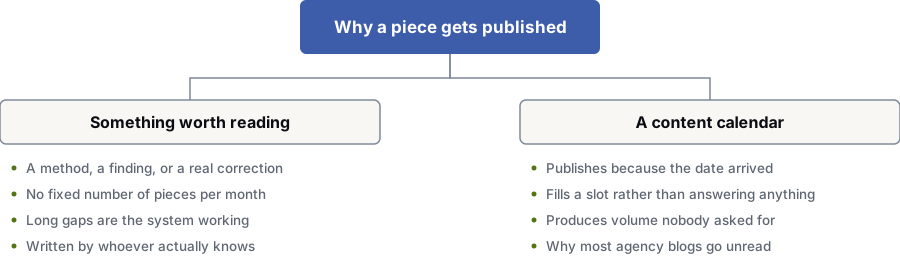
Something worth reading
- A method, a finding, or a real correction
- No fixed number of pieces per month
- Long gaps are the system working
- Written by whoever knows
A content calendar
- Publishes because the date arrived
- Fills a slot instead of answering anything
- Produces volume nobody asked for
- Why most agency blogs go unread
Start here
Got a marketing question our guides don’t answer yet?
Start with your own site. The free checkup shows what to fix first, in about a minute.
Prefer to talk it over? Book a free call