
Editorial policy
Our editorial policy and how we decide what to publish
Our editorial policy: every page starts with a written brief, every figure links to its source, and Zubair Afzal answers for every page by name. Each page says at its foot how it was approved. AI can draft, never publish.
What this covers
What we publish, and how we choose it
This editorial policy covers everything on this site. We publish three kinds of page: what we do, how search and websites work, and answers to questions business owners ask about marketing. Search demand on its own is never enough reason to write a page.
Before anyone starts writing, we ask: can we say something specific and true that the pages already ranking do not? If not, we do not write the page.
Most of the rules below are built into the system this website runs on. If a page breaks one, the site fails to build.
Before drafting
Three questions a page idea has to pass
We ask these before anyone writes a word. Many ideas stop at the second question.
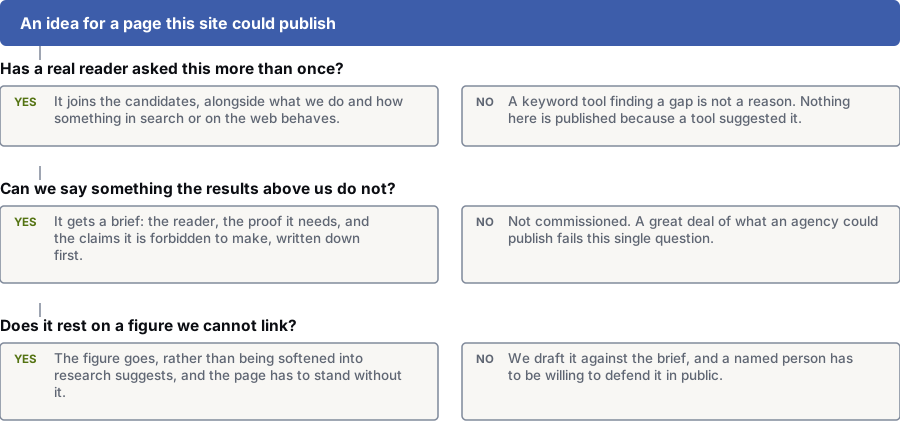
Is there a question readers need answered?
Yes: It joins the list, alongside pages about what we do and how search and websites work.
No: Search volume alone is not enough. We do not write a page just because a keyword tool shows a gap.
Can we say something the pages above us do not?
Yes: It gets a written brief first: who it is for, the proof it needs and the claims it must not make.
No: We do not write it. Much of what a marketing company could publish fails this question.
Does it depend on a figure we cannot link?
Yes: The figure comes out. We never soften it into "research suggests". The page has to work without it.
No: We write it against the brief, and the person who signs it off must be willing to defend it in public.
Every page starts with a written brief
No brief, no page. We write nothing until someone has noted who the page is for, what they want, what it has to prove and what it must not claim.
The brief is a set of required fields stored with the page: the search intent, the reader in their own words, their problems and doubts, the proof and sources the page needs, what it offers that others do not, and the claims it must never make.
A brief with a missing field fails the build. Filler is easy to spot, because the fields ask for things you can only write after doing the research.
Sourcing
How we source figures, claims and dates
Many marketing statistics lose their source as they get passed around. One blog post quotes a figure, a second repeats it without a link, a third calls it "studies show", and by the fourth nobody can find the original. We keep out of that chain.
- Every figure we publish names its source and links to it. If we cannot link it, we delete it.
- We use primary sources first: official platform documentation, standards bodies, regulators, government publications and public datasets. A vendor blog about a study does not count as the study.
- Every figure comes with the period it covers. A number about search behaviour describes one moment in time.
- We only publish our own figures when the method behind them is on the same page.
- When something is our opinion, the page says so in those words.
- Every page shows when it was created and when it was last substantively updated. The second date only moves when the content does.
Our AI policy
Where we use AI, and where we never do
| What AI may do | What our team must do | |
|---|---|---|
| Research | Group search queries, summarise documentation and suggest angles we had missed. | Decide what the page is for. Read every source directly before relying on it. |
| The brief | Suggest a first draft of the intent, structure and likely objections. | Write the reader, their problems and the claims the page must not make. |
| Drafting | Draft text and suggest outlines from an approved brief. | Answer for it. A draft goes nowhere until it passes our automated checks and a named person approves it for publication. |
| Facts and figures | Nothing. AI is not a source and we never cite it as one. | Check every claim against its primary source, or remove it. |
| Review and publishing | Flag broken links, duplicate headings, invalid schema and near-duplicate text. | Record who approved publication and on what basis: an editorial review of the page, or owner authorisation after the automated checks. Pages published on owner authorisation are then reviewed page by page, most important first. No automated check can approve a page. |
Our commitments
What we promise, and what we will not publish
Most editorial policies are vague about independence. Ours are specific.
We commit to
- Publishing only pages that pass our checks and that a named person has approved and will defend in public
- Linking the source of every figure, even when the source does not help our argument
- Saying clearly when something is an opinion, an estimate or an early view
- Correcting errors on the page with a dated note
- Keeping it obvious which pages sell something and which pages explain something
We will never
- Invent a statistic, study, benchmark or survey result
- Publish AI-drafted text that has not passed our checks and a named approval
- Recommend a platform, tool or partner because someone paid us
- Accept a sponsored post, a paid mention or a paid link on this site
- Make near-identical pages by swapping in a different industry or city name
- Change an update date to make a page look newer than it is
Corrections
Our corrections policy: what happens when we get something wrong
We will make mistakes, so we have written down what happens next.
You tell us
Email us the page and the sentence. You don’t have to prove anything, and anonymous reports get the same treatment.
Outcome: A reply, usually within two working days
We check the original source
We go back to the primary source, not to a site that quoted it. If that source has changed, moved or been withdrawn, we treat the claim as unsupported until another primary source supports it.
Outcome: A decision to correct it, clarify it, or leave it with an explanation
We correct it on the page
We fix the error and add a dated note saying what changed. If the error changed the meaning of the page, the note also says what the page used to claim.
Outcome: A corrected page with a visible correction note
We withdraw it if we cannot support it
If a page depends on a claim we cannot back up, we take it out of search rather than patch around the gap. It takes a one-line change to our approval register and applies on the next deploy. Nothing is deleted.
Outcome: The page removed from search, or retired
We tell you what we did
If you left contact details, we reply, including when we decide the original was right. The reply names the source we checked, so you can disagree with it properly.
Outcome: A direct answer to whoever reported it
Questions
Questions about our editorial policy
- How do I report a mistake on this site?
Use the contact form. Tell us the page and quote the sentence you think is wrong. You don’t need to prove anything: a page and a sentence is enough for us to go back to the source.
We reply within a couple of working days. If the claim was wrong, we correct the page and add a dated note saying what changed. If it was right, we tell you which source we checked and what it says.
- Do you use AI to write this content?
Yes. We use it to summarise research, group search queries, suggest outlines, suggest edits and run automated checks. Nothing it drafts is published until it has passed our automated checks and Zubair Afzal has approved it by name. Each page’s footer says which kind of approval it had: an editorial review of that page, or his authorisation after the automated checks.
AI is never a source, we never cite it and it cannot approve anything. The approval that lets a page appear in search is recorded by name, in a file no automated process writes to.
- What does "substantively updated" mean on your pages?
It means the content changed in a way that matters: a corrected claim, a rewritten section, advice updated because a platform changed, or a revised argument. Only changes like these move the update date.
Fixing a typo, swapping a link or changing the design does not move it. Refreshing dates to make old pages look new misleads readers, so we do not do it.
- Can a company pay to appear in your writing?
No. We do not accept sponsored posts, paid mentions, guest articles, affiliate placements or paid links on this site. We do not sell recommendations inside client work either.
When we recommend a platform or tool, it is because we would use it ourselves. If we ever have a commercial link with something we write about, the page will say so in the main text.
- Why do so few of your pages include statistics?
Most statistics shared in marketing cannot be traced back to a source we would stand behind. When a figure fails that test, we delete the sentence.
Pages that do use figures link to primary sources, such as platform documentation, standards bodies, regulators and public datasets, and state the period each figure covers. Fewer numbers, better ones.
Last updated · Published by Zubair Afzal, responsible editor