
Agentic AI marketing
Marketing that runs every day, not in a monthly batch
Agentic AI marketing means the routine, checkable parts of search, content and measurement run continuously in the background, while anything that changes what your business says, spends or publishes still waits for a person. This page explains exactly where that line sits, and why we draw it there.
Prefer to talk it through? Book a strategy call
The category, named plainly
What agentic AI marketing actually means
Agentic AI marketing is marketing in which software decides what to work on next, does some of that work, checks whether it worked, and adjusts — continuously, rather than in the batch a person has time for. The word agentic is doing one job in that sentence: it separates a system that chooses its next action from one that waits to be told.
That is the whole of the definition. It is not a claim that the software is intelligent, and it is not an argument that people are removed from the process. Every piece of marketing that carries risk still has a person in front of it, and on this engagement that person is named.
The reason the distinction is worth having is frequency. Most agency work is batched into a month because people are expensive and calendars are finite, not because a month is the right interval for the work. A form that stopped delivering, a page that fell out of the index and a competitor who rewrote their pricing all cost something every day they go unnoticed. Software is bad at judgement and very good at noticing, so the sensible division of labour is to give it the noticing.
Three things that get confused
Automation, agentic marketing and a monthly retainer
These are sold as though they are versions of the same thing. They differ on three questions, and the third is the one that decides whether any of it is safe to buy.
| Dimension | What starts the work | What it decides for itself | Who is accountable when it is wrong |
|---|---|---|---|
| Rules-based automation | A condition somebody wrote down, usually a while ago. It fires whether or not the situation it was written for still exists. | Nothing. It executes the rule exactly, which is its strength when the rule is right and its failure mode when the rule has gone stale. | Whoever wrote the rule, if they still work there. In practice this is the category where nobody is, which is why so much of it goes unmaintained. |
| Agentic AI marketing | A change in the evidence: a ranking move, a broken page, a new competitor page, a form that stopped converting. | What to examine next, and what to propose. It executes only inside a bounded set of reversible, low-risk actions. | A named person, on every change, automatic or not. The log says what changed, why, and how it was undone if it was. |
| A monthly retainer | The calendar. Work is planned in a cycle and reported at the end of it, regardless of when the problem appeared. | Nothing between meetings. The judgement is excellent and the latency is the cost, and the latency is rarely priced. | The account lead, at the next report — which is also when you usually find out. |
The boundary
One test decides whether a change waits for you
Not how confident the system is, and not how clever the work is. Two questions: can it be undone in one step, and does it change what your business says, spends or promises.
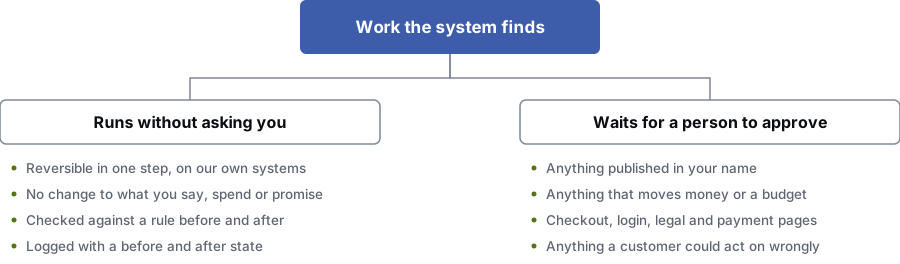
Runs without asking you
- Reversible in one step, on our own systems
- No change to what you say, spend or promise
- Checked against a rule before and after
- Logged with a before and after state
Waits for a person to approve
- Anything published in your name
- Anything that moves money or a budget
- Checkout, login, legal and payment pages
- Anything a customer could act on wrongly
What actually runs
Four things worth running every day
These are not chosen because they are impressive. They are chosen because each one has a cost per day it goes unnoticed, and because getting any of them wrong is recoverable.
Watching the site for damage
Pages dropping out of the index, redirects that started chaining, a form that stopped delivering, a template change that removed a heading from four hundred pages. None of this announces itself, and all of it is cheap to find the day it happens and expensive to find in a quarter.
Watching the market move
Competitors publishing, repricing, changing how they describe themselves, or appearing in answers where you used to be. A ranking report tells you the score. Watching the other side tells you why it changed, which is the part you can act on.
Keeping the evidence current
Rankings, impressions, conversions, calls, the gap between them, and how the major assistants currently describe your business. Measurement is worth almost nothing in arrears, because the decision it should have informed was already made.
Preparing the work, not publishing it
Drafts, briefs, technical fixes and metadata come ready with the evidence attached, so the person reviewing them is deciding rather than starting. The queue is prepared continuously. It is released by a person.
Where we stop
What we will automate, and what we will not
Most of the risk in this category is not technical. It is a vendor quietly widening the first list, so this is ours, written down and held against us.
Runs continuously
- Crawling, indexing and site-health checks against a fixed standard
- Monitoring rankings, impressions, conversions and assistant answers
- Detecting competitor changes and new pages in your market
- Preparing drafts, briefs and fixes with the evidence attached
- Flagging anything that looks like a regression, within hours
- Recording every change with a before state and a one-step undo
Never without a person
- Publishing anything written in your name
- Editing checkout, login, payment, legal or account pages
- Changing a price, a claim, a guarantee or a contact detail
- Moving, redirecting or deleting a URL that already earns traffic
- Spending or reallocating budget on any advertising platform
- Replying to a customer, a reviewer or a journalist
Questions
What people ask before letting any of this near a live site
Will anything be published on my website without me seeing it first?
No. Publishing anything in your name is on the approval side of the line, and it stays there. That covers page copy, blog posts, profile descriptions, review responses and anything else a customer could read and act on.
What runs without asking is the work that does not change what you say: monitoring, crawling, checking that a page is still indexed, watching for a form that has stopped delivering, flagging a competitor change. Those are reversible, invisible to your customers, and the whole point of running them daily is that nobody has to remember to.
How is this different from the marketing automation I already have?
Rules-based automation does the same thing every time a condition is met. Somebody writes the rule, and when the situation changes the rule keeps firing anyway — which is why most automation quietly turns into something nobody maintains and nobody trusts.
The agentic version decides what to look at next rather than only what to do when told. That is genuinely more useful and genuinely more dangerous, which is why the boundary matters far more than the capability.
What happens when the system gets something wrong?
Every automatic change is recorded with what it was before, what it is now, why it happened and how to undo it. Undoing it is one step, not a support ticket.
If something wrong reaches your site, we tell you before you find it. That is the same commitment as the rest of the engagement: you hear about a problem from us, with what we are doing about it, rather than noticing it in a report.
Can I buy this as software today?
Not yet. The platform is being built, and we are not going to sell a login to something that is not finished or quote features that do not exist.
What you can buy today is the work, run this way, as a managed engagement with a named person accountable for it. When the self-serve product is ready it will be announced here with a date on it.
Does running things continuously mean producing more content?
No, and this is the failure mode worth naming. Publishing at volume because a system makes it cheap is the thing Google’s spam policies describe as scaled content abuse, and it is the most common way an automated marketing programme damages a site.
Continuous does not mean more. It means the gap between something going wrong and somebody noticing is hours instead of weeks. Most of what runs every day produces nothing at all, which is the correct outcome when nothing is wrong.
Read next
The rest of the category, in more detail
How it works
Ask us what we would run on your site, and what we would not
Forty minutes. We will go through what could reasonably run without asking you, what has to wait for a person, and whether any of it is worth the change in how you work. Sometimes the answer is that a quarterly audit is enough.
Prefer to talk it through? Book a strategy call
If we don't deliver the work we agreed to deliver for reasons within our control, you don't pay for the undelivered work. Read our guarantee
Related
Where to go next
- how an engagement runsWhere the continuous work sits inside a normal month.
- the standards we hold ourselves toIncluding the claims we refuse to make about any of this.
- AI search visibilityA different question: how AI systems describe your business.
- what happens if we do not deliver
- talk it through with us
Last updated · Not yet approved for publication