
Leads, Reviews, Tracking & Reports
Lead tracking and follow-up that turn more enquiries into customers
Every call and form tracked to its source, a reply to each lead in your name, every review answered, and a monthly report you can read. It is in every BOOSTD plan.
One enquiry, followed
Example- Search or ad clickSource recorded
- Call or formCounted once
- CRM recordMatched to the click
- CustomerValue reported
In every planIncluded in Local or Growth, from $149 a month. Every plan has every feature; they differ by size.
Compare plansThe part most skip
Want more customers? Start with the leads you already have
Before buying more leads, check what happens to the ones you get now. The leads you lose after the enquiry can be worth more than a new channel, and you’ve already paid for them.
The pattern is common. An enquiry gets one call. Anyone who doesn’t buy this month never hears from you again. Reviews get asked for when someone remembers. The tracking is too patchy to prove any of it, so the talk goes back to needing more leads.
None of this is hard. It’s just nobody’s job, so it stays broken for years.
That’s why BOOSTD checks it continuously: a tag that stops firing, a form that fails without an error, a lead source that turns into “direct”. Each is easy to fix on the day and expensive to find a quarter later.
Where leads get lost
Six steps from a customer’s click to a decision
Records drop out at every step, and nothing warns you. Most businesses check the first step and assume the rest worked.
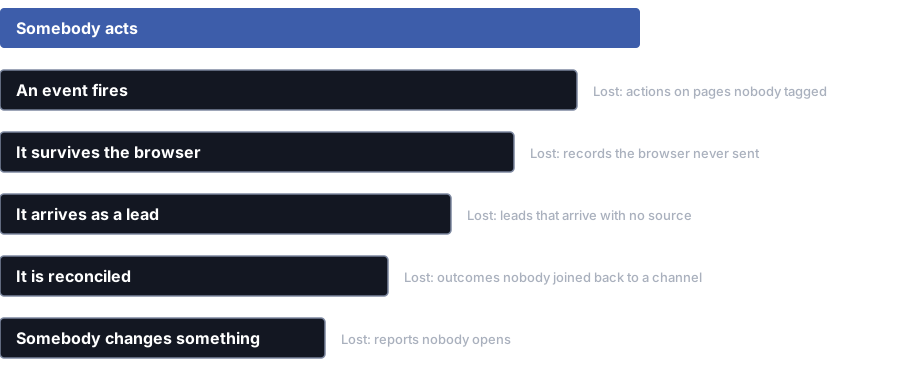
- 1Somebody acts — They send a form, call, book or message your profile.
- 2An event fires — A tag must exist on that page, for that action, and fire once.Lost: actions on pages nobody tagged
- 3It survives the browser — Cookie choices, browser limits and hops to someone else’s booking tool all decide if the record gets sent.Lost: records the browser never sent
- 4It arrives as a lead — It must reach the CRM with a source attached and match a lead definition sales and marketing both accept.Lost: leads that arrive with no source
- 5It is matched up — Analytics, the CRM and the ad platforms are compared. Everyone agrees one number to work from.Lost: sales nobody traced to a channel
- 6Somebody changes something — A budget moves, a campaign stops, a follow-up rule changes. Without this step the rest is wasted.Lost: reports nobody opens
Why it stays broken
Why lead follow-up and tracking never get fixed
The blockers are almost never technical. They’re about people and ownership.
- It belongs to nobody.
- Marketing thinks operations owns the CRM. Operations thinks marketing owns the tracking. Whoever set it up has left. Jobs with no owner get mentioned in one meeting and pushed to the next.
- There’s nothing to show for it.
- A campaign has pictures and a launch date. A fixed lead definition has neither. When the two compete for budget, the campaign wins, even when everyone agrees the fix would pay back more.
- The software is paid for, so it looks solved.
- Owning a CRM doesn’t mean it matches how you sell, and having analytics doesn’t mean it counts your sales. The licence renews, the dashboard loads, and nobody checks until a decision goes badly.
- Nobody dares touch it.
- Nothing was written down, so the setup lives on as rumour: don’t change that field, that report is wrong on Mondays. Fear of breaking it keeps it broken.
What every plan does
Four things BOOSTD looks after once the enquiry arrives
Tracking you can trust
Calls and forms recorded with where they came from, checked every week, with missing data shown as missing rather than guessed.
Every lead followed up
Each lead lands in a simple pipeline. The customer gets a prompt acknowledgement in your name, you get an instant alert, and a reminder if nobody has called back.
Reviews
A reply drafted for every review, including the bad ones prospects read most closely, sent in one tap. Thank-yous for happy reviews can go out on their own if you choose.
Reports that lead to a decision
A short monthly report: how many leads, from where, what we did and what changes next. A dashboard nobody opens isn’t a report.
Scope
What’s included in every plan
- Google Analytics and Search Console connected and checked
- Forms and calls recorded with their source, where it can be known
- A leads pipeline: New, Contacted, Quoted, Won or Lost
- An acknowledgement email to each lead, in your name
- An instant alert to you for every new lead
- Reminders for leads nobody has contacted yet
- A drafted reply for every Google review
- Weekly checks for broken forms, tags and lead sources
- A plain monthly report, honest about what isn’t measured
The order
How it gets set up, step by step
Each step depends on the one before. Counting comes before reporting, because a report built on broken tracking spreads the confusion faster.
Agree the words first
What counts as an enquiry, what makes it worth quoting and what counts as a sale. Setup asks you, in plain questions, so the pipeline matches how you sell.
You get: Lead stages that match your business
Fix tracking before reporting
Forms, calls and the hops between sites where records vanish. BOOSTD sends test enquiries and follows them all the way through.
You get: Tracking that has been tested, not assumed
Every lead in one place
A source on every record, an acknowledgement to the customer in your name, and an alert to you the moment a lead arrives.
You get: A pipeline you can see on your phone
Follow-up that doesn’t stop at one call
Leads nobody has contacted trigger a reminder. You move each lead along as you call, quote and win, so you can see what each source is worth.
You get: Reminders, and a Won or Lost on every lead
Report to a decision
Each month ends with something changing: a page gets reworked, a search gets more attention, a source that never converts gets dropped.
You get: A monthly report saying what changes and why
Questions
Common questions about tracking and follow-up
Why does our analytics never match our CRM?
Because they count different things. Analytics counts a form sent; the CRM counts a lead that passed a sales check. Both are right, so they’ll never agree.
The fix is to agree what a lead is, set up both systems to count that, and compare them once a month.
What is the fastest improvement for most businesses?
Following up the enquiries you already have. Many get one call or email and nothing more, and some of those people would have bought after a second or third try.
It costs nothing in ad spend and is usually a process fix, with no new software needed.
Can you help us get more reviews without breaking platform rules?
Yes. BOOSTD helps you ask every customer at the moment they’re happiest, in a way that’s easy for them and within the platform’s rules, and drafts a reply to every review that comes in.
It never filters out unhappy customers, pays for reviews or writes them. Most platforms ban those tricks, and they put your profile at risk.
Whose job is this inside our business?
One person on your team needs to own the follow-up. BOOSTD records every lead, acknowledges it in your name, alerts you and reminds you when nobody has called back, but the conversation with the customer is yours.
BOOSTD also checks the tracking every week, so a moved form or a new booking tool is flagged before months of leads go unrecorded.
Do we need to replace our CRM?
Almost never. The software is usually fine. The setup is the problem: three stages that mean the same thing, a required field nobody fills in, two records for every customer.
Replace it when it can’t match how you sell, or can’t share data with the platforms you advertise on. Moving has a hidden cost: everything built on the old system needs rebuilding, and old data often arrives incomplete.
How does this change what we spend on search and ads?
It shows which searches and pages bring enquiries, not just visits, so the work goes where it pays. If you also run ads, the same source data tells you which leads they bring.
The limit is your sales cycle: you only learn what a lead was worth once it is won or lost. Marking leads Won or Lost in the pipeline is what makes the numbers mean something.
Services in this area
What leads & reviews covers
Reputation & Review Management
Online review management that gets you more real reviews without breaking platform rules. We build the asking into your routine and reply properly to criticism.Marketing Analytics & Attribution
Marketing analytics and attribution you can trust, with a written account of where the data is blind and tests for what attribution can’t answer.Conversion Tracking & Tag Management
We check and rebuild conversion tracking so each conversion fires once, respects consent and survives a checkout on another domain. Get it wrong and every report built on it is wrong.
Where are your enquiries leaking?
Before you buy more leads, see what happens to the ones you have. The free checkup tests your forms and tracking along with the rest of your site.
Prefer to talk it over? Book a free call
Your BOOSTD score improves within 90 days, or your next month is free. After 6 months, more traffic or leads, or we keep working free (up to 6 free months in any 12 months). Read our guarantee
References
Sources for lead tracking and follow-up
The official documents and research this page is based on. Platform rules change, so check the source before you act on a detail.
Related
More on leads & reviews
- how to measure marketing ROIHow to judge this, and the starting numbers you need first.
- monitoring that runs every dayHow we catch tracking that stops working without warning.
- local search workA steady flow of reviews also helps you rank on Maps.
- organic search
- fixing the pages that lose enquiries
Where we offer leads & reviews
Problems leads & reviews can fix
Last updated · Published by Zubair Afzal, responsible editor