
Serving the United States remotely
SEO and digital marketing for US businesses
The most competitive search market in the world, and the one with the largest marketing budgets. SEO and digital marketing in the United States is rarely won by doing more. It is won by picking a narrower fight than your competitors pick.
Prefer to talk it through? Book a strategy call
Search behaviour
How search works in the United States
Search is not uniform across markets. Engine share, language, device mix and local platforms all shift what a strategy in the United States should prioritise.
- Google dominates, but Bing holds a meaningfully larger share here than in most markets, particularly on managed corporate desktops. For enterprise B2B that is worth attention rather than dismissal, and it feeds Copilot.
- Costs per click in high-value categories — legal, insurance, home services, medical — are among the highest anywhere in the world, which makes paid media unforgiving of loose conversion tracking.
- Search behaviour is strongly local even for national brands. City, neighbourhood and "near me" modifiers dominate service categories, and proximity does more work than most national marketing teams expect.
- Spanish-language search is a substantial and under-served market in many metros. It is treated as an afterthought by most competitors, which makes it one of the more accessible opportunities in US local search.
- Review platforms carry more weight in US consumer decisions than in any other market we cover, and review velocity affects both ranking and conversion.
The market
What makes the United States different
The United States is the most competitive search market in the world and the one where marketing spend is highest. In most commercial categories there is at least one competitor who can afford to acquire customers at a loss for years, which means the question is never whether you can outspend them.
The productive question is what they are structurally unwilling to do. Large advertisers tend to be shallow on specifics: individual matter types, particular failure modes, narrow geographies, everyday operational questions. That is where a smaller business can build a position that is defensible.
Regional variation is significant enough that "the US market" is rarely a useful unit. Competitive intensity, cost per click and buyer behaviour differ enormously between metros in the same category, and a national average conceals both the markets worth entering and the ones to avoid.
Who is here
Who does business in the United States
Multi-location and multi-state operators are the most common complex case — franchise groups, clinic networks, dealership groups, service companies across several metros. The problems are structural: location pages competing with each other, inconsistent profiles, and a content model that cannot express geography properly.
B2B and SaaS companies form the other major segment, typically selling nationally or internationally from launch, with long sales cycles that make last-click attribution actively misleading.
Below both sits an enormous volume of single-market local businesses in the highest-value trades and professions — legal, medical, dental, home services — where cost per acquired customer is the only number that matters and where competition is fiercest.
Where to start
Services that fit businesses in the United States
SEO services
SEO services make your business easier to find on Google and Bing for the searches that lead to enquiries. They suit owners and marketing leads who need qualified leads, not just traffic. Included: technical fixes, local SEO, demand mapping, content, authority building and reporting tied to enquiries.
Paid media
PPC and paid media management across Google, Microsoft, Meta, LinkedIn, TikTok and YouTube, judged on cost per acquired customer and lead quality rather than clicks. It is for businesses spending on ads without knowing which spend produced revenue. Included: tracking, account structure, bidding, creative, landing pages and reporting.
Web design & development
Web design and development plans a site for search and conversion before design starts, then builds it fast, accessible and yours to own. It is for businesses whose site looks fine but does not bring in enquiries. Included: SEO structure, UX, design, build, migrations, Core Web Vitals, accessibility and conversion work.
Lifecycle & analytics
Growth marketing for the leads you already have: email and CRM, marketing automation, review and reputation management, conversion tracking and analytics. It is for businesses whose enquiries do not turn into enough revenue. Included: lifecycle programmes, reliable tracking, reporting, and follow-up that stops paid-for demand leaking.
Strong fit
Industries with the clearest opportunity in the United States
Sectors worth a look in the United States
- Personal Injury Law marketingLower cost per signed case of the type you want, by qualifying earlier and closing the gap between enquiry and retainer.
- HVAC marketingOwn the emergency searches in your service area, then use the quieter months to build the installation pipeline that carries the margin.
- Roofing marketingBe one of the three companies quoting, and be the one that looks least risky by the time the homeowner decides.
- Plumbing marketingOwn the emergency window, then convert one-off callouts into the higher-value repipe, water heater and bathroom work that carries margin.
- Restoration & Emergency Services marketingCapture the homeowner searching at midnight, and build the referral relationships that send work regardless of what the search results do.
How we work here
We serve the United States remotely, and we say so
We serve US businesses remotely, across all four continental time zones. Reporting, calls and delivery run over video, and everything is built in your accounts rather than ours.
We do not have a US office and we will not list one. Where a project needs someone on the ground — photography, a workshop, a site visit — we arrange and quote it separately rather than implying it is covered.
For businesses with a long or complex sales cycle we set up CRM-side measurement early, because platform-reported conversions in the US market are expensive enough to be dangerous when they are wrong.
Where the line is
What we cover in the United States, and what we do not
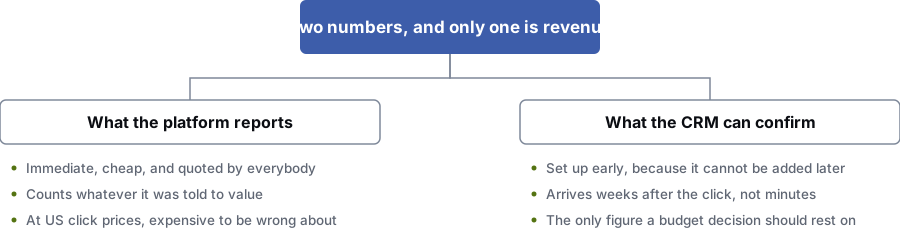
What the platform reports
- Immediate, cheap, and quoted by everybody
- Counts whatever it was told to value
- At US click prices, expensive to be wrong about
What the CRM can confirm
- Set up early, because it cannot be added later
- Arrives weeks after the click, not minutes
- The only figure a budget decision should rest on
Constraints
Marketing rules in the United States
- The FTC governs advertising claims federally. Claims must be substantiated, endorsements and testimonials must reflect genuine experience and disclose material connections, and "results not typical" disclaimers do not cure an unsubstantiated claim. This shapes what a marketing site can say about outcomes.
- Privacy is state-by-state rather than federal. California, Virginia, Colorado, Connecticut and a growing list of others each impose their own requirements, and businesses operating nationally usually end up building to the strictest applicable standard rather than maintaining fifty variants.
- Regulated professions are governed at state level, so legal, medical and financial advertising rules differ across state lines for the same business. Multi-state operators frequently need different claim language in different states.
- Accessibility litigation under the ADA is a real commercial risk in the United States in a way it is not elsewhere. Building to WCAG 2.2 AA is the standard we work to regardless, and in this market it is also risk management.
Primary sources
Where to read the rules for the United States
The statutes and regulators behind the rules above. They are the authority, not this page, and none of this is legal advice.
- Policy Statement on Advertising Substantiation: claims need evidence before they run
FTC
Policy Statement on Advertising Substantiation: claims need evidence before they run
Source: Federal Trade Commission
- FTC Endorsement Guides: testimonials, reviews and disclosure of material connections
16 CFR Part 255
FTC Endorsement Guides: testimonials, reviews and disclosure of material connections
Source: Federal Trade Commission
- Department of Justice guidance on web accessibility under the Americans with Disabilities Act
ADA
Department of Justice guidance on web accessibility under the Americans with Disabilities Act
Source: U.S. Department of Justice
Questions
Working with us from the United States
How do we compete with companies that have far bigger budgets?
By narrowing the fight. In almost every US category the largest advertisers are broad and shallow — they compete on the highest-volume terms and are thin on specifics, because specifics do not scale for them.
Owning a small number of intents completely, with better content and a site that converts, produces more revenue than being fourth on twenty broad terms. It feels like leaving money on the table, which is exactly why it stays available.
We operate in eleven states. How should the site be structured?
Almost certainly with fewer pages than you have now. The common pattern is a page per city built from one template, and those pages compete with each other before they compete with a competitor.
The useful structure has a page where there is something true and specific to say — a real branch, real staff, real work done there, real local context — and a clearly expressed service area everywhere else. Consolidating usually raises visibility rather than lowering it.
Our cost per click keeps rising. Is paid search still viable?
It depends entirely on what you are counting as a conversion. In high-value US categories, clicks are expensive enough that optimising toward form fills rather than closed revenue will quietly destroy the economics.
Before recommending spend changes we rebuild the measurement so the platforms optimise toward customers rather than contacts. That single change is often the difference between paid search working and not.
Should we be marketing in Spanish?
In many US metros, yes, and it is one of the more accessible opportunities in local search because so few competitors do it properly.
Properly means content written for the market rather than machine-translated, and an intake process that can handle a Spanish-language call. Marketing that generates enquiries nobody can answer is worse than not running it.
Are you a US company?
No, and we serve US businesses remotely rather than listing an office we do not have. Delivery for search, website and brand work does not depend on being in the same country.
What we do bring is awareness that the US market has its own rules — FTC substantiation, state privacy law, state-level professional advertising rules and real ADA accessibility exposure. Those shape what we build.
Talk to us about growing in the United States
Start with the free Growth Scan: an indicative read of your website and the few things to fix first, with no sign-up. BOOSTD is in early access, so the market question — who is winning the searches that matter in the United States, and whether the opportunity justifies the investment — is worked through with our team on a strategy call. If it does not, we will say so.
Prefer to talk it through? Book a strategy call
If we don't deliver the work we agreed to deliver for reasons within our control, you don't pay for the undelivered work. Read our guarantee
References
Sources
The primary documents and published research this page relies on. Platform rules change, so check the source before acting on a detail.
More to explore
Other markets we cover
Last updated · Published by Zubair Afzal (responsible editor), on owner authorisation