
Serving the United Kingdom remotely
SEO and digital marketing for UK businesses
A dense, mature market where search competition is high, geography is tight, and advertising and privacy rules are actively enforced. SEO and digital marketing in the UK also has to respect four nations with different law, language and vocabulary.
Prefer to talk it through? Book a strategy call
Who is here
Who does business in the United Kingdom
The core of the market is SMEs and professional practices — trades, solicitors, dental and veterinary practices, accountancy firms, estate agents, independent retailers. Owner-managed, price-conscious, and frequently on the receiving end of a rolling retainer that delivered very little.
Multi-site operators — practice groups, franchise networks, regional service companies — form the more complex end, with the same location-page problems seen elsewhere but compressed into a smaller geography where the pages overlap far more aggressively.
There is also a substantial B2B and professional services sector, concentrated in London, Manchester, Birmingham, Leeds and Edinburgh, competing internationally and less dependent on local search.
The market
What makes the United Kingdom different
The UK is a dense, mature search market. Digital adoption is high, competition is established, and most commercial categories have been actively optimised for well over a decade. There is very little untouched ground, which changes the shape of a realistic strategy.
What that produces is a market where the winnable positions are narrow and specific. Broad category terms are contested by aggregators and national brands; particular services, particular problems and particular localities are not, and they convert considerably better.
The geography compresses everything. Distances between towns are short enough that a local business often competes with several adjacent markets simultaneously, and a service radius that would be unremarkable in North America here covers a dozen competitors.
Strong fit
Industries with the clearest opportunity in the United Kingdom
Sectors worth a look in the United Kingdom
- Plumbing marketingOwn the emergency window, then convert one-off callouts into the higher-value repipe, water heater and bathroom work that carries margin.
- Roofing marketingBe one of the three companies quoting, and be the one that looks least risky by the time the homeowner decides.
- HVAC marketingOwn the emergency searches in your service area, then use the quieter months to build the installation pipeline that carries the margin.
- Family & Divorce Law marketingBe the firm they have already been reading for a month by the time they are ready to make the call.
- Personal Injury Law marketingLower cost per signed case of the type you want, by qualifying earlier and closing the gap between enquiry and retainer.
Search behaviour
How search works in the United Kingdom
Search is not uniform across markets. Engine share, language, device mix and local platforms all shift what a strategy in the United Kingdom should prioritise.
- Google holds an overwhelming share of UK search, with Bing a small remainder concentrated in corporate environments.
- Aggregators, directories and comparison sites occupy a larger share of commercial results than in most markets. Competing for broad category terms often means competing for the first position under several directory listings, which is why specificity outperforms volume here.
- Local search operates at town and postcode granularity rather than city. A business marketing to a city name is frequently invisible to the towns immediately around it, where its actual customers are.
- British spelling and terminology are non-negotiable signals of relevance. Content written in American English reads as offshore, and in professional categories that is enough to lose the enquiry.
- Mobile share is very high, and expectations of page speed have risen accordingly. A slow site is penalised commercially before it is penalised algorithmically.
Constraints
Marketing rules in the United Kingdom
- UK GDPR and the Data Protection Act govern personal data, with PECR covering electronic marketing specifically. PECR is the one that catches marketing teams out — it governs email, SMS and cookies, and the consent standard for cookies is stricter in practice than many UK sites currently meet.
- The Advertising Standards Authority enforces the CAP Code across non-broadcast advertising, including websites and paid media. Substantiation requirements are real, comparative claims need evidence, and rulings are published — the reputational exposure is often larger than the sanction.
- Regulated professions carry their own regimes. Solicitors are governed by the SRA, healthcare advertising by ASA rules alongside professional body guidance, and financial promotions by the FCA, which is materially stricter than most marketing teams assume.
- Accessibility obligations arise under the Equality Act, and for public sector bodies under specific accessibility regulations. We build to WCAG 2.2 AA as standard regardless of sector.
Primary sources
Where to read the rules for the United Kingdom
The statutes and regulators behind the rules above. They are the authority, not this page, and none of this is legal advice.
- ICO guidance on direct marketing, cookies and electronic communications
PECR
ICO guidance on direct marketing, cookies and electronic communications
- The UK Code of Non-broadcast Advertising and Direct & Promotional Marketing
CAP Code
The UK Code of Non-broadcast Advertising and Direct & Promotional Marketing
Source: Advertising Standards Authority
- Financial promotions and adverts: what firms must do and who may approve them
FCA
Financial promotions and adverts: what firms must do and who may approve them
Source: Financial Conduct Authority
Where to start
Services that fit businesses in the United Kingdom
SEO services
SEO services make your business easier to find on Google and Bing for the searches that lead to enquiries. They suit owners and marketing leads who need qualified leads, not just traffic. Included: technical fixes, local SEO, demand mapping, content, authority building and reporting tied to enquiries.
Local SEO
Local search is decided by different signals than the rest of SEO — proximity, profile quality, review behaviour and how clearly your service area is defined. We work all of them, for single locations and for multi-location businesses.
Web design & development
Web design and development plans a site for search and conversion before design starts, then builds it fast, accessible and yours to own. It is for businesses whose site looks fine but does not bring in enquiries. Included: SEO structure, UX, design, build, migrations, Core Web Vitals, accessibility and conversion work.
Content & digital PR
Content marketing and digital PR give people a reason to cite you: pages that answer questions properly, original research, and coverage earned on the story. It is for businesses publishing with no return. Included: content strategy, copywriting, digital PR, thought leadership, original research, video and podcasts. No bought links.
How we work here
We serve the United Kingdom remotely, and we say so
We serve UK businesses remotely. Time zone overlap is workable in both directions, and we schedule calls and reporting around UK business hours rather than expecting the reverse.
We do not have a UK office. Plenty of agencies list a serviced address in London for credibility; we would rather tell you where we are and let the work make the argument.
We handle contracts, invoicing and reporting in sterling for UK businesses, and we do not use rolling twelve-month lock-ins — scope and term are agreed explicitly and stated in the proposal.
Where the line is
What we cover in the United Kingdom, and what we do not
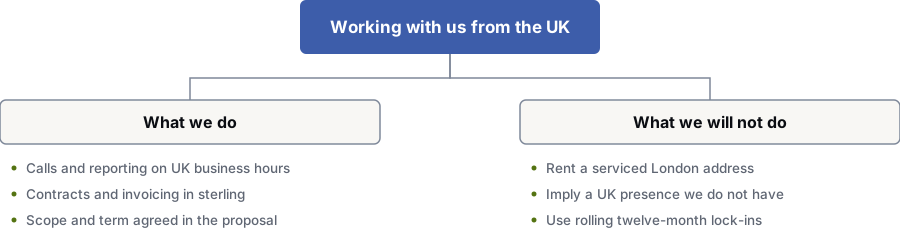
What we do
- Calls and reporting on UK business hours
- Contracts and invoicing in sterling
- Scope and term agreed in the proposal
What we will not do
- Rent a serviced London address
- Imply a UK presence we do not have
- Use rolling twelve-month lock-ins
Questions
Working with us from the United Kingdom
Directories and comparison sites outrank everyone. How do we compete?
Not on the broadest category terms — those are largely settled, and a smaller business spending years attacking them is subsidising an aggregator.
Specific services, specific problems and specific localities are winnable, because they require real expertise and local relevance rather than page count. Those searches also convert far better, since the person making them has already narrowed what they want.
How granular should our local targeting be?
More granular than most UK businesses assume. Targeting a city name when your customers are in the surrounding towns is a common and expensive mistake — the geography is tight enough that adjacent towns behave as separate markets.
That does not mean a page per town. It means being clear about the towns you serve, saying so specifically, and building pages only where there is something real to say about that area.
Has GDPR made email and remarketing not worth it?
No, though PECR rather than GDPR is usually the part that catches people out — it governs electronic marketing and cookie consent specifically, and the standard is stricter than many UK sites currently meet.
Built properly, consent-based programmes in the UK are smaller and perform better than the alternative. We build the mechanics in from the start and flag anything close to the line for your legal advisers, because we are not them.
We were locked into a twelve-month contract that delivered nothing. How is this different?
Scope and term are stated explicitly in the proposal, with named deliverables and dates rather than a monthly allocation of hours. You should be able to read it and know exactly what you are buying.
Beyond that, our guarantee covers delivery specifically: if we do not deliver the agreed work for reasons within our control, you do not pay for the undelivered work. That is the failure mode you experienced, and it is the one we are willing to be held to.
Do you have a London office?
No. We serve UK businesses remotely and we are not going to list a serviced address to look established.
For search, web and brand work it makes no practical difference to delivery. Where a project needs someone present, we arrange and quote it rather than implying it comes with the retainer.
Talk to us about growing in the United Kingdom
Start with the free Growth Scan: an indicative read of your website and the few things to fix first, with no sign-up. BOOSTD is in early access, so the market question — who is winning the searches that matter in the United Kingdom, and whether the opportunity justifies the investment — is worked through with our team on a strategy call. If it does not, we will say so.
Prefer to talk it through? Book a strategy call
If we don't deliver the work we agreed to deliver for reasons within our control, you don't pay for the undelivered work. Read our guarantee
References
Sources
The primary documents and published research this page relies on. Platform rules change, so check the source before acting on a detail.
More to explore
Last updated · Published by Zubair Afzal (responsible editor), on owner authorisation