
Serving Wales remotely
SEO and digital marketing for businesses in Wales
Wales shares a legal jurisdiction with England, diverges from it on devolved policy, and is bilingual. SEO and digital marketing in Wales has to reflect both, and English-only keyword research will not show you either.
Prefer to talk it through? Book a strategy call
Who is here
Who does business in Wales
The Welsh economy carries a larger public and third sector share than most of the UK, which shapes who we talk to: housing associations, health-adjacent organisations, education providers and the suppliers who tender to them all operate under expectations a purely commercial business never meets.
Tourism is the other major thread, concentrated on the coasts and in the national parks, and selling almost entirely to people who are somewhere else when they decide. Accommodation, attractions, activity operators and hospitality all compete for the same planning-stage attention.
Manufacturing remains significant, particularly in the south east and along the north coast, with the same characteristics found across the border: technical buyers, long cycles and websites originally built as brochures.
Cardiff, Newport and Swansea hold most of the commercial density along the southern corridor, while north Wales orients towards Chester, Liverpool and the north west of England. Businesses in the north frequently serve a cross-border market that a Wales-only strategy would ignore entirely.
The market
What makes Wales different
Wales is small enough that a serious content programme still stands out, and varied enough that a single national plan rarely fits. The south east operates much like an English city region; the west and the north do not.
Devolution is the part UK marketers most often underestimate. Because Wales sits inside the England and Wales legal jurisdiction, it is easy to assume everything else matches, and in housing, health, education and planning it frequently does not.
Language is a market factor rather than a decoration. Welsh is used most widely in the north and west, and for organisations operating there a visibly English-only presence carries a cost that shows up in trust rather than in traffic.
Obligation or choice
Whether to publish in Welsh depends on what you are
Welsh language standards attach to what an organisation is rather than to where it sits. Public bodies are covered, most private businesses are not, and anyone tendering for public work will be asked the question either way.
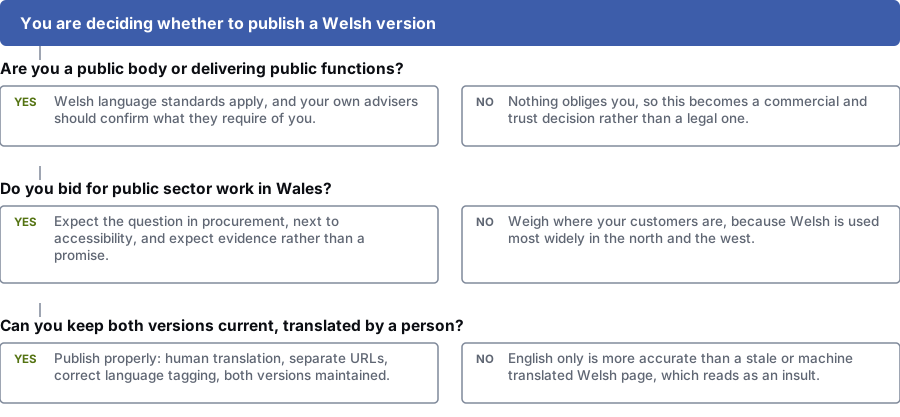
Are you a public body or delivering public functions?
Yes: Welsh language standards apply, and your own advisers should confirm what they require of you.
No: Nothing obliges you, so this becomes a commercial and trust decision rather than a legal one.
Do you bid for public sector work in Wales?
Yes: Expect the question in procurement, next to accessibility, and expect evidence rather than a promise.
No: Weigh where your customers are, because Welsh is used most widely in the north and the west.
Can you keep both versions current, translated by a person?
Yes: Publish properly: human translation, separate URLs, correct language tagging, both versions maintained.
No: English only is more accurate than a stale or machine translated Welsh page, which reads as an insult.
Strong fit
Industries with the clearest opportunity in Wales
Sectors worth a look in Wales
- Hospitality & Food Service marketingA table that goes empty tonight cannot be sold tomorrow. Hospitality marketing is mostly the work of moving demand into the hours you cannot fill, and of keeping the commission-taking middlemen from owning your customer.
- Home Services & Trades marketingHVAC, roofing, plumbing, restoration and the trades around them. High-intent local search, phones that have to ring, and a service area that decides most of what is winnable.
- Dental Practices marketingGrow attended new patient appointments inside a realistic catchment, then keep them, because retention is worth more per pound than acquisition ever is.
- Retail & Ecommerce marketingRetail runs on margin, inventory and a marketplace that is simultaneously your largest sales channel and your most aggressive competitor. That combination sets the boundaries for everything marketing can usefully do.
Search behaviour
How search works in Wales
Search is not uniform across markets. Engine share, language, device mix and local platforms all shift what a strategy in Wales should prioritise.
- A share of demand is expressed in Welsh, concentrated in particular categories and particular areas. Volumes are small compared with English, but the competition for them is smaller still, and the intent tends to be high.
- Dual place naming splits queries. Eryri and Snowdonia, Bannau Brycheiniog and the Brecon Beacons, Caerdydd and Cardiff are all in circulation at once, and content acknowledging both is reachable from both.
- Cardiff absorbs a disproportionate share of commercial search volume, which tempts businesses elsewhere to target it and then wonder why the enquiries are unusable. Swansea, Newport, Wrexham and the county areas need naming in their own right.
- Tourism demand is national and cross-border rather than local. Most of it originates in England, arrives months ahead of the visit, and is resolved through comparison and planning content rather than through a proximity search.
- Public sector procurement drives its own search pattern, with organisations looking for suppliers who can already demonstrate accessibility and Welsh language capability rather than promise to acquire it later.
Constraints
Marketing rules in Wales
- Welsh language standards apply to public bodies and to some organisations delivering public functions, setting requirements about how Welsh is used in services and communications. Most private businesses are not covered, but any organisation bidding for public work should expect the question and should have its position confirmed by its own advisers.
- England and Wales share a legal jurisdiction, so the courts, solicitors and their regulator are common ground. Devolved policy is not: housing, health, education, planning and parts of environmental regulation are made in Wales and can differ substantively from the English position.
- If you publish in Welsh, publish properly. Human translation, separate URLs for each language, correct language tagging and hreflang, and a real commitment to keeping both versions current. A stale or machine-translated Welsh version reads as an insult rather than an effort.
- UK-wide regimes are unchanged. UK GDPR, PECR and the CAP Code apply in Wales exactly as elsewhere, and Equality Act accessibility obligations sit alongside the public sector accessibility regulations for the bodies they cover.
Primary sources
Where to read the rules for Wales
The statutes and regulators behind the rules above. They are the authority, not this page, and none of this is legal advice.
- Welsh Language (Wales) Measure 2011, the basis of the Welsh language standards
Welsh Language Measure
Welsh Language (Wales) Measure 2011, the basis of the Welsh language standards
Source: legislation.gov.uk
- The Welsh Language Commissioner, who sets and enforces the standards
Welsh Commissioner
The Welsh Language Commissioner, who sets and enforces the standards
Source: Welsh Language Commissioner
- Accessibility requirements for public sector websites and apps
PSBAR
Accessibility requirements for public sector websites and apps
Source: GOV.UK
Where to start
Services that fit businesses in Wales
Web design & development
Web design and development plans a site for search and conversion before design starts, then builds it fast, accessible and yours to own. It is for businesses whose site looks fine but does not bring in enquiries. Included: SEO structure, UX, design, build, migrations, Core Web Vitals, accessibility and conversion work.
Content strategy
A content strategy is mostly a set of decisions about what not to make: which topics you have no realistic claim to, which existing pages should be merged or removed, and which pieces are worth more effort than anything new.
Local SEO
Local search is decided by different signals than the rest of SEO — proximity, profile quality, review behaviour and how clearly your service area is defined. We work all of them, for single locations and for multi-location businesses.
Technical SEO
Crawling, rendering, indexing, site architecture, performance and migrations. Technical SEO rarely wins a ranking on its own — but technical problems quietly cap everything else, and they are the cheapest thing on this site to get wrong.
How we work here
We serve Wales remotely, and we say so
We serve organisations in Wales remotely. No Cardiff address, no Welsh telephone number and no claim to be a local supplier, which matters more here than usual because some tenders ask the question directly.
We do not translate into Welsh ourselves. Where a bilingual site is needed we build the architecture for it correctly and work alongside a human translator you appoint or we help you find, and we state plainly which parts we are responsible for.
Bilingual builds are planned as two maintained versions rather than one plus an afterthought, because the failure mode is always the same: the Welsh pages stop being updated and become the most visible evidence that nobody is looking after them.
Scheduling and reporting run in UK hours and in English unless you need otherwise, and we will tell you when a piece of work would be better handled by a Welsh-language specialist than by us.
Questions
Working with us from Wales
Do we legally have to publish in Welsh?
It depends on what your organisation is rather than where it is. Welsh language standards apply to public bodies and some organisations delivering public functions; most private businesses are not covered by them.
That is a question for your own legal advisers rather than for us. What we can say is that if you tender for public sector work in Wales you will be asked, and having no answer is a weak position to be in.
Is a bilingual website twice the work forever?
Roughly twice the content work, yes, and that is the real number. What it does not double is the build, the technical work or the reporting.
The decision that matters is scope. A bilingual core — services, contact, the key information — that is maintained beats a full mirror that goes stale within a year.
Which place names should our content use?
Both, wherever both are in use. Eryri and Snowdonia, Bannau Brycheiniog and the Brecon Beacons are all being searched for right now, and choosing one loses you the other.
The natural way to handle it is to lead with the name your audience uses most and acknowledge the alternative in the same passage, so the page is findable either way without reading like a glossary.
Our UK site already covers Wales. What is different?
Usually the policy detail. Because Wales sits inside the England and Wales legal jurisdiction, UK pages tend to assume everything matches, and in housing, health, education and planning it often does not.
For most businesses the fix is a small number of genuinely Welsh pages where the difference is real, not a duplicate site. We would rather find the four pages that are wrong than rebuild forty that are fine.
We are in north Wales and sell mostly into England. Does that change anything?
It changes the geography, not the principle. North Wales trades heavily across the border, and a plan built only around Welsh place names would miss a large part of your actual market.
We would target the towns and cities your customers are in on both sides of the border, and treat Welsh language provision as a separate decision driven by your audience rather than by the map.
Talk to us about growing in Wales
Start with the free Growth Scan: an indicative read of your website and the few things to fix first, with no sign-up. BOOSTD is in early access, so the market question — who is winning the searches that matter in Wales, and whether the opportunity justifies the investment — is worked through with our team on a strategy call. If it does not, we will say so.
Prefer to talk it through? Book a strategy call
If we don't deliver the work we agreed to deliver for reasons within our control, you don't pay for the undelivered work. Read our guarantee
References
Sources
The primary documents and published research this page relies on. Platform rules change, so check the source before acting on a detail.
More to explore
Elsewhere in United Kingdom
Last updated · Published by Zubair Afzal (responsible editor), on owner authorisation