
Technical SEO
Technical SEO services that fix what's holding your site back
Technical SEO makes sure Google can crawl, read and index your pages, and that your site is fast. We fix what blocks them so the rest of your SEO can pay off.

In every planIncluded in Local or Growth, from $149 a month. Every plan has every feature; they differ by size.
Compare plansTechnical SEO sets the limit for everything else
Technical fixes rarely win a search on their own. They decide how much of your other SEO gets to count.
A page Google can't crawl, or sees as empty, earns nothing. A page fighting four near-copies of itself earns a fraction of what it should.
None of this is obvious, because the site looks fine to everyone who works on it. That's why we start here on large sites, and plan migrations before launch.
Stage by stage
Four steps every page has to pass to rank
They happen in order. Fewer pages make it through each step. A page lost early can't be saved later.
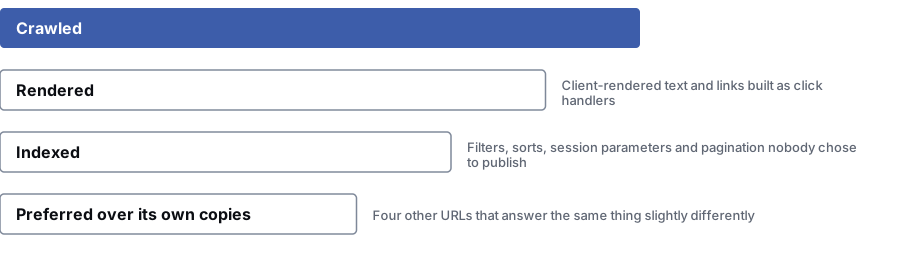
- 1Crawled — A page Google never reaches earns nothing. On a big site, where crawl time goes matters most.
- 2Rendered — What Google receives can differ from what your browser shows. Nothing warns you when this fails.Text loaded in the browser and links that only work on click
- 3Indexed — Thousands of pages "discovered but not indexed" usually means duplicate pages. The fix is in the site structure.Filter, sort, session and pagination URLs nobody meant to publish
- 4Chosen over its own copies — A page fighting four near-copies of itself earns a fraction of what one page would.Four other URLs that answer the same question
Google's published thresholds
Core Web Vitals targets for real visitors
Google's own thresholds, checked at the 75th percentile of real visits. Lab scores help you find problems; these are the numbers that count.
We work to these on mobile first, where most sites fail. Passing on a fast desktop connection proves very little.
Common findings
Pages missing from Google? These are the usual causes.
- "Discovered – currently not indexed" on thousands of URLs.
- Usually a duplicate page problem. Filters, sorts, session parameters and pagination create huge numbers of near-copies, and Google spends its time there instead of on your key pages. The fix is in the site structure, not a single setting.
- Your site looks great to people and mostly empty to Google.
- Content loaded in the browser, links that only work on click, pages that only exist once scripts run. It works for visitors and fails for search engines, even though nothing on the page looks wrong.
- Traffic dropped on a specific date and nobody knows why.
- A drop on a clear date is more often a site change than an algorithm update. We work back from the date to what was released and which URLs, links or templates changed.
- Your structured data is valid but describes something that isn't on the page.
- Markup that doesn't match what visitors see can hurt you. We check it against the page and remove claims the page can't back up.
What's included
What our technical SEO service covers
- A crawl of the whole site, never just a sample
- Rendering checks: what Google receives versus what the browser shows
- Index coverage and the causes behind it
- Log file analysis for large sites, to see where crawlers spend time
- Internal links and site structure
- Duplicate content, canonicals and URL parameters
- Filter navigation and pagination
- Core Web Vitals fixes based on real visitor data
- How images, fonts and scripts load
- Structured data checked against what the page shows
- XML sitemap structure and upkeep
- robots.txt, directives and accidental blocks
- International sites and hreflang, where needed
- Migration planning, redirect maps and launch monitoring
Migrations
Moving platforms? Here's how we keep your rankings.
Migrations lose more search revenue, faster, than anything else. The protection happens before launch.
List what has value
We record every URL that earns traffic, links or sales, and how it performs today. After launch the old data is gone.
You get: A full URL list with a performance snapshot
Map the new structure
One-to-one redirects wherever possible, and a clear decision where not. We fix chains and loops and account for every old URL, with nothing dumped on the homepage.
You get: A complete redirect map
Carry everything else across
Internal links, canonicals, structured data, sitemaps, hreflang and tracking all move to the new structure. Skip this and you lose traffic even with perfect redirects.
You get: A signed-off checklist before launch
Test on staging
We crawl the staging site like Google would, before anyone sets a launch date. Sites often go live still blocked from search; we catch that here.
You get: A pre-launch check report
Launch and check daily
We watch indexing, crawl errors, redirects and rankings daily for the first few weeks. A problem found in three days is a small fix; found in three months, it costs you a quarter.
You get: Daily monitoring and a rollback plan
Questions
Technical SEO questions
What is technical SEO, in plain terms?
Technical SEO makes sure search engines can reach your pages, understand them and add them to their index. It also keeps your site fast and stable.
It rarely wins a ranking on its own; it removes the limits. If a page can't be crawled or indexed, no content or links will help it.
How is your audit different from the one we already have?
Our audit ends in tickets your developers can start on Monday. Many audits are a crawl tool export with severity labels: accurate, but nobody knows what to do next.
Each ticket shows the expected impact, the effort, the pages affected and how we'll check it after release.
Will fixing Core Web Vitals improve my rankings?
It might, but nobody can say by how much. Google's "good" thresholds, measured on real visitors, are Largest Contentful Paint at or under 2.5 seconds, Interaction to Next Paint at or under 200 milliseconds and Cumulative Layout Shift at or under 0.1.
The better reason is sales. Slow, jumpy pages lose people before they buy or enquire, mostly on mobile.
Can you help us migrate without losing traffic?
Yes, and we start well before launch. We list every URL with value, plan the redirects, update internal links, canonicals, structured data and sitemaps, then watch for drops daily.
Some movement after a move is normal. What you can avoid is the six-month slide after a migration where only the redirects were planned.
Our site is a JavaScript app. Is that a problem?
Not by itself, but more needs checking. Is the key content in the first HTML? Are the links? Does rendering finish every time? Is each page a proper URL?
We test what the server sends. When this goes wrong, nothing warns you: the page looks perfect to you and mostly empty to a crawler.
Find out what's holding your search traffic back
Traffic dropped? Pages won't index? Migration coming up? Tell us what you're seeing and we'll tell you what we'd check first.
Prefer to talk it over? Book a free call
Your BOOSTD score improves within 90 days, or your next month is free. After 6 months, more traffic or leads, or we keep working free (up to 6 free months in any 12 months). Read our guarantee
References
Sources for technical SEO
The official documents and research this page is based on. Platform rules change, so check the source before you act on a detail.
Related
More on technical SEO
- technical faults that never send an alert
- what technical SEO coversA plain guide to what it includes.
- website design and developmentWhere most technical problems start, or get avoided.
- AI search visibilityAI tools hit the same crawling and rendering limits.
- local and multi-location searchSites with many locations hit these problems first.
- the standards we work to
- structured data: what markup can and cannot doSchema is part of technical SEO, and easy to oversell.
Where technical SEO matters most
Problems technical SEO can fix
More SEO services services
Last updated · Published by Zubair Afzal, responsible editor