
International growth
International growth marketing: run several markets without clashes
Past two or three countries, international growth marketing is held back by markets clashing on one site, not by demand. Fix the clashes first.
Your free checkup
ExampleScore 58 out of 100. Could reach 74
Tap a check to see what we’d fix first. Anything big waits for your approval.
Google Business ProfileNeeds work
Pick the main category people search for and list every service you offer.
Mentioned in AI answersMissing
Answer the questions customers ask, clearly, on the pages AI tools read.
Speed on phonesGood
Nothing to fix now. We keep an eye on it as you add pages.
Pages Google can findGood
All found. New pages get linked from your menu so they stay that way.
Spot the signs
Signs your multi-country website has outgrown its setup
These tend to start around your third market and get worse with each one you add. If four or more are true, your setup is holding back growth, not demand.
- A page built for one country often shows up in another country’s results
- Several near-identical English versions exist and you can’t predict which one shows up
- Adding a page in one market has, at some point, made another market disappear
- Prices, delivery promises or payment options don’t match where the visitor is
- Visitors get sent to a version they didn’t choose and can’t easily leave
- Each country manager reports a number head office can’t reproduce
- Local teams have bought their own analytics, call tracking or automation tools
- Nobody can say which market a piece of group content was written for
- The same product has three different names across your own sites
Four common clashes
Four ways markets clash on a multi-country site, and the fixes
These technical problems explain a lot of weak international results. All four can be fixed without a new strategy.
| Dimension | What you see | What’s happening | What fixes it |
|---|---|---|---|
| English versions competing | The wrong country’s page ranks, or one version wins everywhere | The versions are too alike to tell apart, so search engines pick one and hide the rest | Complete hreflang tags that point both ways, plus local content in each version |
| Language tags broken without warning | A market that used to show up stops after a routine update | A page was added without its return links, which removed it from the set | Automatic checks when you publish, and a regular review of the whole site |
| Wrong currency or delivery details | Lots of visits and very few sales in one or more markets | Visitors see a price, delivery promise or payment method that doesn’t apply to them | Market worked out from the site section, with a visible choice they can change |
| One averaged report | Group results look flat while single markets swing wildly | Every market is blended into one line, with one definition and one currency | Figures for each market against a group benchmark, with demand and conversion split |
Why the problems keep coming back
Three reasons international websites keep breaking
Fixing the four clashes is a project. Keeping them fixed means dealing with why they appeared, usually one of these three.
- Different people added markets one at a time.
- The first market was a careful decision. The fourth was a folder someone created on a Thursday. Now the site has three URL patterns, two ways of handling language, and tags nobody has understood since the person who built them left. Nothing is broken enough to force a rebuild; everything is broken enough to cost you visibility.
- Nobody owns the whole site, only its parts.
- Each country manager owns their market and is judged on it. Nobody is responsible for how markets affect each other, which is where the problems happen. A page published in one country that hurts another is nobody’s problem, so the same kind of problem keeps coming back.
- Group content is written for no market in particular.
- To avoid favouring one country, group content gets written in a neutral voice aimed at everyone. It sounds foreign everywhere, answers no market’s specific worries, and is the content most likely to be duplicated across versions.
Who owns what
Decide who owns each task, one task at a time
International businesses often argue about central control as if it were one question. It’s a series of separate decisions, and the right answer differs for each because the cost of getting it wrong differs.
Some things have to sit with the group, because of risk, not control: what the company claims about its product, how regulated wording is handled, what counts as a conversion, and which analytics setup produces the group view. Get these wrong and the legal or reporting problem lands at head office wherever the decision was made.
Other things have to sit with each market, because head office tends to get them wrong: which platforms matter in a country, when the busy season falls, what tone sounds trustworthy, which partnerships count, what a fair price looks like locally. Overruling that know-how from another country is how a group loses a market it had.
The biggest mistake is never writing the split down, so every disagreement becomes a fight about who’s in charge. One page listing which tasks the group owns, which each market owns and who settles conflicts removes more friction than any restructure.
A group rule that gives markets nothing gets ignored, and enforcing rules across borders rarely works. Rules that come with something the market wants get followed: a working analytics setup, a content budget, or creative they’d otherwise pay for.
Why group rules get ignored
Why country teams follow some group rules and ignore others
You can decide who owns each task and write it down. Markets will still ignore the split if the group gives them nothing. Enforcing rules across a border is slow and rarely works. Giving markets something useful does.
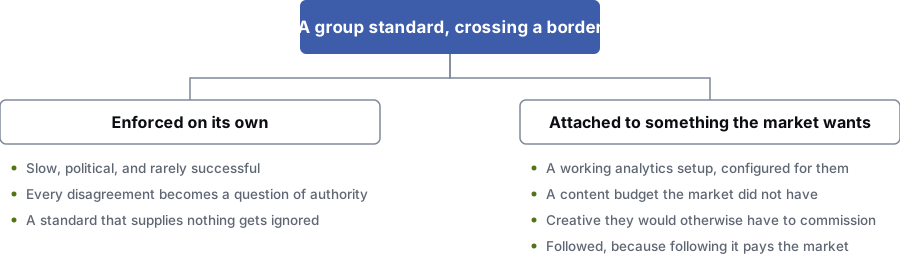
Enforced on its own
- Slow, political, and rarely works
- Every disagreement turns into who’s in charge
- A rule that gives nothing gets ignored
Paired with something the market wants
- A working analytics setup, set up for them
- A content budget the market didn’t have
- Creative they’d otherwise have to pay for
- Followed, because following it pays off
The order of repair
How to fix a multi-country website without taking it offline
These steps assume you keep trading the whole time, and none needs a rebuild. The first two usually hold the biggest gains.
Find out what exists
List every market, language version, URL pattern, language tag, analytics property and tool a local team has bought. It’s rarely written down and always messier than the diagram, sometimes including a market nobody at group level was tracking.
You get: A checked list of everything across the whole site
Check the language tags on every version
Check that every version points to every other and that each link is returned, and fix the breaks. Then set up automatic checks so publishing a page can’t silently remove a market from the set. It’s often the most valuable technical fix available, and the one most often put off.
You get: Complete, two-way language tags, checked every time you publish
Make each version local
Where markets share a language, versions need to differ in content, not just the currency symbol: local proof, worries, words and contact details. Where a market can’t justify that, merge it into a regional version rather than keep a near-copy.
You get: Versions with local content, or a planned merge
Match prices and delivery to the visitor
Currency, tax display, delivery promises, payment methods and stock should match the market the visitor is in. Work that out from the site section, not only the browser. Keep the country choice visible and easy to change, and stop redirecting people automatically.
You get: Prices and delivery details that match each market section
Agree one way to measure, then rebuild the reports
Use one definition of a conversion, one analytics setup and one group currency with local currency alongside. Report each market against a group benchmark, with demand and conversion separated. Agree the definitions before you build the dashboard.
You get: A group reporting model head office and markets both accept
Write down who owns what
On one page, list the tasks the group owns, the tasks each market owns and the named person who settles conflicts. Pair the group’s side with something markets want. Rules that give nothing get ignored across borders.
You get: A one-page ownership split, with a way to settle conflicts
Where to get help
Services for running a multi-country website
Structure and language tags
Local content
Questions
Questions about international growth marketing
Why do our English pages compete with each other?
Because they’re almost identical. Four English versions may differ only by a currency symbol, a phone number and some spellings, so search engines pick one and mostly hide the rest.
Language and region tags (hreflang) exist to solve this, but only if they’re complete and every page points back to the others. Where they’re incomplete, search engines guess, and the wrong market gets the wrong page.
We implemented hreflang years ago. Why is it still wrong?
Because it has to be maintained. Every version must point to every other version, and each must point back. Add one page to one market without the return links and that page drops out of the set without warning.
Nothing in your content system warns you, and the gaps pile up. If you’ve published across several markets for a couple of years, assume the tags are partly broken and check them.
Should marketing be run centrally or by each country?
Both, decided task by task. Brand claims, regulated wording, what counts as a conversion, the analytics setup and reporting benchmarks belong to the group, because getting them wrong in one country creates legal risk and meaningless numbers.
Channel choice, creative, local partnerships and promotion timing belong to each market, because platforms and habits differ by country more than head office expects. Write the split down.
Do we need a separate site for each country?
Usually not. Most businesses selling in several countries do better with one well-organised site with clear sections by region and language. Separate sites each need their own authority, upkeep and budget.
Separate country domains are worth it when a market has its own operations, legal company and product range, and enough scale to build visibility from scratch.
How should international performance be reported?
Show every market figure next to a group figure for the same period, and track demand separately from conversion. Without the group line you can’t tell a weak market from a weak quarter.
Use one definition of a conversion, one analytics setup and one currency for the group view, with local currency next to it. Most disputes over the numbers are about definitions, settled by agreeing terms, not rebuilding dashboards.
Our prices show in the wrong currency. Is that a real problem?
Yes. It’s one of the most direct sales losses you can fix. A visitor shown a foreign currency, a delivery promise that doesn’t apply or a payment method they don’t use will leave.
Work out the market from the site section, not only the browser. Keep the country choice visible and easy to change. Automatic redirects based on location often make this worse, and Google’s guidance on multi-regional sites advises against them.
Where to get help
Services that solve this
International SEO
International SEO starts with one choice: country domains, subfolders or subdomains. Then hreflang that validates and pages adapted to each market.Technical SEO
Technical SEO makes sure Google can crawl, read and index your pages, and that your site is fast. We fix what blocks them so the rest of your SEO can pay off.SEO & Organic Growth
Phone not ringing while competitors show up above you? Our SEO services fix your site, write the pages buyers search for and show you every call and form it brings in.Marketing Analytics & Attribution
Marketing analytics and attribution you can trust, with a written account of where the data is blind and tests for what attribution can’t answer.Multi-Location & Franchise SEO
Multi-location SEO services for chains and franchises. Head office sets the structure, each branch supplies local facts, and every location page and profile gets found.
Have all your markets checked together
Send us your market list and site structure. We’ll check the language tags on every version, find pages competing with their own copies, and tell you which markets are held back by clashes and which by demand.
Prefer to talk it over? Book a free call
Your BOOSTD score improves within 90 days, or your next month is free. After 6 months, more traffic or leads, or we keep working free (up to 6 free months in any 12 months). Read our guarantee
References
Sources for international growth marketing
The official documents and research this page is based on. Platform rules change, so check the source before you act on a detail.
Last updated · Published by Zubair Afzal, responsible editor