
Marketing Analytics & Attribution
Marketing analytics agency that ends the argument about what works
Marketing analytics and attribution you can trust, with a written account of where the data is blind and tests for what attribution can’t answer.

In every planIncluded in Local or Growth, from $149 a month. Every plan has every feature; they differ by size.
Compare plansThe starting position
Two things are true at once
Most businesses measure far less well than they could. And no business, at any budget, gets a complete picture of what caused a sale. A lot of wasted money sits in the gap between the two.
The gap is structural, not a configuration error. Someone sees an ad on a phone, searches on a laptop three days later, asks a colleague, then buys from a link in an email. Consent choices remove part of that path. Browsers cap how long identifiers survive. Platforms report their own performance by their own definitions. Analytics tools fill some gaps with modelling, which is reasonable, but still an estimate.
Two wrong responses are common. One is deciding marketing can’t be measured, so budget goes to whoever argues best. The other is buying a tool that claims to have solved attribution, which moves the uncertainty into a black box and adds a licence fee.
What works is narrower. Instrument what you can, properly, once. Write down where the data’s blind so nobody rediscovers it in a meeting. Cross-check analytics, platform reporting, the CRM and what customers tell you. When a question matters enough, test it instead of guessing.
Two different questions
Attribution and incrementality aren’t competing methods
They answer different questions. Most arguments about performance come from asking one to do the other’s job.
| Dimension | Attribution | Incrementality testing |
|---|---|---|
| The question it answers | Which touchpoints appeared on the path to a conversion we managed to record | What would have happened if we hadn’t run this at all |
| How it works | Joins recorded events to a conversion using identifiers, platform data and modelling | Withholds activity from a matched group or region and compares outcomes against a control |
| What it’s good for | Daily optimisation, spotting breakage, understanding the sequence of a buying journey | Budget decisions, channel disputes, and anything where the size of the number matters |
| Where it misleads | Rewards whatever appeared last, usually the channel that harvested demand someone else created | Needs enough volume and enough patience. An underpowered test produces confident nonsense |
| What it costs | Setup time, plus ongoing upkeep as platforms and privacy rules change | Real money, in the form of demand you deliberately don’t serve for a period |
| Minimum viable version | Correct GA4 events, offline conversion import, and one agreed definition of a lead | Turn one channel off in one region for a set period and watch the whole business, not the channel |
What the report is made of
Where the evidence goes before it reaches you
None of these stages is a mistake, and none is hidden from you on purpose. Together, they’re why a complete account of what caused a sale isn’t available at any budget.
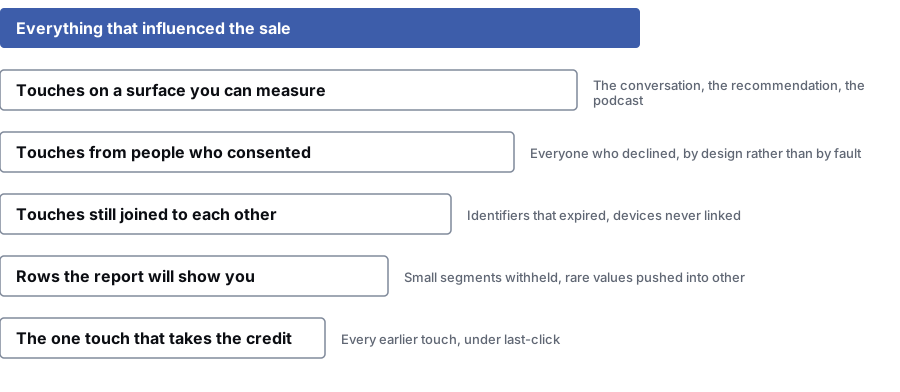
- 1Everything that influenced the sale — An ad seen on a phone, a search on a laptop days later, a colleague asked, then a click from an email. All of it happened. None of it arrived as one path.
- 2Touches on a surface you can measure — Only events on your properties and the platforms reporting to you get counted. A question on the enquiry form is the one way to see any of the rest.The conversation, the recommendation, the podcast
- 3Touches from people who consented — Where consent is declined, measurement is limited by design. Consent mode fills part of the gap with modelled conversions, not observed ones.Everyone who declined, by design, not by fault
- 4Touches still joined to each other — Browsers cap how long identifiers survive, so a three-week decision arrives as several unrelated visits from several apparent people.Identifiers that expired, devices never linked
- 5Rows the report ends up showing you — Cardinality limits and thresholding mean the number on screen isn’t always the number you asked for. Neither announces itself.Small segments withheld, rare values pushed into other
- 6The one touch that takes the credit — Which is why brand search looks like the most efficient line in the account. It harvested demand something further back created.Every earlier touch, under last-click
The blind spots
Where the numbers stop being reliable
These are less faults to fix than things to know. A team that knows them decides better than one with a cleaner dashboard and no idea what’s missing.
- The report is full of "(other)" and hidden rows.
- GA4 bundles high-variety values into an "(other)" row, and withholds rows when a report could identify individuals, which happens more once Google signals or demographics are on. Neither is a bug, but the number on screen isn’t the number you asked for, and teams that don’t know this chase differences that aren’t real.
- The comparison you need is older than the retention window.
- A standard GA4 property keeps user and event data for a limited period, shorter than most assume and shorter than a two-year comparison needs. Aggregate reports go back further; detailed exploration doesn’t. If nobody exported the detail, it’s gone. That’s the strongest argument for a warehouse export.
- Consent choices removed part of the picture and nothing accounted for it.
- Where consent is declined, measurement is limited by design, and consent mode fills some of the gap with modelled conversions, not observed ones. That’s legitimate, but it isn’t counting. A report that mixes observed and modelled conversions without saying so will eventually be challenged by finance, and rightly.
- Brand search looks like the best channel you have.
- Under last-click, the channel that captures demand gets credit for demand something else created. Brand search is the clearest case: cheap and converts well, so cutting the activity that made people search for you looks free for about a quarter. It’s the costliest mistake because it looks like a good decision going in.
- Analytics and the CRM disagree, so nobody trusts either.
- Usually they count different things and nobody reconciled the definitions. Analytics counts a form submission; the CRM counts a qualified lead. Both can be right and never match. Until one definition exists and both systems use it, every performance conversation starts from scratch.
The work
Four layers, built in this order
A measurement plan, before a single tag
Which decisions the data must support, what a lead and a customer are, and which events matter. Written down and agreed with finance as well as marketing. Most failed setups skipped this and started with tags.
A collection layer that survives privacy changes
GA4 event design, consent mode done properly, server-side collection where the accuracy earns its cost, and offline conversion import so closed revenue gets back to the platforms doing the bidding.
Reporting built around decisions
A report should say what changed, why, and what we’re doing differently. A warehouse export where volume justifies it, so the detail still exists in two years. If nobody opens it, it isn’t reporting.
A testing habit
Geo holdouts, platform lift tests where they’re sound and available, and a self-reported attribution question on your forms. Planned as a routine, because a test designed after the argument starts is already compromised.
Our position
What we won’t tell you
We will never hand you a number that says exactly what caused a sale, because that number doesn’t exist. We’ll tell you what we measured, how confident we are in it, and what we’d test next.
That’s a less comfortable pitch than a dashboard promising unified attribution, but it’s the only one that survives a finance director asking how the number was produced.
The businesses that decide best aren’t the ones with the fanciest models. They agreed their definitions, know where their data is blind, and run a small test before a big change.
Questions
What finance and marketing both ask
Is GA4 good enough on its own?
It’s a reasonable foundation and a poor single source of truth. It’s modelled and privacy-constrained: it hides small segments once certain features are on, groups high-variety values into an "(other)" row, and keeps user and event data for a limited window by default.
Set up well, it answers a lot. Just don’t treat it like a ledger: it’s an estimate, better for trends than exact numbers.
Will server-side tracking fix our data loss?
Partly, and not the way it’s usually sold. It gives you control over what’s collected and sent, holds up better against browser cookie limits, and improves the events you forward to ad platforms.
It doesn’t recover data from people who declined consent. Selling it as a way around consent rules describes a compliance problem, not a measurement fix. It also costs money to run, so we recommend it only when the accuracy gain earns that cost.
Should we add "How did you hear about us?" to our forms?
Yes, in most cases. Self-reported answers are imprecise and won’t match your analytics neatly. But it’s the only signal that sees the podcast, the recommendation and the conference chat, none of which shows up in a tag.
Treat it as one input among several. Where it consistently disagrees with your analytics, the disagreement shows you where you’re blind.
How do we decide budget if attribution is unreliable?
By testing. Turn a channel down or off in one matched region for a set period, watch total business outcomes rather than that channel’s own numbers, and compare against a control.
Between tests, use attribution for what it’s good at: spotting breakage, understanding sequence, day-to-day tweaks. Don’t ask it to settle an argument that belongs to testing.
We don’t have much volume. Does any of this apply?
The instrumentation does. Correct event design, agreed lead definitions and offline conversion import matter more at low volume, because every misattributed lead is a bigger share of your total.
Formal statistical testing usually doesn’t: a geo holdout won’t reach significance in a sensible timeframe. Rely on careful instrumentation, self-reported attribution and bigger, slower changes that are easier to see.
Find out how far your current numbers can be trusted
We’ll review your GA4 setup, consent configuration and how reported conversions compare with your CRM, then tell you which numbers are safe to decide on.
Prefer to talk it over? Book a free call
Your BOOSTD score improves within 90 days, or your next month is free. After 6 months, more traffic or leads, or we keep working free (up to 6 free months in any 12 months). Read our guarantee
References
Sources for marketing analytics agency
The official documents and research this page is based on. Platform rules change, so check the source before you act on a detail.
Related
More on analytics & attribution
- organic search performanceWhere attribution gaps are widest and least discussed.
- testing changes on siteTesting needs a measurement layer you can trust.
- diagnosing a traffic drop
Where analytics & attribution matters most
Problems analytics & attribution can fix
More leads & reviews services
Last updated · Published by Zubair Afzal, responsible editor