
Serving California remotely
SEO and digital marketing for California businesses
California is not one market. Bay Area software, Los Angeles media, Central Valley agriculture and San Diego biotech behave nothing like each other, and SEO and digital marketing in California runs under a privacy regime that changes what you may do with the data underneath all of it.
Prefer to talk it through? Book a strategy call
The market
What makes California different
California would rank among the largest economies in the world if it were counted on its own, and that scale hides how little its regions have in common. Software and venture capital in the Bay Area, entertainment and logistics in the south, agriculture through the Central Valley and biotech around San Diego are separate economies that happen to share a state government.
The practical consequence is that a statewide campaign usually underperforms five regional ones. Buyer language, competitive intensity and cost per click all move sharply between metros, and a single statewide keyword set flattens differences that a regional split would have converted.
Competition here often includes companies funded to grow rather than to profit. They can hold the highest-volume terms indefinitely, which is why the winnable ground is normally the specific, considered, lower-volume query that a growth-at-any-cost competitor never bothers to write for.
What you are allowed to see
California traffic arrives with instructions attached
Opt-out preference signals are built into browsers people here use. Honouring them is correct behaviour and it permanently shrinks what analytics observes, so the baseline has to include the loss.
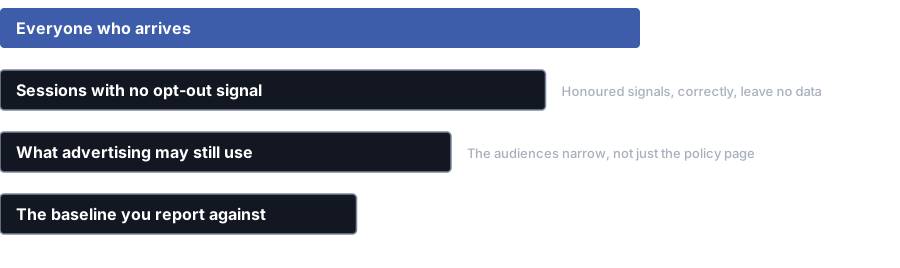
- 1Everyone who arrives — The real audience, all of it, including the part your reporting will never be able to describe in full.
- 2Sessions with no opt-out signal — Global Privacy Control support ships in browsers people here use, and the signal has to be honoured rather than treated as optional.Honoured signals, correctly, leave no data
- 3What advertising may still use — Opting out of sale or sharing and limits on sensitive information reach tag management, pixels and audience syncs.The audiences narrow, not just the policy page
- 4The baseline you report against — Set it here deliberately, because a number measured before the signals were honoured will read later as a decline that never happened.
Who is here
Who does business in California
Software and technology companies are the most common engagement, usually selling nationally from day one with self-serve and sales-assisted motions running side by side. They need attribution that survives long trials and multi-touch journeys rather than last click.
Consumer and direct-to-consumer brands are the second cluster, concentrated in Los Angeles and Orange County, where creative volume and paid social efficiency matter more than raw search volume.
Then there is everything the coverage ignores: clinics, professional firms, contractors and agricultural suppliers across the Inland Empire, Sacramento and the Valley, competing in ordinary local search with none of the funding advantages of the coastal categories.
Search behaviour
How search works in California
Search is not uniform across markets. Engine share, language, device mix and local platforms all shift what a strategy in California should prioritise.
- A meaningful share of California traffic arrives with an opt-out signal attached, because Global Privacy Control support is built into browsers people use. Honouring it is correct behaviour and it permanently reduces what analytics can see, so the baseline has to be set with that in mind.
- Spanish-language search is substantial across Southern California and the Central Valley, and it is under-served in most commercial categories because competitors treat translation as a checkbox rather than as a separate market.
- Technology buyers here are unusually likely to research inside AI assistants and developer communities before they open a search engine at all, which shifts weight toward being cited by those systems rather than only ranking in them.
- Distance changes intent. "Near me" in Los Angeles County can mean forty minutes of driving, while in San Francisco it can mean four blocks, and a service-area configuration that ignores that produces enquiries nobody wants.
Strong fit
Industries with the clearest opportunity in California
Sectors worth a look in California
- SaaS & Software Products marketingMore qualified trials and demos from bottom-of-funnel demand you own, measured through to paid conversion rather than signup count.
- IT Services & Managed Service Providers marketingA pipeline of contracts from your actual service area, built around the trigger events that start the search rather than a steady stream that does not exist.
- Ecommerce & DTC marketingIdentify which term in the revenue equation is limiting the business, work on that one, and hold every channel to contribution margin rather than to a revenue chart.
- Cosmetic Dentistry marketingEarn the consultation from a self-paying patient who has been researching for months, then make the consultation convert — because the consultation, not the enquiry, is where this business is won.
Where to start
Services that fit businesses in California
SaaS SEO
For a software company, organic traffic is a proxy metric and a misleading one. We build search around the stages a buyer moves through — comparison and alternatives searches first, then the category content, then the top of funnel that only pays off if the rest exists.
AI search optimisation
AI search optimisation gets your business found and described accurately in Google AI Overviews, ChatGPT, Copilot, Gemini and Perplexity. It suits businesses whose buyers ask an assistant for a shortlist. Included: crawler access checks, answer-ready pages, entity consistency, corroborating coverage and honest measurement.
Entity optimisation
Search engines and language models resolve you to an entity before they decide anything else about you. If your name, category, location and ownership are described three different ways across the web, you are three weak entities rather than one clear one.
Analytics & attribution
Perfect attribution does not exist. What does exist is a measurement setup you trust, a written account of where it is blind, and a way to test the questions attribution cannot answer. That is a better position than most businesses are in.
Constraints
Marketing rules in California
- The CCPA as amended by the CPRA gives California consumers rights that directly affect marketing operations: the right to opt out of the sale or sharing of personal information, the right to limit use of sensitive personal information, and the requirement that businesses honour opt-out preference signals such as the Global Privacy Control. That touches tag management, advertising pixels and audience syncs, not just the privacy policy.
- California also regulates data brokers separately, with registration duties and a deletion mechanism administered by the California Privacy Protection Agency. If any part of your acquisition depends on purchased audience data, that deserves a conversation with counsel before it becomes a marketing plan.
- California automatic renewal rules are stricter than most states on how subscription offers must be presented, consented to and cancelled, which shapes landing page copy and checkout design for any recurring-revenue business selling into the state.
- We are not lawyers and none of this is legal advice. We build to what your counsel tells us applies, and we would rather ask them a question early than discover the answer in a complaint.
Primary sources
Where to read the rules for California
The statutes and regulators behind the rules above. They are the authority, not this page, and none of this is legal advice.
- California Consumer Privacy Act, as amended by the CPRA: opt-outs, sensitive data and GPC
CCPA
California Consumer Privacy Act, as amended by the CPRA: opt-outs, sensitive data and GPC
Source: California Attorney General
- Data broker registration and the statewide deletion mechanism
Delete Act
Data broker registration and the statewide deletion mechanism
- California's automatic renewal law for subscription offers
BPC § 17602
California's automatic renewal law for subscription offers
How we work here
We serve California remotely, and we say so
We serve California businesses remotely from outside the state. There is no California office, no local number and no local staff, and we will not list one to look closer than we are.
Time zone difference is the only real logistics question and scheduling solves it: calls land in your morning, asynchronous work happens overnight, and everything is built in accounts you own.
On privacy-sensitive builds we work alongside your counsel rather than around them. We will describe what a tag does and what data it moves; the ruling on whether that is permitted is theirs.
Questions
Working with us from California
Does the CCPA change how we can run advertising in California?
Yes, in ways that show up in the tag layer rather than the privacy policy. Opt-out of sale or sharing, limits on sensitive personal information and honouring browser opt-out signals all affect which pixels may fire for which visitors.
We build the measurement so those choices are respected by default and the reporting still makes sense. What is legally required of your specific business is a question for your counsel, not for us.
Should we run one California campaign or several?
Several, almost always. The Bay Area, Los Angeles, San Diego and the Central Valley have different competitors, different costs and different buyer vocabulary, and a statewide average serves none of them well.
The exception is a national product with no geographic buying pattern, where splitting by region adds admin without adding signal.
Our competitors are venture funded. Can we compete on search at all?
Usually yes, but not on the terms they are buying. Funded competitors buy breadth because breadth is what growth targets reward, and breadth leaves the specific questions uncovered.
The work is finding queries where a considered buyer is close to a decision, answering them better than anyone else, and making sure the site converts that visit.
How does honouring Global Privacy Control affect our reporting?
It reduces what you can observe, permanently, for the share of California visitors whose browsers send the signal. That is the intended outcome of the law rather than a fault to be engineered around.
We set the baseline with that loss included and lean on modelled and first-party measurement, so a privacy change does not read as a traffic drop in your board pack.
Do you have an office in California?
No. We serve California remotely and say so plainly rather than renting a mailbox in San Francisco and calling it a presence.
If a project needs someone physically in the state — a shoot, a site survey, a workshop — we arrange it and quote it separately.
Talk to us about growing in California
Start with the free Growth Scan: an indicative read of your website and the few things to fix first, with no sign-up. BOOSTD is in early access, so the market question — who is winning the searches that matter in California, and whether the opportunity justifies the investment — is worked through with our team on a strategy call. If it does not, we will say so.
Prefer to talk it through? Book a strategy call
If we don't deliver the work we agreed to deliver for reasons within our control, you don't pay for the undelivered work. Read our guarantee
References
Sources
The primary documents and published research this page relies on. Platform rules change, so check the source before acting on a detail.
Last updated · Published by Zubair Afzal (responsible editor), on owner authorisation