
SaaS & Software Products marketing
SaaS marketing agency for more demo requests and paid accounts
SaaS marketing agency for software companies that want more qualified trials and demo requests, tracked through to paid accounts.

What people search
“[competitor] vs [competitor]” and similar searches
Comparison and alternatives
The best-converting searches in SaaS, and the ones most companies leave to review sites.
- [competitor] vs [competitor]
- [competitor] alternatives
- best alternative to [incumbent tool]
- [competitor] pricing explained
- open source alternative to [competitor]
- switching from [competitor]
Category and jobs to be done
Demand that exists before your category has a name. People describe a task, not a product.
- how to track employee time across projects
- best applicant tracking system for small business
- software to manage recurring invoices
- tool to schedule social posts for multiple clients
- spreadsheet replacement for inventory tracking
Technical and integration checks
Searched by the evaluator, not the buyer. Usually answered in the documentation.
- does [product] have an api
- [product] salesforce integration
- [product] sso saml setup
- [product] data residency eu
- [product] rate limits
- [product] soc 2 report
Free tools and templates
Good for reach more than sales. Worth doing when the tool covers the same job as the product.
- free invoice template
- okr template google sheets
- employee onboarding checklist template
- saas pricing calculator
- free uptime checker
These are example searches from keyword research and public search data. Before we suggest anything, we check how often people search for them in your area.
Timing
How demand moves through the year
Search demand for your category may be smaller than the market. Nobody searches for a new category until people agree on what to call it. Until then, you can only capture searches for the problem and for the tools people already compare.
Demand is global, so geography isn’t the limit. Language, currency, where data is stored and support hours decide which markets you can serve. International expansion is a product and operations decision first. Marketing follows it.
B2B software demand has a strong weekly pattern. Trials and demo requests drop at weekends and in late December. Evaluations cluster around budget cycles. A two-week test that runs over a holiday will give you the wrong answer.
Sales cycles get much longer as seat counts grow and security review joins in. The same product can close in a day at ten seats and take five months at five hundred. Blended averages hide that difference, and it is the one that matters for forecasting.
The evaluation, in order
You’re shortlisted before anyone reaches your site
Most of the filtering happens in places you don’t control, and most of the deciding happens away from your marketing pages. You can still win both stages. You just win them with documentation, pricing and the product itself.
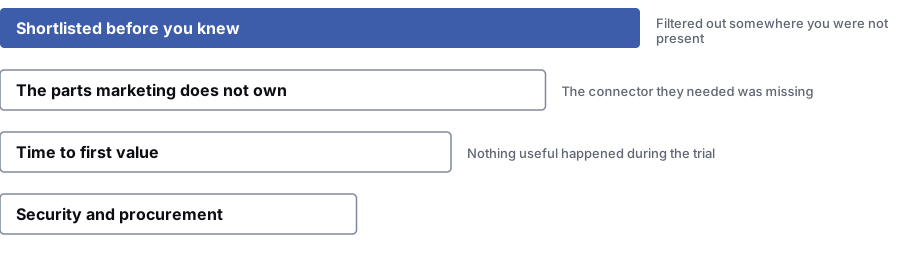
- 1Shortlisted before you knew — Peers, community threads, review sites and AI answers do the filtering. The list is short before anyone reaches you.Filtered out somewhere you weren’t present
- 2The parts marketing doesn’t own — Documentation, the API reference, integrations, the status page and the security posture. None of it is marketing copy.The connector they needed was missing
- 3Time to first value — Products that need setup, a data import or an admin before anything useful happens lose to weaker products that don’t.Nothing useful happened during the trial
- 4Security and procurement — Above a certain deal size these join in. A published security posture and current certification status move things faster than any feature.
How they choose
How the shortlist gets made
Know how they choose and you know where to show up.
- They arrive with a shortlist. Peers, community threads, review sites and AI-generated answers do the first round of filtering. By the time someone reaches your site, they’re usually comparing you with two or three named alternatives.
- A technical evaluator checks the parts marketing doesn’t control: documentation quality, the API reference, integrations, the status page and the security page. A weak docs site can lose a deal the marketing site had already won.
- The pricing page is the most visited page on most SaaS sites. Hiding prices costs self-serve products a lot, because buyers drop you from the list without saying so. For enterprise deals it matters less. A price range and a clear note on what drives it is usually enough.
- Integration with tools they already use is often a hard requirement. If the connector they need is missing, nothing else on the page matters.
- Time to first value decides the trial. Products that need setup, a data import or an admin before anything useful happens lose to weaker products that show something useful in ten minutes.
- Above a certain deal size, security and procurement join in. A published security posture, a list of sub-processors and your current certification status can close a deal weeks sooner than a questionnaire exchange.
Common problems
Why SaaS leads dry up
More traffic than last year and the same number of customers usually means most visitors were never going to buy.
SaaS marketing should cover the whole route from search to revenue: capture the searches people make while comparing tools, get them into the product fast, and track which trials turn into paid accounts. If organic search is the only gap, our SaaS SEO service covers it on its own. Software sold to buying committees has its own B2B SaaS page.
- The blog performs and the product doesn’t.
- Content written to hit a traffic target attracts students, job seekers, competitors and casual researchers. It looks like success because the report counts readers. You need pages that only someone choosing a tool would open. They get a fraction of the traffic and bring in most of the revenue.
- Review sites and affiliates own your comparison searches.
- In every category, some searches convert far better than the rest: your brand against a competitor, alternatives to the market leader, switching questions and pricing comparisons. Most companies publish none of these pages. Affiliate roundups take the traffic, and you appear as option nine of twelve. Your own pages let you choose which features get compared, answer the objections and send the visitor to the next step.
- The marketing site and the app are one tangled property.
- App URLs get indexed. The documentation sits on a subdomain with no links pointing to it. The site gets redesigned without redirects. Trial pages get crawled and duplicated. Together it means you compete on content from a weaker position than a rival who kept the site, docs and app in a clean structure.
- A trial start is being counted as a conversion.
- Signups are the easiest number to move and the one least tied to revenue. Chasing them brings in people who never activate. It also trains every ad platform to find more of those people. The conversion that matters is a trial that reaches first value. Send that event back to the ad platforms so they learn to find those people.
- Growth is being treated as an acquisition problem when it is a retention problem.
- If customers leave at a steady rate, new sales have to grow just to stand still, and the target rises every month. Marketing can make this worse. Overselling brings in customers the product will disappoint, and they leave faster and review you harder. Before raising the acquisition budget, look at retention by segment. The answer can change the whole brief.
Where to spend
Start with SaaS SEO, then conversion fixes
In the order we'd put them. Start at the top.
Comparison and switching pages on your own site
We write comparison, alternatives, switching, integration and use-case pages and publish them on your domain. They get modest traffic and bring in a large share of revenue, because everyone reading them is already choosing between named tools. The programme starts here, not after a year of blog posts.
Pricing, signup and time to first value
Most SaaS sites lose more revenue between the pricing page and the first useful action in the product than they lose in acquisition. We look at how plans and limits are shown, how much the signup form asks for, and what a new account sees in its first five minutes.
A clean split between the marketing site, the docs and the app
We decide what lives on the main domain, what goes on a subdomain, which app URLs search engines should never crawl, and how the docs link back to the site. It often decides whether your content builds on itself or gets spread thin across three properties.
Reporting that reaches trial-to-paid
We connect the ad platforms, the website, product analytics and billing. Then each channel can be judged on paid accounts and revenue, not signups. Until that link exists, every decision rests on a number that barely tracks what you want to grow.
Your website
What to fix on your website
- Published pricing with clear tiers, limits and a note on what moves a customer up a tier
- A comparison page for each competitor you lose deals to, fair enough to stand up to scrutiny
- An integration directory with a proper page for each integration, not a wall of logos
- A trust and security page: certification status, sub-processors, where data is stored, and a link to the status page
- Documentation and an API reference that search engines can crawl, linked from the marketing site
- A self-serve signup path that doesn’t force people through a demo request form
- A changelog that stays current, because evaluators read it as proof the product is alive
- Use-case pages written for a specific role and job, alongside the general features page
The rules
Rules that shape your marketing
Comparison pages that name competitors are valuable and legally sensitive. Keep every claim factual. Source it from the competitor’s own public pricing and documentation, date the page and keep it easy to update. A comparison that is accurate today becomes misleading the week they change their plans.
Security and certification claims must be exact. Holding a completed SOC 2 Type II report is different from being mid-audit. Both are different from following a framework without an audit. Procurement teams check this, and overstating it can kill an enterprise deal.
Bidding on competitor brand names is covered by both ad platform policy and trademark law, and the rules differ by country. Something allowed in one market may be banned in another. Using a competitor’s trademark in the ad text is treated differently from bidding on it as a keyword.
Tracking on a site that serves visitors in the EU, the UK or Canada comes with consent obligations, and they follow the user into the app. Analytics that keep running after someone rejects the consent banner are a compliance problem first and a data problem second.
Sources
The rules in full
Each rule above, linked to the body that publishes it. Which ones apply depends on where you work. Rules change, so check the latest version.
- Permits naming competitors in advertising, provided the comparison is truthful and not deceptive.
- FTC 16 CFR 14.15
- Source: US — FTC Statement of Policy on Comparative Advertising (eCFR)
- Storing or reading cookies on a user’s device needs consent unless strictly necessary.
- PECR regulation 6
- Source: UK — Privacy and Electronic Communications Regulations 2003, reg. 6
- Storing or accessing information on a user’s device requires consent unless strictly necessary.
- ePrivacy Dir. Art. 5(3)
- Source: EU — Directive 2002/58/EC, Art. 5(3) (EUR-Lex)
Questions
Things to know about SaaS marketing
Should we write comparison pages about our competitors?
Yes. It is usually the best content investment a SaaS company can make. The people searching are near the end of their evaluation. If you publish nothing, they land on a third-party roundup where you’re one option among many.
Write them fairly. Say where the competitor is the better choice, source every claim from their public documentation and date the page. A page that reads like propaganda converts worse than a fair one, and it carries more legal risk.
Should our blog and docs be on the main domain or a subdomain?
For most SaaS companies, the blog and documentation belong on the main domain in subfolders. Only the app itself should sit on a separate subdomain. That keeps the authority you build in one place and lets the docs support the marketing pages.
The exception is when a docs tool can’t run under your main domain without a lot of engineering work. Then link heavily in both directions, so the two properties at least support each other.
We get plenty of trials but almost none convert. Is that a marketing problem?
It depends on who is signing up. If the trials are the wrong people, it is a marketing problem. If the right people can’t get anywhere useful quickly, it is a product problem. To tell which, split trial-to-paid conversion by source and by fit with your ideal customer profile.
If some sources convert well and others don’t, fix acquisition. If nothing converts whatever the source, the trial experience is the problem. More traffic will only make the numbers look worse.
Can marketing help with churn?
Yes, indirectly. Overselling brings in customers the product was never going to satisfy. They leave faster and review you more harshly. Narrowing who the marketing speaks to often improves retention without changing the product.
Marketing can’t keep a customer the product is failing. If retention is the problem, spending more on acquisition makes the reports worse and the business no better.
How long before SEO does anything for a SaaS company?
Comparison and switching pages on a domain with some authority can bring in trials within a couple of months, because the searches are specific and not very competitive. Broader category coverage on a new domain usually takes six to twelve months to become a meaningful channel.
Nobody can promise a date. What we can commit to is publishing the pages that convert first, so your earliest results are sales and not just a traffic chart.
Find out where you stand
Start with the free checkup. It shows what to fix first on your website, with no sign-up. Want the full plan for your SaaS business? Book a call, and we'll look at your market, your competitors and the searches that bring in customers.
Prefer to talk it over? Book a free call
Your BOOSTD score improves within 90 days, or your next month is free. After 6 months, more traffic or leads, or we keep working free (up to 6 free months in any 12 months). Read our guarantee
References
Sources for SaaS marketing agency
The official documents and research this page is based on. Platform rules change, so check the source before you act on a detail.
Related
More on SaaS marketing
- B2B SaaS demand generation for committee sales
- building B2B pipeline
- IT services marketing
- BOOSTD for SaaS teams
Guides for SaaS
Other technology businesses
Industries close to SaaS
Last updated · Published by Zubair Afzal, responsible editor