
Technology & Software
Marketing for technology businesses, by business model
Technology is the sector where the industry label tells you least. What decides the strategy is the business model underneath it: self-serve product, enterprise contract, or regional service agreement. These pages are written to that split.
Prefer to talk it through? Book a strategy call
The category
Technology & Software: what the businesses have in common
Technology marketing usually fails for a structural reason rather than a creative one. The acquisition motion and the sales motion do not match, so the marketing produces attention the business has no way to convert, month after month, while everyone argues about the content calendar.
The useful question is never "what works in tech". It is how your product is bought: by whom, after what trigger, over what period, with which other people in the room. Everything else follows from that answer, and these pages are split along it rather than along the sector label.
How it is bought
Technology marketing fails when the motion does not match the sale
The sector label decides nothing. What decides everything is whether a customer can arrive without speaking to anyone, whether delivery needs somebody on site, and when the renewal risk lands.
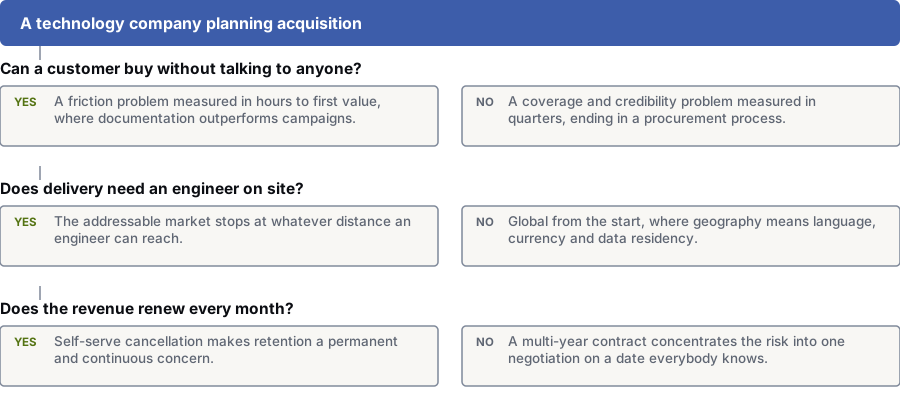
Can a customer buy without talking to anyone?
Yes: A friction problem measured in hours to first value, where documentation outperforms campaigns.
No: A coverage and credibility problem measured in quarters, ending in a procurement process.
Does delivery need an engineer on site?
Yes: The addressable market stops at whatever distance an engineer can reach.
No: Global from the start, where geography means language, currency and data residency.
Does the revenue renew every month?
Yes: Self-serve cancellation makes retention a permanent and continuous concern.
No: A multi-year contract concentrates the risk into one negotiation on a date everybody knows.
Where they split
Where one technology strategy stops working
These differences are the reason the pages below are written separately rather than as one page with the business type swapped out.
- A self-serve product and a six-figure enterprise contract need almost opposite marketing. One is a friction-reduction problem measured in hours to first value; the other is a coverage and credibility problem measured in quarters, with a named account list and a procurement process at the end of it.
- Software scales without a footprint; services do not. A SaaS company can add a customer in a country it has never visited. An IT services firm cannot install a firewall from four thousand miles away, which caps the addressable market at whatever an engineer can reach.
- Recurring revenue behaves differently depending on how it renews. A monthly subscription with self-serve cancellation demands constant retention attention; a three-year support contract concentrates all the risk into one negotiation on a date everyone already knows.
- The credibility currency is not the same. Software buyers want documentation, uptime history and integration depth. Services buyers want accreditations, named engineers, response times and evidence that you have handled a business like theirs.
Questions
Technology marketing questions, answered
Our category does not really exist yet. Can SEO help?
Partly, and it is important to be open about which part. Search captures demand that already exists. If nobody is typing your category name, no amount of optimisation creates those searches this year.
What usually does exist is search around the problem your product solves and the tools people currently use instead. That is where the winnable ground is, alongside comparison and alternatives coverage for the incumbents you displace. The category term itself becomes worth owning later, once other people start using it.
We sell both self-serve and enterprise. How does that change things?
It usually means running two acquisition programmes that share a brand and almost nothing else. Self-serve is optimised for reducing friction to first value; enterprise is optimised for reaching a named list of accounts and surviving a committee.
The practical decision is which one the website is primarily built for, because they pull the homepage in opposite directions. The common answer is a self-serve path that is self-serve and a clearly separated enterprise path, rather than a compromise that makes both worse.
Why are SaaS and IT services on separate pages if they are both technology?
Because they are opposite businesses. A software company sells the same product to a customer in another country with no delivery cost; an IT services firm sells engineer time inside a radius someone can drive.
One is priced per seat with churn as the central risk. The other is a contracted relationship with renewal as the central risk. Demand arrives differently, the buyer is different, and the channels that work are different. One page covering both would be true of neither.
How do you handle a nine-month sales cycle when reporting monthly?
By reporting on leading indicators that are open about what they are, and by not pretending a month is a meaningful unit. Early on that means coverage of the accounts and searches that matter, meeting quality, and how far conversations progress.
It also means agreeing up front on the point at which a programme can fairly be judged. Any agency that offers to show pipeline impact in a sixty-day sales cycle business is either working somewhere else or claiming credit for deals that were already moving.
Do you need to understand our product technically?
Enough to write something an engineer will not dismiss, which is a higher bar than most agencies clear. In practice that means access to your documentation, a working account where possible, and time with whoever handles technical evaluation calls.
Where we do not have that depth, the clear structure is that your team provides the technical substance and we handle structure, distribution and search. What does not work is us guessing, because technical readers detect it immediately and the credibility cost is permanent.
More to explore
Last updated · Published by Zubair Afzal (responsible editor), on owner authorisation