
Utilities & Energy Services
Marketing for energy and water businesses under regulation
The product is identical whoever supplies it, the price is compared on somebody else’s website, and every word of the offer sits inside a rulebook. What is left to work with is billing, service, contract timing and trust, and these pages start from there rather than from a campaign.
Prefer to talk it through? Book a strategy call
The category
Utilities & Energy Services: what the businesses have in common
Utilities marketing gets written about as though it were retail with meters attached. It behaves far more like regulated finance: the offer is constrained, the language is reviewed, the comparison happens somewhere else, and the customer arrives at the site mainly to do administration.
None of that leaves nothing to work with. It moves the value into routine places — the renewal window, the moving-home journey, the bill page, the complaint that never becomes a review — and these pages are organised around those rather than around campaigns.
Choice, or none at all
Whether the customer is able to leave decides the entire plan
Half of this sector competes for customers who can switch at a renewal date. The other half serves customers who cannot choose it and cannot leave, which removes acquisition and replaces it with something harder.
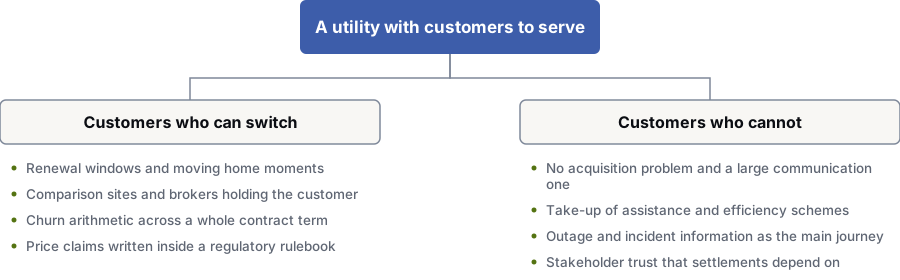
Customers who can switch
- Renewal windows and moving home moments
- Comparison sites and brokers holding the customer
- Churn arithmetic across a whole contract term
- Price claims written inside a regulatory rulebook
Customers who cannot
- No acquisition problem and a large communication one
- Take-up of assistance and efficiency schemes
- Outage and incident information as the main journey
- Stakeholder trust that settlements depend on
Where they split
Where one utilities strategy stops working
These differences are the reason the pages below are written separately rather than as one page with the business type swapped out.
- Household and commercial supply are separate businesses. Domestic acquisition is consumer marketing under consumer rules; industrial and commercial supply is a broker-mediated negotiation involving consumption profiles, contract terms and procurement cycles, and the two share little beyond the meter.
- A monopoly network has no acquisition problem and a large communication one. Water companies and distribution operators cannot be chosen or left, so the objective moves to take-up of assistance schemes, efficiency behaviour, incident information and the stakeholder trust that regulatory settlements depend on.
- Unregulated energy services play by different rules entirely. Solar, heat pumps, insulation, battery storage and charging hardware are consumer purchases involving installers, quotes, finance and grants, which is much closer to a home improvement sale than to a supply contract.
- Energy consultancy and efficiency businesses sell against a cost line rather than a commodity. Their buyer is a finance or facilities decision maker looking for a documented reduction, so the argument is built on measurement and payback rather than on tariff.
Questions
Utilities marketing questions, answered
Comparison sites bring us customers we lose money on. What is the alternative?
There is no clean alternative, only a different mix. Intermediaries deliver volume on demand and take both the margin and the relationship, and a supplier with no direct channel has nothing to price against them with.
Direct demand is slower to build and cheaper per customer once it exists: brand search, service reputation, referral and keeping the customers already on the book. Suppliers who fix their economics usually do it by shrinking the intermediary share rather than by walking away from it.
Energy is a commodity. What is there to differentiate on?
Everything except the energy. Customers do not experience supply, they experience billing accuracy, the app, how long the phone takes to answer, what happens when they move house and how they are treated when they cannot pay.
That is also where complaints and reviews come from, which makes service quality an unusually direct marketing asset here. A supplier with a visibly better experience can hold a price that is not the cheapest on the table.
Our traffic is all bill payments and outage checks. Is that a problem?
Only if you keep counting it as marketing traffic. Those are customers doing necessary things, and the right measure is whether they finish without calling.
The commercial upside sits next to it rather than inside it. A logged-in customer who has just completed a task is the right audience for a renewal, a tariff change or an efficiency product, and very few utility sites are built to do anything with that moment.
How much are we allowed to say about price?
Less than you would like and more than compliance will volunteer. Price claims in regulated energy and water are governed by defined comparison methods, so the constraint is the basis of the claim rather than the claim itself.
The practical route is to settle the evidence before the creative. Once the method behind a saving or a comparison is agreed with the compliance team the copy is straightforward, and doing it the other way round is why campaigns get stripped back to nothing a week before launch.
We are a monopoly water business with no competitors. Why market at all?
Because acquisition is not the objective. The work is take-up of the things that reduce cost and risk: leak reporting, water efficiency, payment support schemes, priority service registers and roadworks communication.
There is also a reputational job with a real financial consequence, since regulators, ombudsmen and satisfaction measures all sit on top of how well a monopoly communicates. Being understood is the outcome here, not being chosen.
Related
Where to go next
More to explore
Last updated · Published by Zubair Afzal (responsible editor), on owner authorisation