
Wholesale & Distribution
Marketing for wholesalers and distributors selling to trade
Wholesale demand begins with opening an account rather than browsing a product. Margin is thin, volume settles the argument, and the ordering portal has quietly become the place where distributors are compared against each other.
Prefer to talk it through? Book a strategy call
The category
Wholesale & Distribution: what the businesses have in common
Wholesale rarely gets written about because none of it photographs well. It is a business of stock depth, credit terms, delivery windows and product codes, sold to buyers who already know what they want and are deciding only who to get it from.
That makes the marketing question an unusual one. It is not how to make people want the product, because they already do. It is how to become the account they open, and then how to make leaving inconvenient enough that nobody bothers.
Identical stock, different job
Three questions that decide what a distributor is selling
Demand here is derived from somebody else, so it cannot be grown by advertising. What changes between distributors is whether anyone else holds the same lines, whether the stock expires, and who opens the account.
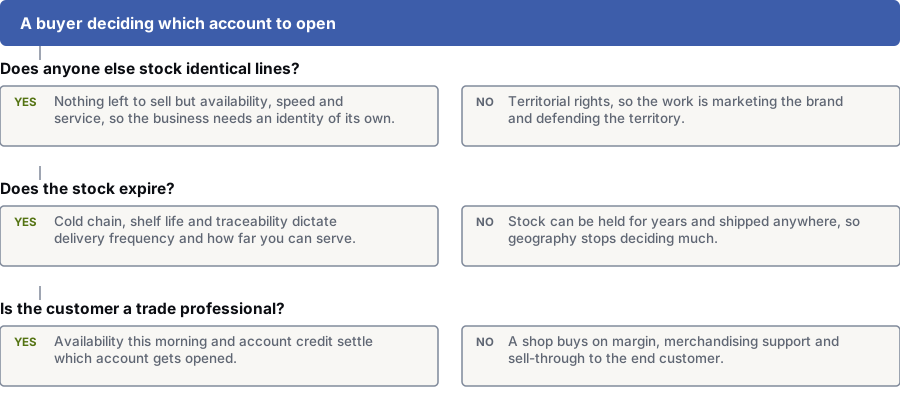
Does anyone else stock identical lines?
Yes: Nothing left to sell but availability, speed and service, so the business needs an identity of its own.
No: Territorial rights, so the work is marketing the brand and defending the territory.
Does the stock expire?
Yes: Cold chain, shelf life and traceability dictate delivery frequency and how far you can serve.
No: Stock can be held for years and shipped anywhere, so geography stops deciding much.
Is the customer a trade professional?
Yes: Availability this morning and account credit settle which account gets opened.
No: A shop buys on margin, merchandising support and sell-through to the end customer.
Where they split
Where one wholesale strategy stops working
These differences are the reason the pages below are written separately rather than as one page with the business type swapped out.
- Supplying trade professionals and supplying retailers are different disciplines. A merchant serving contractors competes on availability this morning and on account credit; a distributor serving shops competes on margin, merchandising support and how well the product sells through to the end customer.
- Perishable and non-perishable distribution run on different clocks. Food and pharmaceutical wholesale carry cold chain, shelf life, traceability and licensing constraints that dictate delivery frequency and geography, while a fastener distributor can hold stock for years and ship anywhere.
- Exclusive and open distribution need opposite marketing. A distributor holding territorial rights markets the brand and defends the territory; one competing against six others carrying identical stock has nothing to sell but service, speed and availability, and has to build an identity of its own.
- Some distributors are quietly becoming retailers. Opening a consumer channel alongside a trade one creates a pricing conflict with the very customers being supplied, and it needs deliberate separation rather than a shop bolted onto the same domain.
Questions
Wholesale marketing questions, answered
Our buyers are trade professionals. Do they really search for suppliers?
They search when they need a new supplier, which is exactly the moment worth being present for. That happens when an existing distributor lets them down, when a product line changes, when they open a second site or when a category they have never stocked appears on a customer request.
The searches look nothing like consumer ones. They combine a category with a word like trade, wholesale, bulk or distributor and often a region, and the person making them is checking whether you will supply someone of their size at all.
Should we publish prices when every account is on a different tier?
Publish structure rather than numbers. Minimum order values, how tiers are set, delivery days by region, carriage-paid thresholds, credit terms and lead times on non-stocked lines answer most of what a prospective buyer wants to know before applying.
Some distributors go further and show a list price to logged-out visitors with contract pricing behind login. That works where the tiering is disciplined; it causes arguments where the tiers were negotiated individually over twenty years.
Our biggest supplier has started selling direct. What do we do?
Start by being open about what you were being paid for. If the answer was access to the brand, the position was always fragile. If it was consolidation, local stock, credit, returns handling and knowing the trade, then the manufacturer has taken on a job they are usually poor at.
The practical response is to make those things visible rather than assumed, and to reduce single-supplier concentration. Buyers rarely want to place ten orders with ten manufacturers to fill one van.
We have forty thousand lines and terrible product data. Where do we start?
With the lines that already sell, not with the catalogue as a whole. Fixing attributes, naming and images across the top few thousand movers affects revenue this quarter; a data project that starts alphabetically will be abandoned before it reaches anything commercial.
It is also worth separating what needs fixing from what needs hiding. A large tail of near-duplicate, discontinued or unfindable lines does more harm indexed than it does removed.
How do we get customers to order online rather than phoning?
By making the online route faster than the phone for the orders they place most often. Saved templates, reorder from history, accurate stock figures, correct contract pricing and a search that copes with part numbers and misspellings do almost all of that work.
Discounting online orders rarely helps and teaches the wrong lesson. Buyers move channel when it saves them time, not when it saves them a percentage point they have to justify to somebody.
Where to start
Where wholesale marketing starts
This sector is covered on this page rather than split into separate industry pages. These are the services that apply, and the neighbouring sectors that sell to the same buyers.
Services that do the work
Sectors that share these buyers
More to explore
Guides that answer the same questions
Other sectors
Last updated · Published by Zubair Afzal (responsible editor), on owner authorisation