
Arts, Entertainment & Recreation
Marketing for gyms, clubs, venues and attractions
A seat unsold at curtain and an hour unbooked on a court are gone for good, and the member who quietly cancels in March costs more than the one who never joined. These pages are written for operators where capacity is perishable and retention is the actual business.
Prefer to talk it through? Book a strategy call
The category
Arts, Entertainment & Recreation: what the businesses have in common
Everything in this sector is measured against a clock and a room. There are only so many places, sessions, seats or slots, they exist for a fixed period, and whatever is not sold by then is not sold at all.
The second force is quieter and larger. Most of these businesses are subscriptions in disguise, and the money is made or lost in the months after somebody joins rather than in the week they signed up.
The clock and the room
Three questions decide how a leisure operator is marketed
Every seat, court and session expires on a schedule. What differs is whether the person filling one is coming back on a contract, whether they were already nearby, and whether you can contact them again.
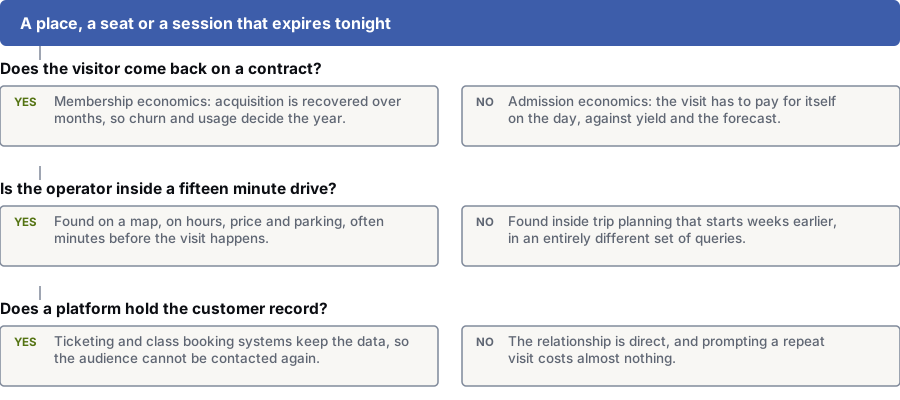
Does the visitor come back on a contract?
Yes: Membership economics: acquisition is recovered over months, so churn and usage decide the year.
No: Admission economics: the visit has to pay for itself on the day, against yield and the forecast.
Is the operator inside a fifteen minute drive?
Yes: Found on a map, on hours, price and parking, often minutes before the visit happens.
No: Found inside trip planning that starts weeks earlier, in an entirely different set of queries.
Does a platform hold the customer record?
Yes: Ticketing and class booking systems keep the data, so the audience cannot be contacted again.
No: The relationship is direct, and prompting a repeat visit costs almost nothing.
Where they split
Where one arts & recreation strategy stops working
These differences are the reason the pages below are written separately rather than as one page with the business type swapped out.
- Membership and admission are different businesses. A gym or club sells a recurring relationship and lives on churn, notice periods and usage; an attraction or a one-off event sells a visit and lives on yield, capacity and the forecast.
- Publicly funded arts organisations answer to more than the box office. Grant conditions, access obligations, learning programmes and fundraising sit alongside attendance, and a plan optimised purely for ticket revenue can put the funding itself at risk.
- Professional sport has three customers at once. Supporters, members and commercial partners want different things from the same crowd, and partnership is sold on evidence about the first two, which makes data capture a revenue function rather than an administrative one.
- Destination and neighbourhood operators are found in different ways. A local gym competes inside a fifteen-minute drive on map results; a regional attraction competes inside trip planning that starts weeks earlier in an entirely different set of queries.
Questions
Arts & Recreation marketing questions, answered
We fill up in January and empty out by spring. How do we break that cycle?
By moving part of the January budget from the sign-up to the first eight weeks of the membership. Attrition in fitness is concentrated early and is driven by whether the person started, not by the offer that got them through the door.
The mechanics are unspectacular: an onboarding sequence, a first session booked, a named person, and a prompt when attendance stops. It is cheaper than replacing the member and it is almost never funded.
The ticketing system owns our customer data. Can we do anything about that?
Some of it, and it is worth doing before that contract renews. Check what the agreement says about data ownership and marketing permission, because operators are often more restricted than they assume and occasionally less.
The durable fix is giving people reasons to come to you directly: membership, presale access, a newsletter worth opening, a site that sells without a redirect. Direct sales are cheaper and they are the only ones that leave you with a relationship.
Should we discount unsold capacity?
Sometimes, but structure it so the lower price is earned rather than announced. A last-minute cut published to everybody reprices the whole audience.
Segmented release works better: members first, then subscribers, then a limited public allocation. Similar revenue on the night, without teaching the rest of the season to wait.
Does search matter when our audience lives on social platforms?
Yes, because the two do different jobs. Social creates the wanting and search catches the deciding, and opening times, parking, prices, wet weather options and what is on nearby are where a visit is confirmed or abandoned.
For anything with an address, the map listing usually does more commercial work than the homepage. Photographs, hours, facilities and recent reviews settle a same-day visit far more often than a campaign does.
We are a sports club with fans, members and sponsors. Who should marketing serve?
All three, but not with the same content or the same measure. Fans are an audience, members are a subscription, and sponsors are buying access to both.
What connects them is the data. A club that can describe its supporters accurately can sell partnership on evidence rather than on badge placement, and that is usually a bigger commercial change than anything done to ticket sales.
Related
Where to go next
More to explore
Last updated · Published by Zubair Afzal (responsible editor), on owner authorisation