
Gyms & Fitness Clubs marketing
Gym marketing agency that keeps January joiners paying all year
Gym marketing that keeps members, not just signs them up, so your January joiners are still coming in week seven and still paying in month nine.

Measuring results
What counts as a result
These numbers show if your marketing brings in customers. Website visits alone don't.
- Members still paying at 3, 6 and 12 months, grouped by when they joined
- Net member change (joins minus cancellations), checked every week, not just at month end
- Average revenue per member, including personal training, class packs and paid extras
- Attendance in a member's first six weeks. It's the earliest sign they might cancel
- What it costs to win a member, against what they pay before they leave
- Cancellations by reason, and by which staff member ran the joining chat
- Freezes and downgrades taken instead of cancelling, counted as saves, not losses
- Referrals from current members, tracked on their own, not mixed in with walk-ins
Common problems
Why gym and fitness websites lose enquiries
Most gyms track the wrong number. Joins are easy to count and celebrate, but tell you nothing about whether the club made money. A member who quit in February cost more to win than they ever paid.
A good gym marketing agency tracks numbers like these instead. They move slower and are harder to fake, and they change where the marketing goes.
- The whole budget goes out in the four weeks it's needed least.
- January demand shows up because of the date, not your ads. Advertising then competes for decisions already made, at the year's highest prices, for the members least likely to be there in June. Some January presence makes sense; spending the year's budget there and going quiet for eleven months is the most common mistake gyms make.
- Every campaign is a discounted joining offer.
- A waived joining fee trains your local market to wait for the next one, brings in the members who leave soonest, and makes full-price members feel foolish. It's the only tool most gyms have because nothing else is built: no trial without a phone call, no reason to pick one coach over another, no plan for week two.
- Nobody has looked at when members cancel.
- Cancellations come in bunches: a spike when the minimum term ends, another where attendance dropped weeks earlier, a trickle who never built a routine. Each needs a different fix at a different time, which only shows once someone plots when people leave. One monthly churn number hides all of it.
- The first six weeks are left entirely to chance.
- A new member either builds a habit early or drifts off. The difference is usually a handful of nudges: a booked induction, a first class with a named coach, a check-in when attendance drops, a reason to come in on an off day. They are cheap to set up, and most clubs don't have them.
- The timetable is a PDF and the prices sit behind an enquiry form.
- A prospective member wants to know what it costs and whether their class fits their week. A three-week-old PDF answers neither, and a price behind a form sends people to the club that published theirs. Neither shows up in search either, so you drop out of the searches that matter most.
- A budget chain opened nearby and the only answer was price.
- You won't win that fight, and trying loses the members who never chose on price. What holds them is everything the low-cost model skips: coaching, a timetable with real names, a room that isn't packed at 6pm, childcare, a pool, physio, people who'd notice if you left. Say that clearly.
What people search
Searches like “gym near me”
Joining searches
Local, urgent and bunched into a few weeks a year. Distance and opening hours filter the list first.
- gym near me
- 24 hour gym [town]
- gyms with a pool near me
- gym no contract [city]
- ladies only gym near me
Class, discipline and coach searches
They know what they want to do. They're just looking for a time and a coach. These convert better than any general gym term, and almost nobody targets them.
- beginner reformer pilates [area]
- boxing gym for beginners near me
- strength coach [town]
- saturday morning yoga class [area]
- personal trainer prices near me
Doubt, pause and cancellation searches
Someone deciding whether to stay. They often land on a rival's page. That's how a wobble turns into a lost member.
- how to cancel gym membership
- can i freeze my gym membership
- gym contract notice period
- is a gym membership worth it
- quiet times at the gym
Comparison and price checks
Nearly always done before a visit. If the club hasn't published its prices, another website usually answers.
- gym prices [town]
- gym day pass near me
- student gym membership [city]
- corporate gym membership [area]
- family gym membership cost
These are example searches from keyword research and public search data. Before we suggest anything, we check how often people search for them in your area.
How they choose
How buyers choose between you and a rival
Know how they choose and you know where to show up.
- Distance decides most of it, but not as the crow flies. What matters is whether you're on a route people already travel: between work and home, or near the school run.
- People check contract terms early. A club that states its minimum term, notice period and freeze policy earns more trust than one that makes you phone.
- Timing settles a lot. Does their class or coach run when they can make it? That matters most at studios, where the discipline is the reason to join.
- People check how crowded it gets at peak times through reviews, photos and word of mouth. Crowding is also the top reason people leave a gym they otherwise liked.
- Few people join without visiting first, so what matters is how easily they can book a trial, day pass or guest visit without a sales pitch.
- Facilities unrelated to training often decide it: parking, childcare, a pool, the changing rooms, hours that suit shift work.
- For personal training and small-group coaching, people choose the coach, not the club. Qualifications, specialism, who they usually train and what a session involves matter more than the name over the door.
Two problems, opposite shapes
When members join, and why they cancel
That mismatch is the whole money problem. A club that only markets for new joins refills a bucket three times a year while it leaks every week.
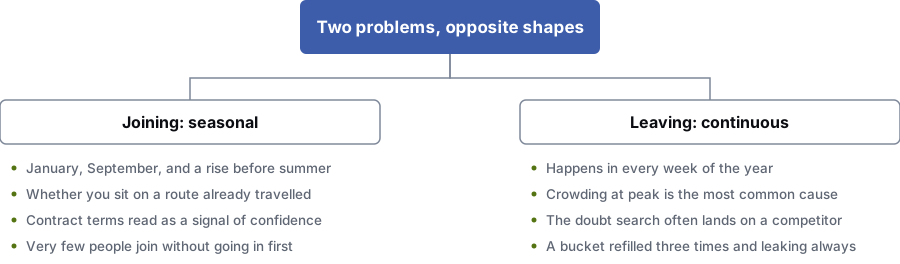
Joining: seasonal
- January, September, and a rise before summer
- Whether you are on a route they travel
- Contract terms show how confident you are
- Few people join without visiting first
Leaving: all year
- Happens in every week of the year
- Crowding at peak is the most common cause
- Doubt searches often land on a rival
- A bucket refilled three times, always leaking
Where to spend
Start with local SEO, then the website
In the order we'd put them. Start at the top.
Win the map results in a small catchment
Almost every joining search is local and on a phone, and the map results are the shortlist. Keep staffed and access hours accurate, post fresh gym-floor photos, set the features people filter on, and give each club its own profile. It's the least glamorous work here, and usually the best-returning.
A timetable, a price and a join button that work on a phone
Put the timetable on the page as real text with instructor names, state prices with the term and notice period, let people book a trial themselves, and make joining take a couple of minutes without a phone call. Most gym websites lose more members here than any campaign wins back.
Reviews that answer the crowding question
Prospective members read reviews to find out whether they'll queue for a squat rack at 6pm. Ask every member at the right moment, with no incentives or filtering, and reply to critical reviews with something concrete: a timetable change, more equipment, different staffing.
Your website
What a good site does
- The class timetable as real text on the page, kept current, with the instructor named for each session
- Full prices, including joining fee, minimum term, notice period and what a freeze costs
- A trial, day pass or guest visit people can book online, no phone call or sales appointment needed
- Coach and instructor pages, with qualifications, specialism and who they usually train
- Opening hours split into staffed hours and access hours, with holiday changes stated
- Photos of the actual gym floor at a realistic time of day, not an empty room at dawn
- A joining process that takes a couple of minutes on a phone and doesn't fail at payment
- Parking, childcare, accessibility, changing rooms and pool or studio availability stated clearly
- A clear page on cancelling, freezing and downgrading, written so your own members can find it
The rules
What regulators expect
Most advertising regulators treat fitness ads as health ads. Claims about weight loss, body shape, medical conditions or recovery are restricted in many markets, before-and-after photos are often treated as a results claim needing evidence, and a testimonial can't be shown as typical unless it is. We only write claims you can back up, and avoid medical framing.
Contract and cancellation terms are an active consumer protection issue. Regulators in several markets have stepped in over minimum terms, notice periods, automatic renewal and how easily members can leave, and auto-renewal disclosure rules keep changing. The advertised price has to be the price charged, joining fee included, and the term must be visible at the point of sale, not tucked into a linked document.
Personal training and nutrition sit close to a regulated line. A trainer describing a programme is fine; diagnosing, treating or prescribing for a condition usually isn't, and the line varies by market and the trainer's register. Copy suggesting clinical treatment causes problems for the trainer, not just the advertiser.
Health questionnaires, body composition readings, injury notes and attendance records are personal data, and several regimes add extra rules for health data on consent, storage and lawful basis. Photographing members, especially under-18s, needs recorded consent and a way to withdraw it.
Sources
The rules in full
Each rule above, linked to the body that publishes it. Which ones apply depends on where you work. Rules change, so check the latest version.
- UK advertising rules for weight-control and slimming claims, including evidence and permitted rates of loss.
- CAP Code section 13
- Source: ASA/CAP Code, section 13: Weight control and slimming (UK)
- Unless an endorser’s results are representative, the advert should clearly disclose generally expected results.
- 16 CFR 255.2
- Source: FTC Endorsement Guides (US)
- US online negative-option sales need clear terms, express consent and a simple way to stop recurring charges.
- ROSCA
- Source: Restore Online Shoppers’ Confidence Act (US, FTC)
Questions
Gym and fitness marketing, answered
Should a gym spend most of its marketing budget in January?
No. Keep some January presence, because people are comparing nearby gyms. But it's the most expensive month to buy attention, and it brings in the members who leave soonest.
Put a bigger share into welcome and retention work that runs all year, and hold some back for September, the second reset point, which is much cheaper.
Is member retention a marketing problem?
Partly. Working equipment and proper staffing are operations jobs, and no messaging fixes a gym that's unpleasant at peak times.
But the first six weeks, the nudge when attendance drops, the push to try a class, offering a freeze instead of a cancellation, and the conversation before a minimum term ends are all communication. They cost less than winning new members and move the number that decides if the club makes money.
Should we publish our gym membership prices?
Yes, with the term and notice period next to them. Hiding the price to force a sales call takes you out of every comparison a prospective member makes.
If a budget chain looks cheaper, publishing matters even more, because you can show the price next to what it includes. A number next to a coached timetable, a pool and childcare doesn't lose to a lower number on its own.
We have a lot of followers and very few members. What is wrong?
Usually your content is made for people who already train with you. Current members recognise the room, the coaches and the in-jokes; someone deciding whether to walk in doesn't.
Separate the two jobs. Keep community content for members, and make a smaller amount for strangers: what a first session is like, who the coaches are, how busy it gets, what it costs and how to try it once.
A low-cost chain has opened five minutes away. What do we do?
Stop competing on what they've already won. Their model sells more memberships than the building can hold, with few staff and no coaching, and part of your market will switch for the price whatever you do.
Make the difference obvious: coached sessions with named instructors, equipment free at 6pm, childcare, a pool, physio, a community people would miss. Then make sure your website and local listings say so.
See what to fix first
Start with the free checkup. It shows what to fix first on your website, with no sign-up. Want the full plan for your gym and fitness business? Book a call, and we'll look at your market, your competitors and the searches that bring in customers.
Prefer to talk it over? Book a free call
Your BOOSTD score improves within 90 days, or your next month is free. After 6 months, more traffic or leads, or we keep working free (up to 6 free months in any 12 months). Read our guarantee
References
Sources for gym marketing agency
The official documents and research this page is based on. Platform rules change, so check the source before you act on a detail.
Related
More on gym and fitness marketing
- yoga and pilates studio website designsClass schedule first, intro offers and memberships.
- gym website designsJoin online, class timetables and cancellation done right.
- fixing the join flow
- how salons handle rebooking
- the five separate local competitions
Guides for gym and fitness
Other arts & Recreation businesses
Last updated · Published by Zubair Afzal, responsible editor