
Golf Clubs & Courses marketing
Golf club marketing that grows members and green fees
Golf club marketing that grows membership and green fee income separately, because selling a place to belong and filling tonight's tee sheet are opposite jobs.

How they choose
What makes them pick you
Know how they choose and you know where to show up.
- A prospective member is choosing somewhere to belong for years, so the first questions aren't about golf: who plays there, the competition calendar, how welcoming it is to someone joining alone, whether their handicap fits.
- They check the joining fee, the categories and what happens if circumstances change. Most enquiries stall because nobody published the answers.
- Members judge the course on condition, pace of play and how often visitors clog their preferred times, so visitor policy is a membership issue as much as a commercial one.
- A visiting golfer decides much faster: is the course worth the drive, does the price work, what condition is it in this month, is there a slot when they want one?
- Societies and corporate organisers choose on the whole package: catering, a private room, prize arrangements, how fast you reply, and whether one named person runs the day.
- Reviews and recent photos carry extra weight with visitors, because condition changes through the season. A golfer paying a premium green fee wants to see the course as it is now.
- For resorts and destination courses, people are choosing a trip, not a round, months ahead alongside hotels and travel, with a whole group to agree.
Two products, one clubhouse
How new members and visiting golfers each make up their minds
Membership and visitor demand run on completely different timescales. Marketing that works for one is almost useless for the other. Societies fill the days neither of them wants.
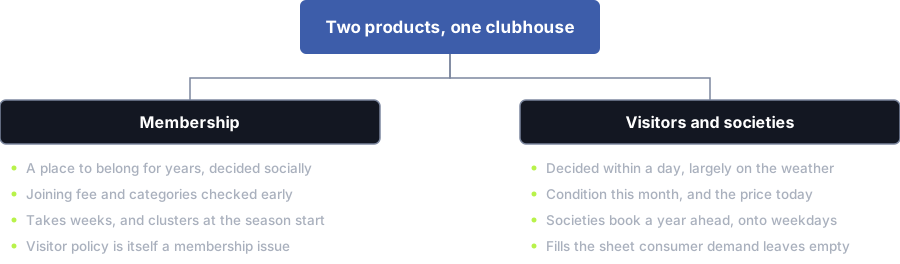
Membership
- Somewhere to belong for years
- Joining fee and categories checked early
- Takes weeks, peaks at the season start
- Visitor policy is a membership issue too
Visitors and societies
- Decided within a day, mostly on weather
- Condition this month, and today's price
- Societies book a year ahead, for weekdays
- Fills the slots other golfers leave empty
What people search
Searches such as “golf club membership [area] cost”, grouped by intent
Membership research
Slow, careful and usually private. People compare two or three clubs over weeks, looking for numbers most clubs won't publish.
- golf club membership [area] cost
- joining fee golf club [county]
- flexible golf membership near me
- young adult golf membership [city]
- golf clubs accepting new members [region]
Visiting golfers, playing soon
Often searched a day or two before playing, usually on a phone, and heavily swayed by the weather. This demand fills an otherwise empty tee sheet.
- golf courses near me visitors welcome
- green fees [town]
- book a tee time [area] tomorrow
- twilight golf rates near me
- pay and play golf course [county]
Groups, societies and corporate days
One enquiry worth many green fees, made by one organiser for a group, and usually planned months ahead.
- golf society days [region]
- corporate golf day packages [city]
- golf and food package for 24 players
- golf day venue hire near me
Condition and practicalities
Checks people make before committing to a drive and a green fee. Other websites usually answer them before the club does.
- is [course] open today
- golf course dress code [club]
- buggy hire golf course near me
- best value golf course [county]
- winter greens [area] golf
These are example searches from keyword research and public search data. Before we suggest anything, we check how often people search for them in your area.
Measuring results
Numbers that matter
These numbers show if your marketing brings in customers. Website visits alone don't.
- Membership enquiries by category, and how many become members
- Members kept by category and length of membership, with each resignation reason recorded
- Revenue per available tee time, reported separately for weekdays and weekends
- Direct green fee bookings as a share of visitor rounds, and the margin gap against platform bookings
- Returning green fee players as a share of visitor rounds, a number booking platforms make it hard to grow
- Society and corporate enquiries received, quoted, won and rebooked the next year
- Extra spend per round across catering, bar, buggies and the pro shop
- Function and clubhouse hire bookings, counted separately from golf income
Common problems
The golf club marketing traps to avoid
Golf club marketing is hard because your two income streams want opposite things. Membership grows when a club feels selective and settled; green fee income grows when you fill empty slots before they expire. Run both from the same page and voice, and each undercuts the other.
So keep them apart. Pricing, tone, channels, even which pages exist depend on which one you're working on.
- The website was built for members, and visitors have to use it anyway.
- The homepage opens with competition results, a members' login and a committee notice, and a golfer trying to book a Tuesday morning can't tell if they're welcome. Visitors need a route that answers price, availability, condition and dress code straight away; members need an area that doesn't have to sell.
- Membership prices and categories are not published anywhere.
- The most-searched question about a golf club is what it costs to join, and many clubs answer with a contact form. The people who moved on to a club with a published price table were the members you needed. Publish the categories, joining fee, inclusions and what happens if someone moves away.
- Discounting has been handed to a platform.
- Tee time platforms fill slots that would sit empty, but take the booking relationship, the email address and the rate. A club with no reason to book direct, no record of who played and no way to bring a good visitor back at full price is renting its visitor business. Use platforms for spare slots, not as the plan.
- Society and corporate enquiries die in an inbox.
- These are the biggest single bookings most clubs take, yet they often get a price-only reply days later and no follow-up. The organiser compares several clubs and judges the day by your reply. A clear package page, a form asking group size and date, a same-day reply and a planned follow-up usually earn more than advertising.
- Nobody knows which tee times are losing money.
- A tee sheet is stock that expires, so read it as revenue per available slot, not rounds played. Without that, clubs discount times that would have sold anyway and leave dead midweek mornings untouched.
- Marketing decisions have to get through a committee that meets monthly.
- That's a real limit, and anything needing monthly approval won't happen in time. Agree a framework once — which categories to recruit, how far visitor prices can move, what the club will never discount — then work inside it, with reports a committee can read without a briefing.
Where to spend
Why the website comes before local SEO
In the order we'd put them. Start at the top.
One site with two clearly separate ways in
A visitor route that opens on availability, price, condition and dress code; a members' route with the competition calendar and login. Booking in a couple of steps on a phone, a society form asking group size and date, and a page for each membership category.
Be the obvious course within an easy drive
Visiting golfers search locally and decide fast, and the map results show current photos, whether you're open and reviews on condition. For a club drawing from several towns, it's the fair way to show up in each without inventing locations.
Answer visiting golfers' questions before they ask
Course condition through the season, the dress code, buggy availability, how the course plays for a mid handicapper, what a society day includes: these searches decide whether a golfer drives to you or twenty minutes further, and someone other than the club usually answers them.
Your website
Turn more visits into enquiries
- A visitor route that answers green fee price, availability, condition and dress code with no login
- A page for each membership category, stating the joining fee, subscription and what it includes
- Online tee booking that works on a phone, with a real reason to book direct
- A society and corporate day page with package details, group sizes, catering and a proper enquiry form
- Current course condition, including temporary greens or closures, updated as it changes
- Recent photos of the course as it looks this season, not a set from an unusually good July
- A members' area, so the visitor pages don't have to carry club admin
- Function, wedding and clubhouse hire information, kept separate from the golf pages
- Directions, parking, practice facilities and pro shop opening hours
The rules
Stay inside the ad rules
Golfers check course rankings, awards and accolades, and clubs often overstate them. Name the publication, list and year for any ranking and drop it once it's out of date. Do the same with course architect credits and course history, which club websites often repeat without evidence.
Membership offers are contracts. Waived joining fees, introductory rates and flexible categories need the term, renewal and resignation terms set out at the point of sale, especially where subscriptions are paid in instalments. Consumer regulators treat a golf subscription like any other ongoing contract.
Clubs that hold a licence, run functions and serve alcohol must follow licensing conditions on how events are advertised, to whom and at what hours, and alcohol promotions are restricted separately in most markets. A prize draw or competition attached to a golf day can fall under gambling or lottery rules, depending on how entry works.
Members' clubs often have long-standing category rules on age, gender, guest access and voting rights, which equality laws have focused on in several jurisdictions. We publish what the rules say and won't write recruitment copy implying access a category doesn't give. The rules themselves are for the club and its advisers.
Sources
Primary sources for these rules
Each rule above, linked to the body that publishes it. Which ones apply depends on where you work. Rules change, so check the latest version.
- Licensed premises must not carry out irresponsible alcohol promotions, such as drinking games or free-drink offers.
- Mandatory conditions
- Source: Licensing Act 2003 (Mandatory Licensing Conditions) Order 2010 (England and Wales)
- Prize draws and competitions must meet Gambling Act 2005 conditions or may be an illegal lottery.
- Free draws, prize comps
- Source: Gambling Commission (Great Britain)
- Associations of 25 or more members must not discriminate over membership, access or guests, subject to exceptions.
- Equality Act 2010 Pt 7
- Source: Equality Act 2010, Part 7: Associations (Great Britain)
Questions
What to ask before you pay for golf club marketing
Will advertising green fees upset the membership?
It can, unless you're specific about which tee times you're selling. Members object to visitors at prime weekend times, not to the club filling a Tuesday morning that would have sat empty.
Agree the visitor policy first — which slots, at what price, with what limits — and only market inside it. Showing the committee exactly which slots are advertised is a far easier conversation than a general discount.
Should a golf club publish its membership fees?
Yes. It's a prospective member's first question, and refusing to answer puts you off their shortlist.
Publish the categories, joining fee, yearly subscription, what each includes and what happens if someone moves away or stops playing. If the fee is high, use the page to justify it.
Are tee time booking platforms worth using?
For spare slots, usually yes. They reach golfers who wouldn't otherwise find you and fill slots that would expire unsold.
The mistake is letting them become the whole visitor plan, since every platform booking is a golfer whose details and rate belong to someone else. Make booking direct clearly better: a repeat rate, a proper account, early notice when conditions improve.
How do we grow society and corporate bookings?
Mostly by replying properly. Organisers compare several clubs and read the speed and detail of your reply as a sign of how the day will run.
Publish a package page with group sizes, catering, prize arrangements and guide prices, take enquiries through a form asking date and group size, reply the same day and follow up. Contact last year's organisers before they start looking; rebooking a society is far easier than finding a new one.
We are a members club with a committee. How does that change the work?
It changes the pace and approvals more than the substance. Anything needing a monthly decision stalls, so agree the framework once: categories to recruit, how far visitor prices can move, what the club will never discount.
It also changes the reporting. A committee needs numbers it can read without a briefing: enquiries, new members, resignations, revenue per available tee time and society bookings.
Want more customers from Google?
Start with the free checkup. It shows what to fix first on your website, with no sign-up. Want the full plan for your golf club business? Book a call, and we'll look at your market, your competitors and the searches that bring in customers.
Prefer to talk it over? Book a free call
Your BOOSTD score improves within 90 days, or your next month is free. After 6 months, more traffic or leads, or we keep working free (up to 6 free months in any 12 months). Read our guarantee
References
Sources for golf club marketing
The official documents and research this page is based on. Platform rules change, so check the source before you act on a detail.
Related
More on golf club marketing
- golf course website designsTee times, memberships and events.
- how venues convert an enquiry into a visit
- measuring yield, not volume
Guides for golf club
Other arts & Recreation businesses
Industries close to golf club
Last updated · Published by Zubair Afzal, responsible editor