
How we work
How we would actually work with you
From the first call to monthly delivery: how we assess fit, what the first ninety days look like, which parts of the work run every day without waiting for a meeting, and what we expect from you in return.
Prefer to talk it through? Book a strategy call
The sequence
From first conversation to monthly delivery
This is the shape of most engagements. The detail changes with the work; the order rarely does.
Strategy call
Around forty minutes. We ask what you sell, who buys it, what has been tried, and what growth would actually mean for the business. You get a genuine read on your situation whether or not we work together.
You get: An honest opinion, including "not yet" or "not us"
Fit assessment
We look at your visibility, your competition and the realistic size of the opportunity before writing a proposal. This is unpaid, it takes a few days, and it is the step that lets us decline work we do not think we can move.
You get: A view on whether the opportunity justifies the investment
Proposal and scope
A specific scope with named deliverables, a schedule and a price. Not a tier chart. You should be able to read it and know exactly what you are buying and what happens if it is not delivered.
You get: Scope, schedule, price, guarantee terms
Onboarding — two weeks, not two months
Access, analytics verification, baseline measurement, interviews with the people who know the business. We front-load only what blocks delivery, and start shipping inside the first fortnight.
You get: Verified baseline and the first work underway
Delivery
Work runs to an agreed plan with visible progress. You always know what is in flight, what is next, and what is waiting on you. Nothing goes live without passing our internal quality gate first.
You get: Shipped work, every month
Report and decide
A monthly report that states what we expected, what happened, what we learned and what changes next month. It is written to support a decision, not to fill pages.
You get: A report that ends in a recommendation
The onboarding decision
The question that decides whether onboarding takes two weeks or two months
Discovery is not one thing. Sorting it by a single test, whether delivery is waiting on it, is what lets work start inside the first fortnight while the rest of the research carries on around it.
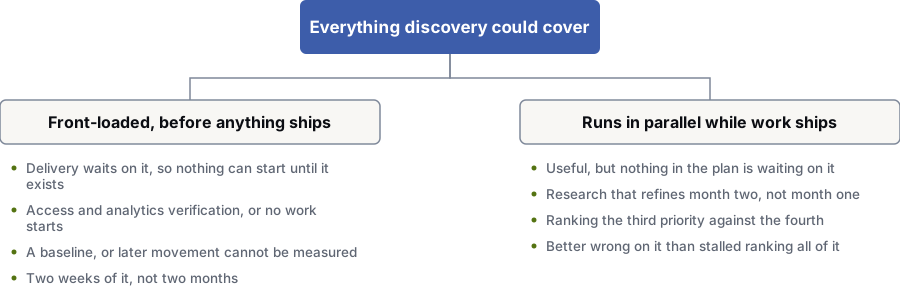
Front-loaded, before anything ships
- Delivery waits on it, so nothing can start until it exists
- Access and analytics verification, or no work starts
- A baseline, or later movement cannot be measured
- Two weeks of it, not two months
Runs in parallel while work ships
- Useful, but nothing in the plan is waiting on it
- Research that refines month two, not month one
- Ranking the third priority against the fourth
- Better wrong on it than stalled ranking all of it
Between the meetings
What happens on the days nobody has a call booked
The sequence above is the part you attend. Most of an engagement is the twenty-eight days in between, and that is where the way we run the work differs from a standard retainer.
A monthly cycle has a cost that never appears on an invoice: the time between something going wrong and somebody noticing. A form that stops delivering, a deployment that adds a noindex tag to a template, a competitor who rewrites the page you were beating — none of these announce themselves, and on a monthly cadence you carry them for up to four weeks before anyone looks.
So the checkable work runs every day rather than in the week before the report. Indexation, redirects, status codes, structured data, page speed, form delivery, ranking movement, what competitors published. On most days it produces nothing, which is the correct outcome. When it produces something, you hear about it that week rather than at the next meeting.
What it does not do is decide anything. Drafts, briefs, fixes and recommendations are prepared with the evidence attached, and a person reads them before any of it goes near your site. Nothing is published in your name without you approving it, and no URL is changed, redirected or deleted without somebody deciding to. That line is published in full, so you can hold us to it rather than take it on trust.
Both directions
What you can expect, and what we need from you
Most engagements that go badly do so because of unclear expectations rather than poor work. These are ours, stated up front.
What you can expect from us
- Work that starts within two weeks of kickoff
- A named person who knows your account, not a rotating queue
- Plain language in every report and recommendation
- Early warning when something is not working
- Full ownership of every account, asset and document from day one
- An honest recommendation to spend less with us when that is the right answer
What we need from you
- Timely access to analytics, accounts and the site
- One decision-maker who can approve content and scope
- Thirty minutes with the people who actually know the business
- Feedback within an agreed window, so the schedule holds
- Honesty about budget and constraints, early rather than late
Questions
What clients ask before starting
How quickly does work start after we sign?
Within the first two weeks. We front-load the parts of discovery that block delivery and run the rest in parallel, so something is shipping while research continues.
A discovery phase that runs for two months before anything is delivered usually means nobody has decided what matters most. We would rather be wrong about the third priority than spend eight weeks ranking all of them.
How much of our time will this take?
Realistically, two to four hours a month once the engagement is running, plus more in the first few weeks for access, interviews and approvals.
The single biggest cause of a slipping schedule is content approval sitting with someone who is busy. We plan around that explicitly and will tell you when it is becoming the bottleneck.
What if it is not working?
You will hear it from us before you have to raise it. Every monthly report says what we expected, what happened, and what changes as a result — including when the honest answer is that an approach is not working.
If the engagement is not producing value, the right conversation is about changing it or ending it, not defending it.
What runs automatically, and what needs my approval?
Monitoring and preparation run without asking you: crawling, indexation and speed checks, redirect and link checks, form delivery, ranking movement, competitor changes, and assembling the evidence behind a recommendation.
Everything that changes what your business says, spends or publishes waits for you. That includes page copy, blog posts, profile text, review responses, prices, claims, advertising budgets and any change to a URL. The full list is published on the agentic AI marketing page so you can check it against what actually happens.
Start with the strategy call
It costs nothing, it takes about forty minutes, and it ends with a straight answer about whether there is an opportunity worth pursuing.
Prefer to talk it through? Book a strategy call
If we don't deliver the work we agreed to deliver for reasons within our control, you don't pay for the undelivered work. Read our guarantee
Last updated · Published on owner authorisation by Zubair Afzal