
Choosing an agency
Questions to ask an SEO agency, and how to judge the answers
Published by Zubair Afzal, responsible editor
First published Updated 7 min read
Want to tell agencies apart fast? Ask what they wouldn’t do for your business, and why.
The questions below are grouped by what each one tests, each with a strong answer and a weak one. Listen for specific answers: a good one could only be about your business.
Group one
Questions to ask an SEO agency about scope and strategy
These show whether anyone has looked at your site, or you’re getting the standard package with your logo on it.
| Dimension | A strong answer sounds like | A weak answer sounds like |
|---|---|---|
| What would you do in the first 90 days? | A plan in order, with reasons. What they check first, what they fix first, and why that order suits your site. | A generic onboarding timeline that would fit any client, with "keyword research" filling month one. |
| What is the main reason we aren’t ranking now? | A specific idea you can test. For example: your four service pages target the same search and split the traffic, so none of them wins. | "You need more content and more links." Said before anyone has opened your site. |
| What would you not do for us? | A clear exclusion with a reason. For example: "We wouldn’t build location pages yet. Your main service pages aren’t bringing in leads, and new pages would dilute them." | Nothing is ruled out. Every service on their price list turns out to be something you need. |
| Who writes the content, and who checks it’s accurate? | Named writers, a set way of getting knowledge out of your team, and a review before anything goes live. | "We have writers." No process for learning your business, no accuracy check and no sample you can read. |
| How do you approach links? | An explanation of what earns a link in your market, what they won’t do and why that matters. | A fixed number of links a month at a fixed price. The sites aren’t named and the method is "proprietary". |
Group two
How will you know if it’s working? Ask these
These decide whether, a year from now, you can tell if the money did anything.
| Dimension | A strong answer sounds like | A weak answer sounds like |
|---|---|---|
| What will you report on, and what will you leave out? | A short list tied to sales or leads. They also tell you which vanity metrics they leave out, and why. | Everything the tools export. A long deck where nothing is ranked, so nothing can be wrong. |
| Which conversions count, and how are they defined? | Named actions with definitions, a note on which are unreliable, and who checks the tracking before the baseline is set. | "Leads." No definition, no removal of duplicates, and no difference between a form fill and a booked appointment. |
| What’s our baseline, and when will it be recorded? | A promise to record a set baseline before anything starts, over a stated period, with seasonal patterns noted. | A vague sense of "how things were before we started". It’s never written down and it shifts over time. |
| Will I have direct access to the raw data? | Yes, in accounts you own, with admin rights you keep after the contract ends. | Access through their dashboard or their agency account. You lose your view if the relationship ends. |
| What does a bad month look like in your reporting? | A clear account of how a drop would show up, when they would raise it and what they would change. | A pause. Or a claim that months aren’t good or bad, because search is a long game. |
Group three
Who does the work, and can you leave? Ask these
The dullest questions in the meeting, and the most costly to skip.
| Dimension | A strong answer sounds like | A weak answer sounds like |
|---|---|---|
| Who in this meeting will still be on the account in six months? | A name, their role, roughly how many hours a week you get and what happens if they leave. | "You’ll have a dedicated account manager." But nobody names them, gives their hours or says who does the SEO. |
| What’s subcontracted, and to whom? | A clear list, such as writing, development, outreach and design, with who does each part and how it is checked. | "Everything is in-house." Said quickly, by a firm too small for that to be likely. |
| What is the notice period, and what triggers early exit? | A stated term and notice period, a non-delivery clause you could use, and an example of when it has been used. | Twelve months, automatic renewal, notice measured in months, and no definition of failure. |
| Who owns the accounts, content and links at the end? | You do. Everything is listed in the contract, and they describe the handover before you ask. | "We can talk about that at the time." Or assets kept in agency-owned accounts by default. |
| How many other accounts does our lead carry? | An exact number, and an open comment on whether that is at the top of their range. | A change of subject to overall team size, or a claim that capacity is never a problem. |
Afterwards
Six questions to ask their references
Ask for two references: one current client and one whose contract has ended. The second call is usually more useful. Keep the questions open; you want stories, not a score out of ten.
- What did the first three months feel like, day to day?
- How quickly do they respond when something breaks on a Friday afternoon?
- What did they get wrong, and how did they handle it once it was obvious?
- Who did you deal with in practice, and was it the person who pitched?
- Did the reporting ever tell you something you didn’t want to hear?
- Knowing what you know now, would you sign the same term again?
Scoring the room
Three tests you can run without knowing any SEO
These three tests show whether someone has thought about your business, or is reading a line written before they saw it.
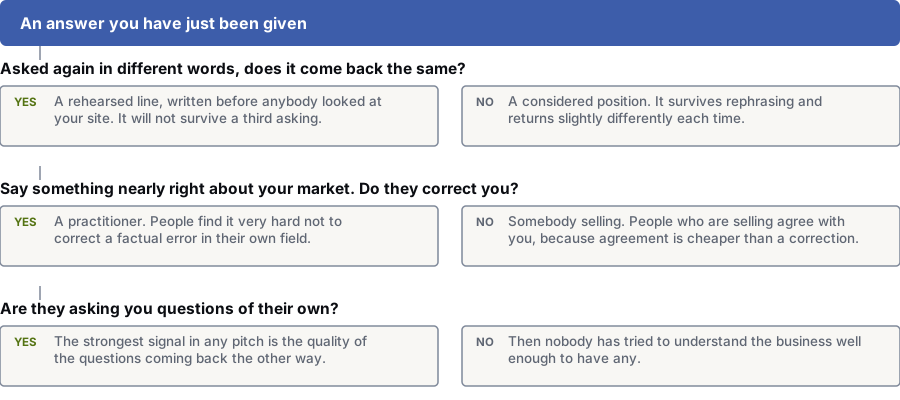
Asked again in different words, does it come back the same?
Yes: A rehearsed line, written before anyone looked at your site. It won’t hold up a third time.
No: A considered view. It holds up when rephrased and comes back slightly differently each time.
Say something nearly right about your market. Do they correct you?
Yes: A practitioner. Experts find it very hard to let a factual error in their own field pass.
No: Someone selling. Salespeople agree with you, because agreeing is easier than correcting.
Are they asking you questions of their own?
Yes: A good sign. The best signal in any pitch is the quality of the questions they ask you.
No: Nobody has tried to understand your business well enough to have any.
Technique
How to run the pitch meeting
Ask the same question twice, half an hour apart, in different words. A considered view comes back slightly changed; a rehearsed line comes back word for word.
Invite disagreement early. Say something about your market that’s nearly right and see who corrects you.
Notice what they ask you. A good agency asks about your margins, your sales process, whether anyone answers the phone at nine on a Monday, and what happens to a lead once it arrives. An agency that never asks how you make money is getting ready to sell you traffic.
Mark each answer specific or generic before you leave. A week later every meeting feels equally good, and your notes are the only record you can trust.
Your questions
Vetting an SEO agency: common questions
How many agencies should I put through this?
Two or three. Any more and the meetings blur together, and you end up picking whoever you saw last.
A long list usually means the brief isn’t written yet. Tighten the brief and the shortlist gets shorter by itself.
Should I send the questions in advance?
Send the brief in advance and keep the questions for the meeting, so you see how someone thinks on the spot.
Factual questions are the exception. Ask about subcontracting, account ownership and notice periods in writing, so the answers are on record.
What if I don’t understand the answer well enough to judge it?
Ask them to explain it again as if to a colleague of yours outside marketing. A practitioner can do that and keep the substance; a weak answer turns into slogans or stays deliberately technical.
You aren’t judging the SEO itself, but whether this person can think clearly about your business.
What if an agency refuses to answer something?
Declining to name another client is normal and often required by contract. Declining to say who will run your account, what’s subcontracted or who owns the accounts at the end isn’t.
Note the refusal and ask why. The reason usually tells you more than the answer would have.
If I only ask one question, which one should it be?
"What would you not do for us, and why?" Nobody can answer it well without looking at your business, and an agency selling its whole menu can’t answer it at all.
A close second: what they think is the main reason you rank where you do now. It makes them commit to an idea you can hold them to later.
References
Sources for questions to ask an SEO agency
The official documents and research this page is based on. Platform rules change, so check the source before you act on a detail.
Related
Keep reading on questions to ask an SEO agency
- how to run the whole selection processThe full selection process these questions fit into.
- the warning signs behind the answers
- how SEO pricing is built
- our own working method
- SEO services
- put these questions to us
- a scoped audit, if you want the diagnosis before the retainer
- how we would answer the first-90-days question
- our done-for-you service
Start here
Bring the whole list to a call with us
Book a strategy call and ask us all fifteen questions. Judge how specific our answers are before you sign anything.
Rather check it yourself? Try our free SEO tools