
SEO Audits
SEO audit services that end with a ranked plan of fixes
An SEO audit with a fixed scope and price. We check your site, searches and competitors, then hand over a ranked list of fixes your developers can build.

In every planIncluded in Local or Growth, from $149 a month. Every plan has every feature; they differ by size.
Compare plansHow it works
How our SEO audit works, stage by stage
A set package with a clear end point, taking two to four weeks.
Agree the scope and get access
We agree what the audit must answer: a general check-up, protecting rankings before a redesign, or explaining a traffic drop. Then we collect access to analytics, Search Console, your CMS and any server log files, because access usually holds things up.
You get: An agreed scope and an access checklist
Collect the data and crawl the site
A full crawl with and without JavaScript, plus index coverage, real-user speed data, log file samples and past search performance. We collect everything before judging anything.
You get: A complete data set, kept and shared with you
Analyse
We review your main templates by hand, check sales pages against search intent, look for pages competing with each other, and compare you with competitors. If traffic has dropped, we build a timeline of site and market events.
You get: A findings list with evidence attached to each item
Rank the findings
Every finding ranked by expected effect against effort, with the reasons. This is where four hundred issues become the six that matter, and where we say which to ignore.
You get: A ranked roadmap with the reasons for the order written out
Hand over properly
A recorded working session with your marketing and development teams to walk through the findings. Written specs go into the ticketing system you already use.
You get: A recorded handover session and sprint-ready specs
What we check
What an SEO audit checks
The standard scope. It grows for very large sites and shrinks when a specific question makes parts irrelevant.
- Crawl access: robots rules, canonicals, redirect chains, status codes and URL parameters
- Index coverage: what is indexed, what is excluded, and whether that was intended
- Rendering: what a crawler sees with and without JavaScript, and what depends on hydration
- Site structure: page depth, internal links, orphan pages and how authority flows through the site
- The quality of templates for the page types that bring in business
- Search intent: whether each sales page answers the search it targets
- Cannibalisation: pages competing with each other for the same search
- Search demand, and the gaps where you have no page at all
- A competitor comparison on the searches that lead to enquiries
- Core Web Vitals and real-user speed data by template
- Whether structured data is valid and matches what the page shows
- International and location setup, where relevant
- A timeline of past performance against site changes, Google updates and market events
- Conversion and tracking accuracy, because a tracking fault can look just like a traffic drop
Which one you need
Three types of audit for three different questions
| Dimension | Technical audit | Full SEO audit | Traffic drop diagnosis |
|---|---|---|---|
| The question it answers | Can Google crawl, render and index this site properly? | Why are organic results below what this business should get? | What caused the drop, and when? |
| Usual reason to order it | A new platform, a migration, or a site that has outgrown its structure. | A decision about a retainer, a new marketing lead, or growth that has stalled for no clear reason. | A drop in the reports that nobody can explain. |
| Most of the effort | Crawl, log file and rendering analysis at scale. | Demand research, search intent and competitor comparison. | Rebuilding past data and matching drops to events. |
| What you get | Specs for your developers, ranked by effect. | A full roadmap covering technical fixes, content, site structure and authority. | The cause, the evidence for it and a recovery plan. |
| When it is the wrong choice | When the site is technically sound and the gap is demand or authority. | When you already know the cause and just need it specified and fixed. | When seasonality or a tracking change explains the drop. We check that first. |
How we narrow it down
From four hundred findings to the six costing you money
Listing every issue is the easy part. What you pay for is what happens to the list next.
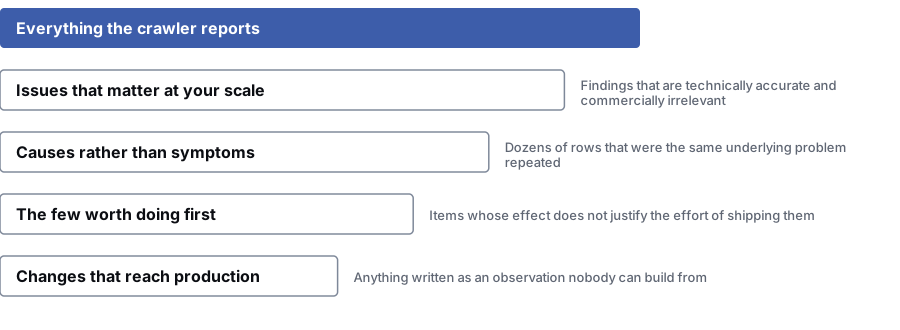
- 1Everything the crawler reports — Any decent-sized site returns hundreds of issues. Producing that list is the cheapest part of an audit.
- 2Issues that matter at your size — Severity labels come from a tool that has never seen your sales pages or your traffic.Findings that are technically correct but do not affect your business
- 3Underlying causes — Much of a findings list is often one template fault, counted once for every URL it affects.Dozens of rows that were the same problem repeated
- 4The few to do first — Ranked by expected effect against effort, with the reasons written out so you can challenge them.Items whose effect is not worth the effort of shipping them
- 5Changes that go live — Each one written against the template it affects, with acceptance criteria and a test to confirm it worked.Anything written as a note nobody can build from
After the audit
What happens after we hand over the audit
Most audits fail here. The advice is correct, yet eighteen months later almost none of it has been done. We plan for that from the start.
Three things make the difference: findings written as tasks a developer can pick up, a handover session with the people making the changes, and a ranked list short enough to act on, even if that means saying three hundred of four hundred findings are not worth your time.
After that, it is your choice who makes the changes. The audit is priced and scoped as a standalone project, not a sales pitch with a crawl report attached.
If you carry on with us, the audit becomes the first quarter of the plan. We do not redo it, and nothing gets charged twice.
What you get
What you receive at the end
The findings list
Every issue, with its severity, evidence, URLs affected and why it matters, including the items we suggest you ignore.
The ranked roadmap
The short version: what to do, in what order, and why, ranked by effect against effort so you can challenge it on the evidence.
The specs
Each structural finding as a task: the template affected, what should change, acceptance criteria, a test, and what happens if it is skipped. Delivered into your ticketing system.
The handover session
A recorded session with your marketing and development teams to answer questions, agree owners for the top items and plan the first sprint.
Questions
What people ask before booking an audit
How is this different from running a crawl ourselves?
A crawler tells you what is technically true. It cannot tell you which of four hundred findings cost you money, which do not matter at your size, and which share one cause.
We use the same crawlers. You pay for the judgement: the evidence for each finding, why it ranks where it does, and what changes if you fix it.
What if the audit finds nothing seriously wrong?
Then we tell you, and look at why results still fall short. Usually the demand is smaller than you thought, your pages do not match what searchers want, or competitors have more authority.
That is a useful finding. It stops a technical project that would have achieved nothing and moves the budget somewhere that might work.
How is this different from your free audit?
The free version is an automated check plus a short review, useful for spotting obvious problems and deciding whether a full audit is worth paying for.
The paid audit adds log files, index coverage data, a manual review of key templates, competitor analysis, demand research and team interviews, and gives you specs to build from.
Will our developers be able to use it?
Yes, the format is built for that. Each structural finding is written against the template or component it affects, with acceptance criteria, a test, and what happens if it is skipped.
A handover session with your development team answers most of the questions that hold up fixes.
How long does an audit take?
Usually two to four weeks from access, depending on site size and how quickly we get analytics, Search Console and log files. Access delays are the most common reason an audit runs long.
Large sites and traffic drop diagnoses take longer. We give you a firm date when we agree the scope.
Do we have to work with you afterwards?
No. The audit is a fixed-scope project. Your own team, another agency or we can implement it.
It is built to be useful on its own, not to make a retainer feel like the only option.
Tell us your question and we will scope the audit to fit
A general check-up, protecting a redesign and explaining a traffic drop are three different projects. Tell us which you need, and we confirm scope, timeline and price before anything starts.
Prefer to talk it over? Book a free call
Your BOOSTD score improves within 90 days, or your next month is free. After 6 months, more traffic or leads, or we keep working free (up to 6 free months in any 12 months). Read our guarantee
References
Sources for SEO audit
The official documents and research this page is based on. Platform rules change, so check the source before you act on a detail.
Related
More on SEO audits
- technical SEO fixesWhere structural findings get built.
- reasons organic traffic fallsThe causes we check when traffic has dropped.
- recovering traffic after a drop
- page speed and Core Web Vitals work
- a sample audit report, run on our own siteA real audit of tryboostd.com: 42 areas, scored in the open.
- the checks to run before a site migration
- questions to ask whoever audits your site
Where SEO audits matters most
More SEO services services
Last updated · Published by Zubair Afzal, responsible editor