
Free SEO audit
Your free SEO audit, with the scope written down first
Send us your URL. We read your site, the results it already appears in and the businesses you compete with, then write back with what we found and what we would do about it. A diagnostic rather than a full audit. No charge, and no obligation to book anything.
Prefer to talk it through? Book a strategy call
What this is
What gets read, and what a scanner cannot see
You send a URL. We read the site, the search results it already appears in and the businesses you compete with, and then write back. There is no instant report, no dashboard, and nothing generated the moment you press send.
That matters because the automated version already exists and is free everywhere. A crawler will happily hand you two hundred flagged issues sorted by severity, and none of that severity has anything to do with your business. It does not know what you sell, who buys it, what a customer is worth to you, or which of your pages you actually need to work.
The judgement worth having is which two or three things deserve your attention, and why. That is the whole of it. This is a diagnostic — the start of a conversation, not a document you could hand a developer as a work order.
What judgement adds
How two hundred flagged issues become two or three worth your time
A crawler sorts by a severity it invented for itself. We sort by what your business sells, and that difference is the entire point of the exercise.
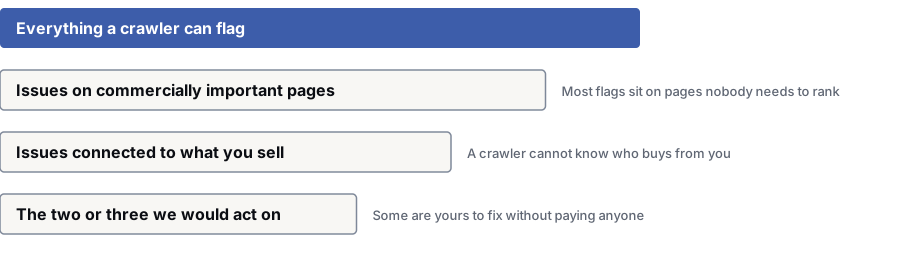
- 1Everything a crawler can flag — Two hundred issues sorted by severity, none of which has anything to do with what your business sells.
- 2Issues on commercially important pages — We check titles, headings and structure on the pages that have to earn, rather than on all of them.Most flags sit on pages nobody needs to rank
- 3Issues connected to what you sell — What a customer is worth to you, and which pages you actually need working, is what decides whether a flag is serious.A crawler cannot know who buys from you
- 4The two or three we would act on — Named in a written reply, roughly in the order we would tackle them, with the uncertain parts marked as uncertain.Some are yours to fix without paying anyone
Scope
What we look at on your site
All of this comes from publicly available information: your site as a crawler sees it, the results it already appears in, public performance data and your competitors’ public pages. We ask for no logins and no access to anything you own.
- Whether your important pages can be crawled, rendered and indexed at all
- What each page is actually targeting, and whether two of them are competing for the same thing
- Titles, headings and metadata on the pages that matter commercially, rather than on all of them
- Site structure and internal linking — whether the pages that make money are reachable and supported
- Real-user mobile performance, where public field data exists for your domain
- Whether the site converts: what a page asks the visitor to do, and how hard it is to do it
- Your Google Business Profile and map presence, where local search is relevant to you
- Whether your pages are in any shape to be cited by an assistant answering a question in your category
- What two or three competitors are doing that you are not, and whether it actually matters
Honest limits
Where this stops, and what a paid audit adds
| Dimension | Free diagnostic | Full paid audit |
|---|---|---|
| Scale of the work | A focused reading of what matters most. | Days of work, across several people. |
| Pages examined | A handful: your homepage, your main commercial pages and a sample of the rest. | The whole site, crawled and analysed page by page. |
| Data used | Public data only. No account access requested or needed. | Your Search Console, analytics, server logs and rank tracking. |
| Depth | The two or three things most likely to be holding you back. | A prioritised backlog with effort estimates, owners and sequencing. |
| What you get | A written reply, and an offer to talk it through. | A documented audit, a technical specification and an implementation plan. |
| What it is for | Deciding whether there is a problem worth spending money on. | Fixing it. |
How it works
Four steps, and the one thing we need from you
There is no funnel behind this. The whole exchange is an email, a considered read, and a reply you are free to ignore.
You send a URL
That is genuinely all we need to start: the address, and ideally one sentence about what you sell and where your customers are. If you have a specific worry — traffic that dropped, a page that will not rank, a competitor who appeared from nowhere — say so and we will look at that first.
You get: Nothing to install and no access to grant
We read it properly
We work through the list above using public data only, looking at the site the way a search engine sees it and the way a customer sees it. Those are not the same view and they rarely agree.
You get: A considered reading, not a scan
You get a written reply
Plain English, short, and specific to your site. It says what we saw, what we would do about it, roughly in what order, and which parts you could sensibly do yourself without paying anyone. Where we are uncertain, it says that rather than rounding up to confidence.
You get: A written response, not a generated report
You decide whether to talk
If it is useful, we can talk it through. If it is not, that is the end of it. There is no sequence of follow-up emails, no call booked on your behalf and no second attempt three weeks later.
You get: A conversation, or silence — whichever you prefer
The terms
What you can expect, and what we will not do
What we will do
- Tell you if the honest answer is that your site is basically in good shape
- Tell you when something is worth fixing yourself rather than paying anyone for
- Tell you if a different kind of agency is a better fit for the problem than we are
- Say when we are uncertain, instead of asserting something to sound authoritative
- Delete your details on request, at any point, without asking you why
What we will not do
- Promise in advance that we will find something, because sometimes there is little to find
- Project a ranking position, a traffic number or a revenue figure from a one-hour review
- Ask for logins to your analytics, hosting or advertising accounts
- Put you into an automated email sequence, or pass your details to anyone else
- Charge for it, or make it conditional on booking a call first
Questions
What people ask before sending us a URL
Is this actually free, or is it a trial of something?
It is free and it is not a trial. There is nothing to sign up to, no card, no time limit and no reduced version of a product you get asked to buy afterwards.
The commercial logic is simple enough to say out loud: some people who get a useful answer come back when they have a budget, and most do not. That trade works for us at this size, and we would rather be plain about it than present it as charity.
How long does it take?
Usually two to three working days from when you send the URL. Nothing is generated on submission, so there is a real queue behind it.
If we are busy enough that it will take longer, we say so when you ask rather than letting it go quiet. If your question is urgent, tell us and we will give you an honest answer about whether we can get to it.
Do you need access to my analytics or Search Console?
No. Everything in this review comes from publicly available information: your site as a crawler sees it, the search results it appears in, public field performance data and your competitors’ public pages.
That is also its honest limit. Without your own data we cannot see which queries you already rank for, where your traffic goes or what converts, and that gap is most of the difference between this and a paid audit.
What if there is nothing much wrong with our site?
Then we say so. It is a real outcome, it happens with sites that have been looked after, and telling you the site is broadly fine is more useful than manufacturing a list of issues to justify the exercise.
When that is the answer, the reply usually moves on to where the actual constraint sits instead — often positioning, conversion, or the fact that nobody is searching for the thing being sold in the way the site assumes they are.
Will this tell me how much traffic or how many leads I could get?
No, and be careful with anyone who says it will. Nobody can turn public data alone into a credible forecast of what a website will earn, and we are not going to pretend otherwise to make the offer sound better.
What you get instead is a view of what is currently getting in the way and what we would do about it. Forecasting worth having comes later, from your own data, with the assumptions written down where you can argue with them.
What if you do not think you can help us?
We tell you in the reply, and we say why. Sometimes the honest answer is that the work needed is not the work we do, or that spending on marketing at all would be premature for where the business currently is.
Where we can, we point you towards the kind of help that would actually fit. That costs us nothing, and it is why a fair number of these reviews end with no pitch in them at all.
Send us your URL
Use the contact form, put your website address in the message and tell us what you are worried about. We will read it properly. There is no charge, and no obligation to book anything afterwards. If we do not think we can help you, we will say so rather than sell you something else.
Last updated · Published on owner authorisation by Zubair Afzal