
SEO Recovery
SEO recovery services: find out why your traffic fell, then fix it
Our SEO recovery services find out why your organic traffic fell before fixing anything. If a drop can’t be reversed, we tell you early.

In every planIncluded in Local or Growth, from $149 a month. Every plan has every feature; they differ by size.
Compare plansWhat you are seeing
Five ways a fall in search traffic shows up
The shape of the drop narrows the possible causes, so that is where the first conversation starts.
- It fell off a cliff on one day.
- A one-day collapse points to a single event: a site release, a robots rule, an expired security certificate, a manual action, a deleted tracking tag or a domain change. It is the easiest shape to diagnose and often to fix.
- It has been sliding for eight months.
- A slow slide points to competitors pulling ahead, ageing content, a pile-up of small technical choices or falling demand. It is the hardest shape to explain and the most often misblamed.
- One section fell and the rest is fine.
- The most useful kind, because the boundary shows where to look. If the blog fell while product pages held, or one language fell and the others didn’t, the search narrows fast.
- Impressions are steady but clicks are down.
- Almost never a ranking problem. Something around your result changed: more ads, a features box, an answer on the results page, or a title and description that no longer match what people want.
- The rank tracker says nothing changed.
- Either the tracking is wrong or the tracked keywords aren’t the ones that brought the traffic. We check both before drawing any conclusion.
Possible causes
Five causes of lost traffic and how to tell them apart
Recovery goes wrong when the plan fixes one of these while the site suffers from another. The graph looks the same; the evidence doesn’t.
| Dimension | What points to it | How fast it changes | What you can expect |
|---|---|---|---|
| Manual action | A notice in the Manual actions report in Search Console. It is either there or it isn’t, so no guesswork is needed. | Nothing changes until Google reviews a reconsideration request, and there is no set timeline. | Can be reversed, as long as the problem is removed and not just hidden. |
| Algorithm change | Timing close to a broad Google update, many pages moving at once, and competitors moving the other way. | Positions can shift again at any time, often not until a later update. | No fixed way back. The job is to make the pages more useful for the people landing on them. |
| Self-inflicted | A release, migration, redesign, template change, plugin update or robots rule that lines up with the drop. | Usually recovers within weeks of fixing the specific fault. | The easiest cause to reverse. That is why we date the drop precisely first. |
| Competitors overtaking you | Your pages are as good as before, but specific competitors now hold the positions you had. | Slow both ways. It built up over months and it unwinds over months. | Winnable in some markets and not in others. Sometimes it is better to compete for different searches. |
| Tracking error | The site is fine, rankings haven’t moved, and the drop shows in only one report, one property or one date range. | Instant, once the tag, filter, consent setting or property setup is fixed. | Nothing was lost. We check this first because it is so quick to rule out. |
Our method
How our SEO recovery service finds the cause
Check the tracking
This comes first: the tracking tag, consent and property settings, filters, bot exclusion, subdomain coverage and whether the report’s date range shows what the reader thinks.
You get: Written confirmation that the drop is not a tracking error
Pin down the date
To the day, where possible. Then we line up everything that changed: releases, content edits, migrations, campaign changes, Google updates and seasonal patterns from past years.
You get: A timeline showing the drop and every possible trigger
Break the data down until a boundary appears
By page type, page group, search topic, device, country and landing page. A drop spread everywhere means one thing. A drop with a clear boundary tells us far more.
You get: An analysis showing what was and wasn’t affected
Rule out what can be ruled out
Manual actions and security issues, indexing and crawl status, error codes, canonical and robots settings, and whether the affected pages still load and display as they should.
You get: A list of causes ruled out, with the evidence for each
Look at the search results
We compare the results for the affected searches now with before: who shows up, how much space ads and features take, and whether Google now answers the question itself.
You get: A view on whether the opportunity itself has shrunk
Write up the diagnosis and the plan
The most likely cause, the evidence for and against it, what we would do about it and in what order. We also say where we think the effort won’t pay back.
You get: A diagnosis with a ranked plan, or clear advice to stop
Weighing the evidence
What can be checked and what can only be inferred
Some findings can be checked directly. Others are judgements based on timing and patterns. Every time we present a finding, we label which kind it is.
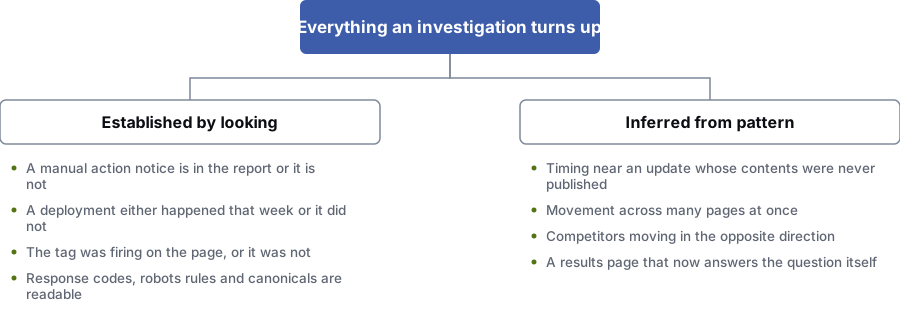
Checked directly
- A manual action notice is in the report or it isn’t
- A release either happened that week or it didn’t
- The tracking tag was firing on the page, or it wasn’t
- What the error codes, robots rules and canonicals say
Inferred from patterns
- Timing near an update Google never explained
- Many pages moving at the same time
- Competitors moving the other way
- A results page that now answers the question itself
Our commitments
What we commit to on every recovery project
We will
- Rule out a tracking error before proposing anything
- Show the evidence for our diagnosis, including evidence against it
- Tell you when the likely cause is something your team did
- Advise against spending when we don’t expect a return
- Mark what is known and what is a judgement, every time we share a finding
We will not
- Promise your traffic will return, because Google decides that
- Claim to know what changed in a Google update that was never explained
- Sell you a monthly plan before we know the cause
- File a disavow just because links are the easiest thing to blame
- Take credit for a recovery that came with a later Google update
When traffic won’t come back
Some drops are not penalties and don’t reverse
The word recovery suggests your traffic is waiting to be won back. Often it isn’t. When search results change, the traffic a page used to get can disappear for good.
The common cases: a question that sent people to your article is now answered on the results page. Two big directory sites move above you. Demand shifts to video, a marketplace or someone’s free tool. None of these is a penalty, and none is fixed by rewriting title tags.
Chasing traffic that no longer exists is expensive. The better move is usually to accept the new ceiling and put effort where demand still turns into sales. We aim to spot this in week two, before you spend a year on it.
Questions
Questions people ask when traffic is falling
Can you guarantee our traffic comes back?
No. Nobody can. Recovery depends on the cause, and some causes have no way back.
We commit to a diagnosis backed by evidence and a clear view of what is achievable, and we advise against spending that we don’t expect to pay off.
How do you know it was an algorithm update?
Usually we can’t know for sure, and neither can anyone else. Google announces updates but doesn’t publish what changed, so any link is a judgement based on timing and patterns.
What we can prove is what did not cause it: a manual action, a release that week or a tracking change is either there or not. Ruling things out is the hard part.
Our rankings look the same but traffic is down. What is happening?
Usually the results page changed around you. More ads, a features box, an answer on the page or a directory site at the top all cut clicks.
Your rank tracker may also be checking a location or device mix that no longer matches your audience. We check both before we conclude anything.
What if we caused it ourselves?
That is one of the better outcomes, because self-inflicted damage is the easiest to reverse. Dropped internal links, lost headings, a stray robots rule or broken migration redirects all have clear fixes.
Our report shows which change caused the drop and how to undo it.
Is disavowing links part of this?
Rarely. A disavow file is for one situation: usually a manual action about links, or an unusual pattern of links that you or someone working for you built.
Used carelessly, it can remove links that were helping you. We confirm links are the cause before we touch them.
How long does the diagnosis take?
For most sites, one to three weeks. Checking tracking and dating the drop is quick. Breaking down a large site and competitor changes takes longer.
You get a full report even if we find nothing wrong with the site.
Find the cause before you pay for a fix
Tell us roughly when the drop started and what changed around then. We will tell you what we would check first, what looks most likely and whether you need a full investigation at all.
Prefer to talk it over? Book a free call
Your BOOSTD score improves within 90 days, or your next month is free. After 6 months, more traffic or leads, or we keep working free (up to 6 free months in any 12 months). Read our guarantee
References
Sources for SEO recovery services
The official documents and research this page is based on. Platform rules change, so check the source before you act on a detail.
Related
More on SEO recovery
- recovering lost organic trafficThe same problem, seen from the business side.
- the common reasons organic traffic drops
- a routine SEO auditAn audit asks what could be better. A diagnosis asks what changed.
- planning a site move properlyMany self-inflicted drops start with a site move.
- tracking you can rely on
- crawling and indexing checks
More SEO services services
Last updated · Published by Zubair Afzal, responsible editor