
Choosing an agency
SEO agency red flags to check before you sign
Published by Zubair Afzal, responsible editor
First published Updated 8 min read
Walk away
Six SEO agency red flags that should end the conversation
Each one promises something nobody can deliver, or stops you checking what was done to your site.
All six are common and legal, and each moves risk from the agency to you.
- They promise specific positions in the search results.
- Promises win deals: a buyer comparing three vague proposals picks the one that sounds certain. But the only reliable way to keep the promise is to target phrases almost nobody searches. You get a report showing first place, a year of budget spent and no new customers.
- The method is proprietary and can’t be described.
- Secrecy protects the price. If nobody can explain what they do, you can’t compare it with a cheaper option or get a second opinion. Later, you can’t tell whether it caused a problem, hand it to another supplier, or tell a developer what to keep during a rebuild.
- You don’t have your own administrator access to Analytics and Search Console.
- Lazy setup or deliberate, the effect is the same. You can’t check the baseline or compare a chart in the report with the platform itself, and when the relationship ends you lose the history. Leaving becomes expensive, even though the contract looked ordinary.
- The agency owns your domain, hosting, ad account or Business Profile.
- These often get set up in agency accounts because it’s faster, and nobody moves them. The moment you disagree about renewal, the agency has the upper hand. Getting a Business Profile or a domain back from an unwilling holder is slow, and meanwhile your listings, ads and sometimes email sit in someone else’s hands.
- Links are sold in packages at a price per link.
- A price per link only makes sense if links are being placed, and placements bought to influence rankings break Google’s link spam policies. The agency carries none of the risk. You inherit a link profile that may need cleaning or disavowing, from sites that rarely send a single visitor.
- A long minimum term with deliverables described only as "ongoing SEO".
- A long term can be fair; a vague one isn’t. If the contract doesn’t name what arrives each month, there’s nothing they can fail to deliver, so the non-delivery clause is decoration. A year later, the only answer to "what did we get?" is a folder of reports.
Why it happens
Why do bad SEO practices keep coming back?
Because the market rewards them. Economists call SEO a credence good: you can’t judge its quality before you buy, and often not afterwards either. Results depend on competitors, the season, your products and a ranking system nobody can see inside. When buyers can’t see quality, confident pitches beat accurate ones.
SEO also takes months to show results, so every agency has a stretch where the client can’t yet tell if it’s working. The safest way through is to make results hard to check: secret methods, reports from the agency’s own dashboard, metrics that always go up. Nobody has to lie for this to happen.
So protect yourself with how you set things up. 1. Own the accounts. 2. Define the deliverables. 3. Keep the notice period short. 4. Insist every task can be explained. These cost a good agency nothing.
Ask before you decide
Five warning signs that deserve a hard question
Each has a fair explanation, and each can also hide a common failure, so ask.
- The reporting is rankings and nothing else.
- Rank tracking is a useful check and a poor scoreboard. Positions vary by location, device and personalisation, and a page can climb while sending fewer visitors because an answer box now sits above it. Ask what the report shows when rankings improve and enquiries don’t.
- You never meet the person who runs your account.
- Keeping delivery staff out of meetings to protect their time can be fair. It can also hide a senior person selling the strategy and whoever is free carrying it out. Before you sign, ask for one working session with that practitioner, not a meet-the-team slide.
- Content is produced without ever speaking to anyone in your business.
- That can work for general topics. It fails on pages where your expertise sets you apart, which are the pages worth writing. If nobody has asked to interview a technician, a partner or a clinician, the content will be a summary of your competitors.
- The proposal is structurally identical to one you’ve seen elsewhere.
- Templates save time. The problem comes when the template replaces the analysis: the same phases, monthly hours and deliverable counts, whatever your site needs. Ask which parts would change for a business twice your size in another sector.
- Nobody in the team can read a server log or a release diff.
- Many serious organic problems start in the code: a release drops a canonical tag, a robots rule ships from staging, a template only shows its content after a script runs. An agency without technical skills will call these content problems and sell you content. Ask who they call when the cause is in the code.
Who pays
Who pays when it goes wrong?
You do. The agency carries almost none of the cost, and whatever outlasts the contract is yours.
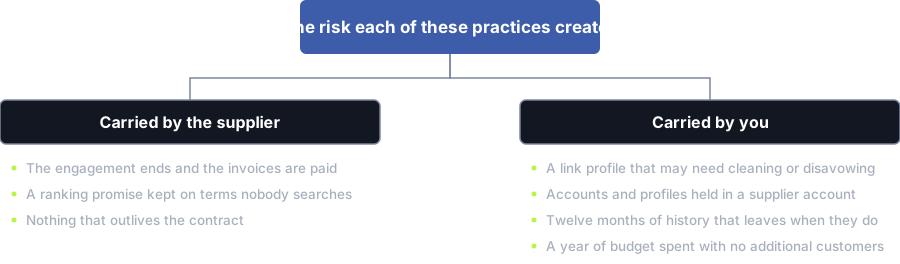
Carried by the agency
- The contract ends and the invoices are paid
- A ranking promise kept on terms nobody searches
- Nothing that outlasts the contract
Carried by you
- A link profile that may need cleaning or disavowing
- Accounts and profiles held in the agency’s name
- Twelve months of history that leaves when they do
- A year of budget spent with no new customers
Protect yourself
What to put in an SEO contract, and what to refuse
None of these terms is unusual, or costly for an agency that plans to deliver.
Require in writing
- Admin ownership of analytics, Search Console, ad accounts, the Business Profile, the domain, the DNS and the CMS, all in your name.
- A named list of monthly deliverables, so non-delivery is a matter of fact and nobody needs to argue.
- A written baseline recorded before anything starts, including the period it covers.
- Disclosure of every subcontractor involved in writing, development or outreach.
- An itemised handover when you leave: documents, dashboards, published content and any accounts created for you.
- The right to a second opinion. You can have an independent party review what was done without breaching the contract.
Decline to sign
- Any clause that leaves assets made for you in accounts the agency controls after the contract ends.
- Automatic renewal with a notice window shorter than one reporting cycle.
- A confidentiality clause so broad that you can’t describe what was done to another supplier.
- Deliverables measured only in hours, credits or "campaigns", with no named output.
- Links priced per link, with the sites unnamed and impossible to review.
- Any promise about search positions, however it is worded. The only versions anyone can keep are worth nothing.
Questions
SEO agency red flags: common questions
Is a ranking promise ever legitimate?
No. Nobody controls Google’s results; they vary by location, device and search history, and change without notice. Google’s own advice on hiring an SEO says no one can guarantee a number one ranking.
The only reliable way to keep that promise is to pick phrases almost nobody searches, so it is met on paper and your business is no better off.
The agency built our website. Who owns it?
Whoever the contract says, so settle it before the build starts. The code, the design files, the content, the domain, the DNS and the hosting account are six separate questions, often with different answers.
If the site sits on an agency platform you can’t export from, you’re renting it. That can be a fair deal, as long as you know it.
Are all paid links a problem?
Links bought or swapped to manipulate rankings break Google’s spam policies, which say paid placements should be marked so they don’t pass ranking signals.
Paying for advertising, sponsorship or placement is normal business. What matters is whether you are paying for the audience or the ranking signal, and whether the link is labelled properly.
The quote is very cheap. Is that a red flag on its own?
Not by itself, but a very low monthly fee buys only a few hours, and they must cover strategy, delivery, reporting and account management.
Ask how many hours the fee covers and whose they are. If nobody will say, the vagueness is the problem, whatever the price.
We’re already in a contract that isn’t working. What now?
First, take back what’s yours. Get admin access to analytics, Search Console, ad accounts and the Business Profile, and export everything published. Do this before you raise the wider issue.
Then read the termination clause and put your concerns in writing, with dates and details. Most contracts have a non-delivery route, and most disputes go to whoever has the better written record.
References
Sources for SEO agency red flags
The official documents and research this page is based on. Platform rules change, so check the source before you act on a detail.
Related
Keep reading on SEO agency red flags
Start here
Get a second opinion on a proposal
Got a proposal or contract that doesn’t feel right? Bring it to a call, and we’ll show you what we’d push back on and where the price looks fair.
Rather check it yourself? Try our free SEO tools