
Link Building & Digital PR
Link building: coverage you could show a journalist, not links you would hide
Most of what is sold as link building carries risk the buyer is never told about. This page starts with what we will not do, because in this part of search the refusals matter more than the offer, and then explains what earning coverage involves.
Prefer to talk it through? Book a strategy call
Start here
What we will not do, before what we will
In this part of search, the refusals define the service. Any provider can describe good outreach; far fewer will put the excluded tactics in writing.
What we do
- Build assets a publication would want to cover whether or not a link came with it
- Approach named journalists and editors individually, with a reason relevant to what they cover
- Provide expert commentary in response to real journalist source requests
- Disclose the source of every link we earn, including the ones that disappointed us
- Advise you when coverage is worth pursuing for brand reasons even though it will carry no link
- Tell you when a campaign idea is not strong enough before we spend your budget pitching it
What we will never do
- Pay for links, or work with intermediaries who pay for links on our behalf
- Use private blog networks or any inventory of sites that exists to sell links
- Place articles on guest post farms that publish anything for a fee
- Arrange reciprocal or three-way link exchanges
- Buy expired domains and redirect them at your site
- Post links in comments, forums, profiles or directories that exist only for links
- Accept a paid placement without the disclosure the platform policies require
Why this page starts that way
The risk is carried by you, not by the provider
If a link campaign goes wrong, the provider loses a client. You lose the domain your business runs on. That asymmetry is the reason this page leads with exclusions instead of a capability list.
The published spam policies are unusually direct on this. Exchanging money, goods or services for links intended to influence ranking is described as link spam. Large-scale article campaigns published mainly for their links are described as link spam. Where a link is paid or sponsored, the platform expects it to carry an attribute that marks it as such, which is another way of saying that a paid link marked passes nothing at all. Paying for a link and then hoping it is not marked is the entire business model of a large part of this industry.
None of that makes the outcome certain. Plenty of sites with bought links rank perfectly well today. Put plainly, you are holding an undisclosed liability with no fixed maturity date, on an asset you cannot easily replace, in exchange for an advantage nobody can size for you.
The alternative is slower and less predictable, which is a real cost and we will not pretend otherwise. Earned coverage arrives when an editor decides it should, not when a campaign plan says it will. What it does give you is a profile that needs no explanation to the next agency, the next investor or the next person who audits it.
What we get called about
Four situations that bring people to this page
- We bought fifty links and nothing happened.
- The usual explanation is that the links were placed on sites with no real audience, in articles nobody reads, and were either discounted or ignored entirely. The report was accurate and the outcome was still nothing. The second most common explanation is that links were not the constraint in the first place, and a technical or intent problem was holding the pages back regardless.
- Our provider will not tell us where the links came from.
- This is the clearest signal available. A provider earning coverage is proud of the placements and lists them. A provider unwilling to name sources is usually protecting either an inventory of sites they control or an arrangement they know you would not approve. You are the one holding the risk, so you are entitled to the list.
- We got PR coverage and none of it linked to us.
- Common, and not always a failure. Some publications have a blanket no-link policy and the mention still has brand value. But if the campaign was sold as authority work and delivers unlinked mentions, it was sold as the wrong thing. That should be agreed at the outset rather than explained afterwards.
- We have a manual action and do not know why.
- Recovery starts with a complete inventory of everything ever done, including work by previous agencies who may not have disclosed their methods. Then a disavow and a reconsideration request that describes what happened and what has changed. It is slow, it is unpleasant, and it is the strongest argument available for never taking the shortcut in the first place.
Where a campaign really loses
Most link building fails long before an email is sent
Outreach gets blamed because outreach is the visible part. In practice the losses are concentrated at the first stage and the last, and neither of them is fixed by pitching harder.
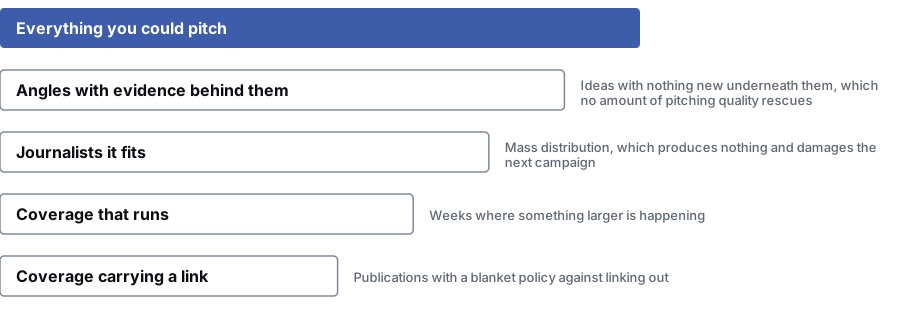
- 1Everything you could pitch — Almost all of it is company news no publication has a reason to run. The story rarely comes from the company; it comes from what the company knows.
- 2Angles with evidence behind them — Data you hold, a pattern only you can see, a regulation explained by somebody who has to comply with it.Ideas with nothing new underneath them, which no amount of pitching quality rescues
- 3Journalists it fits — A small number of named writers who cover this specific subject, approached individually with a reason.Mass distribution, which produces nothing and damages the next campaign
- 4Coverage that runs — An editor decides, not a campaign plan. What else happened that week is not something anybody controls.Weeks where something larger is happening
- 5Coverage carrying a link — Still worth having for brand reasons. It should have been sold as brand work rather than as authority work.Publications with a blanket policy against linking out
The work
How coverage is earned
Find the reason someone would cover you
Interviews with the people who know the business: what your data shows, what customers consistently get wrong, what is changing in your market that nobody outside it has noticed. This is the step that decides whether the rest works, and it is the step most link building skips entirely.
You get: A shortlist of story angles with the evidence behind each
Establish the authority gap
Which competitors are ahead, what they are cited for, and whether authority is the constraint on your pages or whether something else is. Sometimes the real finding is that you do not need links, you need a different page.
You get: Authority gap analysis and a recommendation on whether to proceed
Build the asset
Original research, a dataset with a real finding, a tool people will reference, or expert commentary from a named person with real credentials. It has to stand on its own as something a publication would want, because that is the only thing giving the pitch any weight.
You get: Published asset with the methodology stated openly
Pitch narrowly
A small list of named journalists who cover this specific subject, approached individually, with a reason the story fits what they write. Mass distribution produces nothing and damages the relationships that make the next campaign easier.
You get: Outreach log with every contact, angle and response recorded
Run reactive commentary alongside
Journalist source requests appear daily and are answered by whoever is fastest and most credible. A standing process, with named experts briefed and available, produces steady coverage between campaigns for a fraction of the effort.
You get: Reactive process with briefed spokespeople and response templates
Report with the sources named
Every link, where it came from, what it was for, and plain commentary on the pitches that failed and why. You should be able to hand the report to anyone and have it withstand scrutiny.
You get: Coverage report with full source disclosure
A different kind of search
The searches that decide whether you get cited
Most of this site describes how your buyers search. This page is about a different searcher: the person writing the article that could cite you. Being findable for these patterns is a large part of why some businesses get quoted repeatedly and others never do.
A journalist looking for a statistic
If your research page is the clearest source for a number a writer needs, the citation is close to automatic. This is why original data outperforms outreach.
- average cost of this service uk 2026
- how many businesses in this sector report this problem
- industry survey data on this practice
- latest figures on this market size
A journalist looking for a source to quote
A named expert with a real profile and a history of clear public explanation gets approached. An anonymous company page does not.
- expert on this subject for comment
- who can explain this regulation in plain english
- specialist in this field willing to be interviewed
A writer checking whether you are credible
Runs before a journalist commits to quoting you. What surfaces here decides whether a promising conversation quietly ends.
- company name reviews and complaints
- is this company legitimate
- company name founder background
These are examples of how customers in this market search, drawn from keyword research and public search data. They are illustrative, not a volume claim: we size the demand in your area before recommending anything.
Questions
The questions people ask before buying links
Is buying links dangerous, or is that just something agencies say?
It is against the published search spam policies, which describe exchanging money, goods or services for links intended to pass ranking signals as link spam. That is a policy position, not an opinion, and it applies whether the link is bought directly or through an intermediary who does not tell you.
The practical risk is less often a dramatic penalty and more often quiet devaluation: you pay for fifty links, they pass nothing, and you never find out. The worse outcome is a manual action, which is rarer but costly and slow to recover from. Either way you have paid for something that did not work.
What is the difference between digital PR and link building?
Digital PR earns coverage by giving publications something worth publishing: original data, expert commentary, a newsworthy story. Links follow because a journalist chose to include one. Link building, as usually sold, works backwards from a link target and finds a way to place it.
The distinction that matters is who decides. If an editor decided, it is a citation. If you or a paid intermediary decided, it is a placement, whatever it is called on the invoice.
Are guest posts acceptable?
It depends entirely on whether the publication would run the article if it contained no link. Writing for a publication whose audience you can serve is normal professional activity and always has been.
What the spam policies specifically describe is large-scale article campaigns written mainly for the links inside them, published on sites that accept anything. A site with a page listing its guest post prices is that, regardless of how it describes itself.
Should we disavow our old links?
Usually not. Search engines have become considerably better at ignoring low-quality links rather than penalising sites for them, and a disavow file applied carelessly can remove links that were doing you good.
The exception is a manual action naming unnatural links, where a disavow is part of the recovery. Outside that, the budget almost always produces more by earning good coverage than by trying to remove bad coverage.
Our business is boring. What would anyone write about?
Almost every business we have heard described as boring is sitting on data or expertise a journalist would want. You know what your prices have done over three years, what your customers get wrong most often, what is changing in your supply chain, what a regulation means in practice for people who have to comply with it.
The story rarely comes from the company. It comes from what the company knows. That reframing is most of the work in the first month.
How many links will we get?
We do not commit to a number, and providers who do are usually meeting it with placements rather than coverage. Earned coverage depends on what else is happening in the news that week and on whether an editor finds the story useful, and neither is under our control.
What we do commit to is the work: the assets built, the outlets approached, the commentary submitted, and a full disclosure of every link that results and where it came from.
Find out whether authority is really your constraint
Plenty of businesses buy links when the actual problem was the page, the intent match or a technical fault. Before recommending any coverage work we check that authority is what is holding you back, and say so if it is not.
Prefer to talk it through? Book a strategy call
If we don't deliver the work we agreed to deliver for reasons within our control, you don't pay for the undelivered work. Read our guarantee
References
Sources
The primary documents and published research this page relies on. Platform rules change, so check the source before acting on a detail.
Related
Where to go next
- digital PR campaignsThe campaign side of earning coverage.
- the standards we hold toThe line we will not cross for a result.
- warning signs when choosing a provider
- research we publish ourselvesOriginal data is the most reliable reason to be cited.
- organic growth overallAuthority is one of four workstreams, not a standalone product.
- trade coverage for considered salesWhere a single trade mention can carry a whole evaluation.
More to explore
Markets where link building is a priority
Last updated · Published by Zubair Afzal (responsible editor), on owner authorisation