
Multi-Location & Franchise SEO
Multi-location SEO services that get every branch found on Google
Multi-location SEO services for chains and franchises. Head office sets the structure, each branch supplies local facts, and every location page and profile gets found.

In every planIncluded in Local or Growth, from $149 a month. Every plan has every feature; they differ by size.
Compare plansWhere it goes wrong
Four multi-location SEO problems a single site never has
A single location has a local search problem. A network has an organisational problem too.
- Every location page is the same page.
- One template, one block of copy, sixty town names. Google does not so much penalise these pages as ignore them, because nothing tells them apart. The set underperforms while looking finished on a status report.
- Franchisees have built their own websites.
- Each is a small, weak site competing with your page for the same searches, making unchecked claims on a platform head office cannot access. Enforcing the rules rarely fixes it. The cause is that your location page was not sending them leads.
- Profiles belong to people who have left.
- A manager claimed the profile with a personal account in 2019 and moved on. Nobody can change the hours, reply to a review or fix the address, and it comes to light during something urgent: a closure, a rebrand or a complaint.
- Brand guidelines ban the details that would help.
- The style guide bans naming staff, mentioning neighbourhoods or describing work for named local clients, the very details that make a page locally relevant. The fix is a conversation with the brand team, not a workaround.
Who does what
Head office sets the structure. Each branch supplies the facts.
Head office should own the structure, the standards and the claims. Each branch should own the facts. Most multi-location problems start when one side tries to do the job of the other.
When head office writes the local content, you get sixty identical pages. It does not know which streets the Leeds team covers, or what the Bradford branch did for the local school last spring.
When each branch owns the structure, you get sixty different designs, inconsistent business names, unchecked claims and a brand that looks different in every town.
The model that works writes the split down and keeps the branch part small enough that a busy manager will do it.
Three ways to run it
Three ways networks manage local search, and what each costs
| Dimension | Fully central | Franchisee-led | Shared model |
|---|---|---|---|
| Who writes location content | Head office, from a template, for every site. | Each branch or franchisee, in whatever form they like. | Head office sets the structure. The branch supplies local facts through a short form. |
| Who owns the profiles | A central account. Branches often have no access. | Individual accounts, often personal, and often lost. | Central ownership, with branch staff added as managers. |
| Reviews | Replies written at head office, often slow and generic. | Some branches handle them well and others not at all. | Branches reply within a central policy, and pass anything sensitive up. |
| Local relevance | Low. Pages look the same and read like head office copy. | High where the branch is keen, missing where it is not. | Steady across the network, because each branch only has to give a little. |
| Brand and compliance risk | Low, and that is the main reason companies choose it. | High. Unchecked claims on sites head office cannot see. | Low. Claims and structure stay central, and only facts come from branches. |
| Where it breaks | Sixty near-identical pages, and branches that stop caring. | A split brand, and franchisee sites competing with your own. | Someone has to own the process. Without an owner, it drifts back to central control. |
A quick test to try today
Hide the town name: does the page still belong to that branch?
Identical location pages fail because they could be about any town. This test takes about a minute per page.
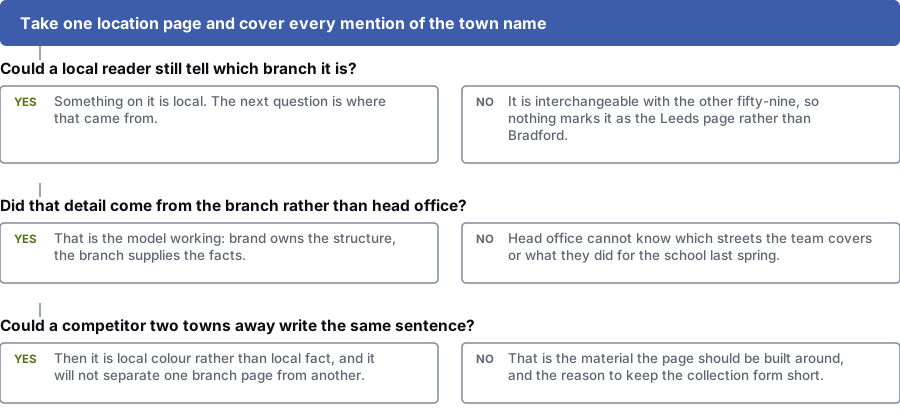
Could a local reader still tell which branch it is?
Yes: Something on it is local. Next, check where that detail came from.
No: It could be any of the other fifty-nine pages. Nothing marks it as the Leeds page and not the Bradford one.
Did that detail come from the branch itself?
Yes: Good. That is the model working: the brand owns the structure and the branch supplies the facts.
No: Head office cannot know which streets the team covers or what they did for the local school last spring.
Could a competitor two towns away write the same sentence?
Yes: Then it is general local colour. It will not set one branch page apart from another.
No: Build the page around that detail. It is also why the collection form should stay short.
The standard
What every location page needs
If a location page cannot include most of these, it should be a directory entry. A branch manager can supply each in a few minutes.
- The people at that site, named where the brand allows it
- The services offered there, which is rarely the full network list
- The areas served, described the way local people describe them
- Photos of that building, that team and their work
- Hours, access, parking and public transport details for that address
- Contact details that reach that branch directly, skipping a central queue
- Local proof: jobs done nearby, reviews from the area, community work
- Local details that matter to buyers there, such as regional rules or conditions
- LocalBusiness structured data that matches what the page shows
- Internal links to the services that branch sells and to nearby branches
How we roll it out
How we roll out multi-location SEO across your network
Audit every location
Every location page, profile, duplicate, franchisee site and forgotten listing. Networks are almost always bigger and messier than internal records show.
You get: A full list of every location, with who owns what
Recover and merge profiles
We claim unclaimed profiles, merge duplicates, move individually owned profiles into an organisation account, and set access so staff can do their jobs without being able to lose the profile. Slow, routine, and the base for everything else.
You get: All profiles merged and under stable ownership
Write the split down
A short document stating what head office controls, what is local and what is not allowed, agreed with brand, legal and franchise development before anything rolls out.
You get: A governance document and franchisee guide
Rebuild the location template
One structure for different local content, with branch fields clearly separate from the fixed parts. If a field is left empty, the page still looks complete.
You get: A location page template and content model
Collect branch details
A short form, followed up region by region. This step decides whether you get sixty distinct pages or sixty copies.
You get: Local content for every site, published in waves
Set up launch and review routines
A checklist for every new branch covering the profile, page, citations, tracking and internal links, plus a review request process branches can run, with a way to step in where one falls behind.
You get: A new location launch checklist and review programme
Questions
What network marketing teams ask
How do we write sixty location pages that are not duplicates?
Not from scratch at head office. Design a page structure with room for local details (the team, areas served, services, parking and access, landmarks, recent local jobs) and collect them from each branch.
Ten minutes from a branch manager gives more local detail than an hour of head office copywriting. The brand controls the structure, tone and claims. The branch supplies the facts.
Should franchisees have their own websites?
Generally no, and where an agreement already allows them, they need managing. They split the brand across weak domains, compete with your location pages for the same searches, and create unwatched brand and compliance risks.
The best fix is a head office location page good enough that franchisees do not want their own: their own contact routing, local content and leads coming in directly. Franchisees build sites when the main page is not bringing them business.
Who should own the Google Business Profiles?
Your organisation, through a business account with the brand as main owner and branch staff as managers. A profile on someone's personal account becomes a problem the day they leave, and recovery is slow and sometimes impossible.
Managers can still update hours, add posts, reply to reviews and upload photos. They cannot take the profile with them or break brand standards.
What should be centrally controlled and what should be local?
Central: the business name format, main categories, brand claims, regulated wording, page structure, the review request process and anything with legal weight.
Local: the team, services at that site, hours and access, areas served, local photos, community work and replies to reviews. Take this from branches and nothing makes each page different.
How long does a new location take to become visible?
The profile can be created quickly, though verification can take several weeks. The page and supporting details can go live on day one if a launch process is in place.
Getting seen in a busy area takes longer and depends on the competition. What we cut is the avoidable delay: weeks lost because nobody had a checklist and the profile was set up after the doors opened.
Can you guarantee every branch will show in the local pack?
No. Distance from the searcher is a big factor in local results and differs for every search. Nobody can promise a position for any branch.
We handle everything else across the network: correct categories, complete profiles, useful local content, steady reviews and no duplicate listings. We also flag branches in areas where the ceiling is low.
Find out how many profiles you have
Before the call, we check your network for duplicates, unclaimed listings and profiles held by people who have left. The count is usually higher than your records say.
Prefer to talk it over? Book a free call
Your BOOSTD score improves within 90 days, or your next month is free. After 6 months, more traffic or leads, or we keep working free (up to 6 free months in any 12 months). Read our guarantee
References
Sources for multi location SEO services
The official documents and research this page is based on. Platform rules change, so check the source before you act on a detail.
Related
More on multi-location SEO
- how long SEO takesThe factors that decide how fast results come.
- review management across a networkHow branches handle reviews varies a lot.
- growing a multi-site business
- showing up in Google Maps
- SEO for large organisationsBig networks face the same delivery problems as large companies.
- the build behind a location networkStore locators and location templates get decided at build time.
- multi-location marketing for groupsPaid ads, brand and operations across the whole group.
- how to do SEO for multiple locationsOur guide, if you want to run it in-house.
Where multi-location SEO matters most
Problems multi-location SEO can fix
More SEO services services
Last updated · Published by Zubair Afzal, responsible editor