
Corporate Groups & Enterprises
Multi-location marketing for groups where deciding and doing are separate jobs
Franchises, multi-site groups and large enterprises share one structural condition: the people who approve marketing are not the people who execute it. Everything difficult about this sector comes out of that gap.
Prefer to talk it through? Book a strategy call
The category
Corporate Groups & Enterprises: what the businesses have in common
The businesses grouped here have very little in common commercially. A three-hundred-outlet franchise, a regional group with eleven sites and a listed company with four business units sell different things to different people at wildly different prices.
What they share is a structure. Marketing is decided in one place and carried out in another, so the difficulty is rarely the idea and almost always the distance between the two. Work that ignores the distance produces agreement in the room and nothing on the ground.
That is what multi-location marketing has to solve, and these pages are written to that condition. They are about who can be told what, who has to be convinced, what the approval chain will pass, and what the numbers have to look like before anyone will act on them.
Persuasion or mandate
The same plan, handed to people you can instruct or only convince
Multi-location marketing divides on one question: whether the centre can direct the unit or has to win it over. The levers, the direction the money flows, and the shape of progress all invert across that line.
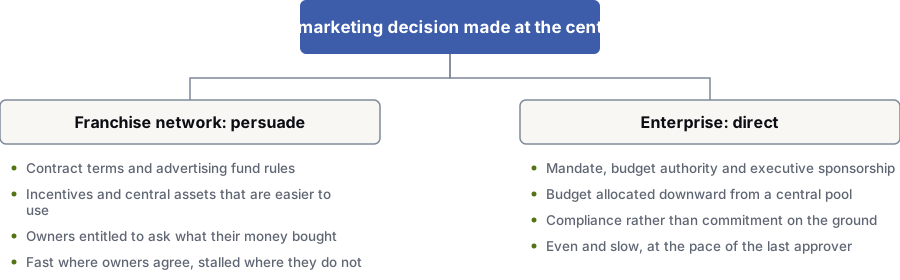
Franchise network: persuade
- Contract terms and advertising fund rules
- Incentives and central assets that are easier to use
- Owners entitled to ask what their money bought
- Fast where owners agree, stalled where they do not
Enterprise: direct
- Mandate, budget authority and executive sponsorship
- Budget allocated downward from a central pool
- Compliance rather than commitment on the ground
- Even and slow, at the pace of the last approver
Where they split
Where one enterprise strategy stops working
These differences are the reason the pages below are written separately rather than as one page with the business type swapped out.
- A franchisor persuades and an enterprise directs, and those need completely different levers. Persuasion runs on contract terms, incentives and making the central option obviously better than the local alternative. Direction runs on mandate, budget authority and executive sponsorship, and it produces compliance rather than commitment.
- The money flows in opposite directions. A franchise advertising fund is money collected from independent owners who are entitled to ask what it bought, which makes accountability a contractual matter. An enterprise budget is allocated downward from a central pool, and the argument is about internal allocation rather than justification to contributors.
- The legal exposure is not the same shape. A franchisor operates under disclosure legislation that constrains what may be said to prospective franchisees, and can be answerable for claims a franchisee makes locally. An enterprise is constrained by sector regulators, advertising standards, accessibility obligations in procurement, and in listed companies by what may be said about future performance.
- Speed limits differ in kind. A franchise system can move quickly wherever owners agree and stalls completely where they do not, so progress is uneven across the network. An enterprise moves at the pace of its slowest required approver even when everybody agrees, so progress is even and slow.
Questions
Enterprise marketing questions, answered
Why separate franchise marketing from enterprise marketing?
Because the lever is different. A franchisor cannot instruct a franchisee to do anything the franchise agreement does not already require, so every central initiative has to be sold to an audience of independent business owners who are entitled to decline.
An enterprise can instruct, and its problem is the opposite: a mandate produces minimum compliance from people with no stake in the outcome. One page is about persuasion and contract; the other is about sponsorship and sign-off. Merging them would make both vague.
How much local freedom should we allow?
Enough that a local team can answer a local question, and no more than that. The workable split is usually that the centre owns anything with legal or brand consequence and anything that benefits from being done once, while the unit owns anything that requires knowing the place.
What fails is drawing the line by default. Nobody decides, so either the centre controls everything and local pages say nothing useful, or nothing is controlled and the group ends up liable for claims it never saw.
Our approvals take six weeks. Does that rule out most tactics?
It rules out reactive ones, and it should change what you commit to. There is no point building a plan around responding to events within days if the review cycle physically cannot produce an approved asset in that window.
The productive response is to pre-clear. Agree claim boundaries, get a library of approved modules signed off once, and reserve the slow route for new territory. Most organisations can move considerably faster inside a boundary that has already been agreed than they can by asking for permission each time.
We have an agency of record. Where would you fit?
Frequently alongside rather than instead. Roster structures usually leave gaps: search and site work that sits between the brand agency and the internal development team, or a business unit too small to get attention from the incumbent.
We will say plainly when the straight answer is that you do not need another supplier. Adding a third party to an already crowded roster usually adds coordination cost rather than capability, and that is a bad trade for you and a short engagement for us.
Can one strategy cover every location or business unit?
One strategy, yes. One plan, no. The strategic decisions — who you are for, what the brand promises, what a lead means, what gets measured — have to hold everywhere or they are not strategy.
Below that, a flagship site in a competitive city and a rural outlet with one competitor need different work, and pretending otherwise wastes budget in one place and starves it in the other.
More to explore
Last updated · Published by Zubair Afzal (responsible editor), on owner authorisation