
SEO
Local SEO vs national SEO: how they differ and which one you need
Published by Zubair Afzal, responsible editor
First published Updated 6 min read
The usual problem
Are you competing for the wrong searches?
Many businesses are. The most common mistake is a year spent chasing results that were never going to bring in customers.
- Ranking nationally, invisible locally.
- Content ranks for broad topics across the country, yet the business doesn’t show in the map pack for its own service in its own city. The SEO worked; it was aimed where the buyers weren’t.
- Strong locally, no growth left.
- The profile is well run, reviews come in steadily and enquiries have levelled off: a maxed-out local market. Growth now has to come from new areas or a national layer.
- Two locations, half the visibility.
- A second branch opened and someone copied the first location page to make a second one. Now both rank worse than the original did alone, because near-identical pages split the signals and give Google no reason to prefer either.
What changes between local and national SEO?
The foundations are the same. Almost everything above them changes.
| Dimension | Local SEO | National SEO |
|---|---|---|
| Who you compete with | Businesses near the person searching. Often a small group you can name. | Every website on the topic, including publishers and marketplaces. |
| Results you compete for | The map pack, the local finder and organic results filtered by location. | Standard organic results, featured snippets and answers to topic questions. |
| Signals that make a difference | An accurate, complete profile, the right primary category, distance, steady reviews and a site relevant to the area. | Content depth and coverage, earned links, authority on the topic, technical health and site speed. |
| What the content looks like | Service pages tied to a place, with local detail that’s true: areas covered, the team there, local context. | Thorough coverage of a topic that stands up anywhere in the country. |
| Role of links | Useful but secondary. Local relevance and citations often matter more than link count. | Central. For competitive national terms, earning coverage is usually what holds you back. |
| Realistic time to see change | Weeks to a few months, especially when profile errors are the cause. | Several months at least, longer in crowded markets. |
| What you measure | Calls, direction requests, bookings and enquiries by area. | Qualified visits, assisted conversions, pipeline and how much of the topic you cover. |
| How it usually goes wrong | Duplicate or suspended profiles, the wrong primary category and copy-paste location pages. | Content aimed at search volume over buyers, with no authority behind it. |
How the searches differ
Examples of local and national searches
Example searches, with no claims about their volume. Results for the first group depend on where the searcher is; results for the second don’t.
Searches filtered by location
The results change with where the person is standing. Distance and profile quality matter most.
- emergency electrician near me
- accountant in [city]
- best dentist [suburb]
- physio open now
- [service] near me open sunday
Searches that look the same everywhere
Everyone sees roughly the same results. Depth, credibility and earned authority decide who ranks.
- how much does rewiring a house cost
- what is a management accountant
- invisalign vs braces
- best crm for small business
Searches that sit in both
Question-style wording with buying intent behind it. The answer needs national credibility and a local way to take the next step.
- boiler replacement cost uk
- conveyancing solicitor fees
- commercial cleaning contract rates
These are example searches from keyword research and public search data. Before we suggest anything, we check how often people search for them in your area.
Two layers, two jobs
National pages build trust, local pages get the call
Many businesses need both. Just don’t ask one layer to do the other’s job. You’ll end up with national pages nobody can act on and local pages nobody trusts.
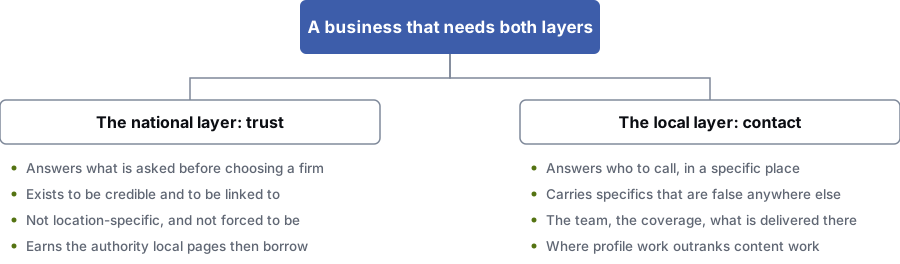
National pages: trust
- Answer questions asked before picking a firm
- Built to be credible and to earn links
- Not tied to one place, and shouldn’t be
- Earn authority that local pages benefit from
Local pages: contact
- Answer who to call in a specific place
- Carry details that are only true there
- The team, the area, the services offered there
- Profile work comes before content work
When you need both
How to run local and national SEO together
Give each layer its own job. That rule matters for multi-location retailers with an online shop, franchise networks, national installers who work locally, and firms with offices in several cities.
National pages answer the questions people ask before they know who to hire, and earn trust and links. Local pages carry details that only apply in one place: the team, the area covered, the services offered from that site.
Link the two layers both ways. National pages send readers to the right local page; local pages point to the national content for the detail behind their claims. Done well, national pages earn authority that helps local pages compete.
Don’t merge them into one set of pages that tries to be both the full guide and the local landing page. Those pages tend to rank for neither.
Decide quickly
Where should your business compete? Six quick checks
- Can you serve a customer three hundred miles away and still make money? If not, national head terms are the wrong target.
- Does the map pack show for your main service searches? If so, a large share of clicks go there, and profile work comes before content work.
- Do your best customers come from a set radius? Check your last fifty enquiries by postcode before you assume.
- Are national publishers ranking for your main terms? If so, plan for a long content campaign or accept that those terms belong to someone else.
- Do you have more than one location? If yes, plan the site structure before you write a single page.
- Would visitors from outside your area help you through links, credibility or recruitment? If yes, national content has value even when it never turns into a sale directly.
Questions
Local vs national SEO: common questions
What is the difference between local SEO and national SEO?
Local SEO competes for results that change with where the searcher is, including the map pack, where distance, an accurate business profile and reviews carry a lot of weight. National SEO competes for results that look the same everywhere, where content depth, site authority and technical quality matter most.
Both need the same basics: crawlable pages, a sensible structure and useful content.
Can a business do both at once?
Yes, and many should. National pages build the authority that makes you a believable choice; local pages turn people nearby into enquiries.
Keep the two separate on your site: national pages target the topic, local pages target the place and the service offered there. Blur them and your own pages compete with each other.
Is national SEO harder than local SEO?
Almost always, yes. Locally, your rivals may be a handful of nearby companies with modest websites. Nationally, you’re up against publishers, marketplaces and companies with a decade of authority.
That’s also why local SEO tends to show results sooner: fixing a category, merging a duplicate listing or completing a profile can change things within weeks.
Should I target national keywords if I only serve one city?
Usually not, if you want enquiries. Traffic you can’t serve costs the same to earn as traffic you can, so your reports look better while enquiries stay flat.
The one good reason to publish national content anyway: it builds credibility that supports your local pages and earns links a purely local site wouldn’t get. Treat it as support; your local pages stay the target.
How do I stop my location pages competing with each other?
Give each location page its own reason to exist: a different team, different services, different areas covered or different local details. If you could swap two pages by changing the city name, one of them should go.
Then link each location page to the services offered there, and each service page to the locations that offer it. Pages usually compete because of weak linking and near-identical content; writing more pages rarely helps.
References
Sources for local SEO vs national SEO
The official documents and research this page is based on. Platform rules change, so check the source before you act on a detail.
Related
Keep reading on local SEO vs national SEO
- the local SEO checklist, in orderWhat to do once you know local search is where you compete.
- multi-location SEO
- national organic search programmesThe wider SEO programme a national layer sits inside.
- diagnosing weak map pack rankings
- why some locations underperform others
- why a business disappears from Maps
- keeping every location’s listings consistent
- internal linking, defined
Start here
Want to know where your business should compete?
Your enquiry data and the results for your main searches usually answer this. Ask our specialists for a second opinion before you commit a year of budget.
Rather check it yourself? Try our free SEO tools