
Why one branch underperforms
Branch performance diagnosis: the branch, the brand or the market?
When one branch lags the rest, find out whether the branch, the brand or the market is the cause before you spend anything on fixing it.
Every location, one view
Example- 72Downtown branchOn track
- 48North branchProfile gaps
- 66Airport branchOn track
Numbers are Growth Scores out of 100
Where it breaks
Three problems that only happen when you have many branches
- Your location pages and profiles are fighting each other.
- Forty pages from one template with the town name swapped don’t rank forty times. They split the signals, and Google picks one more or less at random. Add duplicate or unclaimed profiles and out-of-date hours, and doubling your location pages can cut your total local visibility.
- Branches are running their own marketing.
- A branch that can’t get what it needs from head office will buy it locally: off-brand sites, ads bidding against the group, claims the brand may be legally responsible for. The instinct is to clamp down. What works is giving branches something better than they’d buy themselves.
- Your reports can’t tell you what’s wrong.
- A branch is down twelve per cent. Is that the branch, the local market or the brand? Without a group benchmark next to every branch figure, nobody can say, so the conversation turns to blaming whoever runs the branch.
Where to take it next
Find the cause here, get help or a guide there
This page helps you name why some branches lag. To have it handled, or for the method written out, go to one of these.
Have it run for you
Do it yourself
If the locations are franchised
Reading one branch figure
Three questions that show whether the branch, brand or market moved
Without a group figure next to each branch figure, people blame whoever runs the branch. Sometimes that’s right. Often it’s unfair. These three questions settle it before anyone gets blamed.
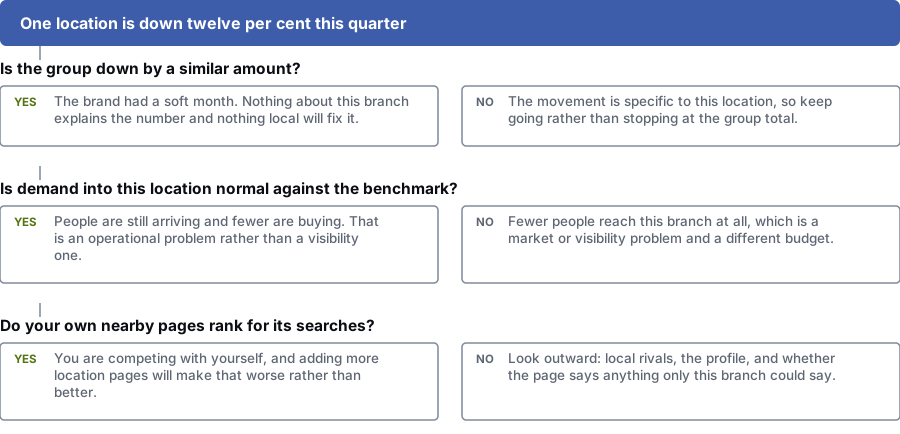
Is the whole group down by a similar amount?
Yes: The brand had a quiet month. Nothing about this branch explains it, and no local fix will help.
No: The drop is specific to this branch, so keep going. The group total won’t explain it.
Is demand for this branch normal against the group?
Yes: People still come in and fewer of them buy. That’s an operational problem, not a visibility one.
No: Fewer people reach this branch at all. That’s a market or visibility problem, with its own budget.
Do your own nearby pages rank for its searches?
Yes: You’re competing with yourself. Adding more location pages will make it worse.
No: Look outward: local rivals, the Google profile, and whether the page says anything only this branch could say.
The underlying tension
Head office wants consistency, branches want to be local
Head office is judged on brand value, legal risk and efficiency, which all reward doing things the same way everywhere. A branch manager is judged on the phone ringing, which rewards being clearly local. Both are right, so decide on purpose where the line sits.
Total central control gives you pages that tell local customers nothing and profiles that go stale because nobody nearby can update them. Total local freedom gives you mixed claims, competing ad accounts and a brand that means something different in every town.
Write down which things the group fixes and which each branch supplies, then make supplying the local part easy enough that people do it.
Drawing the line
What head office should own and what branches should supply
A starting point for the split. The last column shows what happens when the line is drawn the other way.
| Dimension | Owned by head office | Supplied by the branch | What goes wrong if reversed |
|---|---|---|---|
| Brand and claims | Name, logo, positioning, regulated and legal wording | Nothing | Claims the group is liable for, made by people who didn’t check them |
| Location page content | Structure, template, required fields, publishing | Team, services offered here, areas served, local detail | Either identical pages that compete, or pages nobody checked |
| Business profiles | Ownership, categories, naming, bulk fixes | Hours, posts, review replies, photos, temporary changes | Profiles lost when staff leave, or hours that are wrong for months |
| Paid media | Account structure, brand terms, ads, negative keywords | Local budget requests, promotions, seasonal timing | Branches bidding against each other and pushing up the brand’s own costs |
| Reviews | How to ask, policy, escalation, reporting | Asking the customer, and replying in a natural voice | Generic replies that look worse than no reply at all |
| Reporting | Definitions, benchmarks, the group view | What was happening on the ground behind the numbers | Every branch trusts its own numbers and disputes the group ones |
The four areas of work
What we work on when branches underperform
Plan the structure before the pages
Decide how many pages should exist based on separate service areas, not how many branches you run. Then decide what each page must say and which fields hold the local facts. This shapes everything after it and is very expensive to undo.
Run the profiles properly at scale
Bring ownership together, find and merge duplicates, fix categories and make naming consistent. Set up a way for branches to make local edits without head office signing off a change of hours. Then watch for edits from outsiders, because they will happen.
Brand rules branches will follow
Keep a short list of rules that matter most, separate from preferences, and pair it with content and support the branch wants. Following the rules becomes the way to get something useful.
Reports that isolate the problem
Show every branch figure next to the group benchmark, and track demand and conversion separately. That turns most performance meetings from an argument about blame into a question: which of two very different problems do we have?
The test for a location page
What a location page needs to be able to say
If a branch can’t give real answers to most of these, it doesn’t need its own page. It needs a well-run Google profile and a mention on a well-written area page.
- Who works here, by name, with the qualifications that matter to local customers
- Which services this branch offers, and which it doesn’t
- The areas served, described the way local people describe them
- Directions, parking and access details a first-time visitor needs
- Hours, including seasonal and holiday changes that differ from the group
- Local proof: work done nearby, partnerships, sponsorships or accreditations
- Reviews from this branch’s customers, not a group-wide average
- A way to contact this branch directly, not a central queue
- Anything different here, such as equipment, capacity, languages spoken or appointment types
Related services
Services for group and branch-level marketing
At group level
Questions
Common questions about underperforming branches
Do we need a page for every location?
Only where each page can say something true and specific: the team, the services offered there, the areas covered, parking, hours and local details. If a page would just repeat the same copy with a different town name, don’t publish it.
Think in service areas, not buildings. Two branches serving one city usually need one strong area page plus two well-run Google profiles, not two thin pages competing for the same searches.
How do we write two hundred location pages that are different?
You don’t write two hundred essays. You set up a page structure where the local details are separate fields (team, services offered, areas served, opening details, local partners, directions and parking) and each branch fills in real answers.
Each page is then built from local facts, not local adjectives, and fails in plain sight: a branch that supplies nothing ends up with an obviously empty page, not one that looks fine but is a copy.
Who should own the Google Business Profiles, head office or the location?
Head office should own them, with branch managers given access to post, reply to reviews and fix hours. Central ownership stops profiles being lost when a manager leaves and makes bulk fixes possible.
Local editing still matters. A profile only head office can touch goes stale, and wrong hours and unanswered questions cost more local business than most brand slip-ups.
How do we get branch managers to follow the brand rules?
Make following the rules the price of something they want: ready-made local content, a managed Google profile, a share of central ad budget and useful reports. Rules handed down with nothing attached get ignored, and enforcing them damages the relationship.
Separate the rules that matter (name, logo, claims, and legal or regulated wording) from preferences. A twelve-page brand manual gets read once; a one-page list of must-follow rules gets followed. If your locations are franchised, the franchise page covers the extra issues that brings.
How should multi-location performance be reported?
Show every branch figure next to a group figure. Otherwise you can’t tell whether a branch is struggling or the whole brand had a quiet month.
Track demand and conversion separately for each branch too. Low demand means a market or visibility problem; normal demand with poor conversion means an operational one. They need completely different fixes.
Where to get help
Services that solve this
Multi-Location & Franchise SEO
Multi-location SEO services for chains and franchises. Head office sets the structure, each branch supplies local facts, and every location page and profile gets found.Local SEO
Our local SEO services get you onto Google Maps and into "near me" searches. We fix your Business Profile, area pages and reviews, for one location or forty.Enterprise SEO
Enterprise SEO for large sites. We turn findings into sprint-sized tickets and get them through release, brand and legal review.Marketing Analytics & Attribution
Marketing analytics and attribution you can trust, with a written account of where the data is blind and tests for what attribution can’t answer.
Find out why your weakest branch is behind
Send us your branch list and current site structure. We’ll show you where pages compete, which profiles are at risk, and how the site should be set up before you open another branch.
Prefer to talk it over? Book a free call
Your BOOSTD score improves within 90 days, or your next month is free. After 6 months, more traffic or leads, or we keep working free (up to 6 free months in any 12 months). Read our guarantee
References
Sources for branch performance diagnosis
The official documents and research this page is based on. Platform rules change, so check the source before you act on a detail.
Last updated · Published by Zubair Afzal, responsible editor