
Home Services & Trades
Marketing for trades and home service businesses
HVAC, roofing, plumbing, restoration and the trades around them. High-intent local search, phones that have to ring, and a service area that decides most of what is winnable.
Prefer to talk it through? Book a strategy call
The category
Home Services & Trades: what the businesses have in common
Home services is the category where local search matters most and is most often done badly. The demand is real, it is nearby, and a large part of it is decided in the first few minutes after something goes wrong.
What makes it difficult is that the label covers businesses with almost nothing in common commercially. The pages below are written per trade for that reason — the economics, the urgency and the search behaviour are different in each.
Minutes or weeks
The trade you are in is really a position on a clock
A burst pipe is a five minute decision. A roof is three quotes across several weeks. Both are home services, and almost nothing about the marketing carries from one to the other.
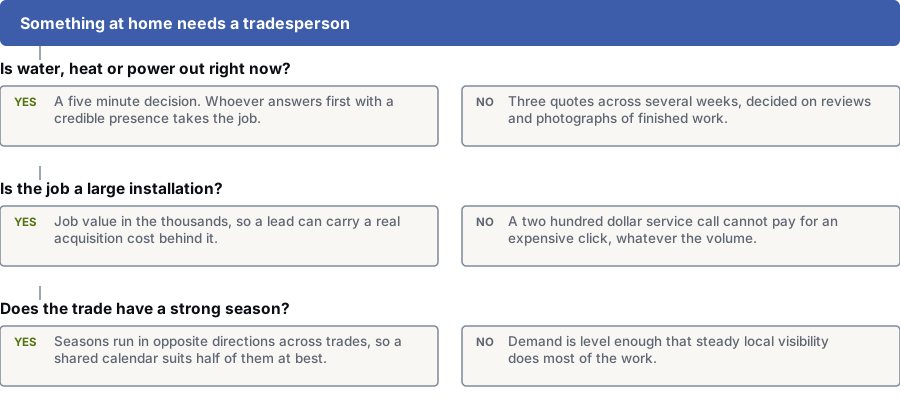
Is water, heat or power out right now?
Yes: A five minute decision. Whoever answers first with a credible presence takes the job.
No: Three quotes across several weeks, decided on reviews and photographs of finished work.
Is the job a large installation?
Yes: Job value in the thousands, so a lead can carry a real acquisition cost behind it.
No: A two hundred dollar service call cannot pay for an expensive click, whatever the volume.
Does the trade have a strong season?
Yes: Seasons run in opposite directions across trades, so a shared calendar suits half of them at best.
No: Demand is level enough that steady local visibility does most of the work.
Where they split
Where one home services strategy stops working
These differences are the reason the pages below are written separately rather than as one page with the business type swapped out.
- Urgency varies enormously. A burst pipe is a five-minute decision; a roof replacement is a three-quote process over several weeks, and the marketing for each is almost unrelated.
- Job value ranges from a two-hundred-dollar service call to a thirty-thousand-dollar installation, which changes what a lead is worth and therefore what you can afford to pay for it.
- Seasonality runs in opposite directions across trades, so a shared content calendar across a multi-trade group is usually wrong for at least half of it.
Questions
Home services marketing questions, answered
Do you work with single-location trades businesses or only large operations?
Both, but the work looks different. A single-location business with three vans has a winnable radius and a small number of services that pay; the job is to own those completely before expanding.
A multi-branch operation has a structural problem instead — locations competing with each other in search, inconsistent profiles, and a site that cannot express service areas properly. That is a different engagement.
We buy leads from an aggregator. Should we stop?
Not immediately. Those leads are usually paying for something, even if the margin is poor, and cutting them before you have replaced the volume is how a business ends a quarter short.
The goal is to make them optional. Once your own search visibility is producing steady booked work, the aggregator becomes overflow capacity rather than a dependency — and you can start declining the worst-quality sources.
More to explore
Last updated · Published by Zubair Afzal (responsible editor), on owner authorisation