
Air Conditioning marketing
Air conditioning marketing agency that sells spring installs
Air conditioning marketing that sells planned installs in spring, instead of paying July prices for heat-wave calls you have no crews left to take.

Your website
What visitors need to see
- Sizing and load explained, so homeowners see why bigger isn’t better
- Efficiency levels compared clearly, with what the difference means day to day
- Current rebate details, with each programme named and sourced
- A heat pump page that answers the cold-weather question fairly
- Financing shown before the quote form, with an estimated monthly figure
- Warranty terms split into manufacturer cover and your own labour cover
- Home assessment booking that says what happens and how long it takes
- Photos of your own finished installs, indoors and outdoors
- Realistic availability during peak weeks, stated clearly
Common problems
Paying for air conditioning marketing that doesn't work?
Air conditioning is two businesses sharing a van. One is a hot, chaotic repair season, capped by your technicians. The other is a planned replacement sold at a kitchen table in April, and it is worth many times more.
Most cooling marketing only targets the repair side. Those customers would have found you anyway.
- Your site is built for repair calls but has to sell installs.
- A phone number and a list of services is enough for someone whose AC just stopped, not for a homeowner spending five figures on a replacement. That buyer wants sizing explained, efficiency levels compared, rebates covered, financing shown early and the install described. Most cooling sites lose them without noticing.
- Your budget peaks just as your capacity runs out.
- In a heat wave your schedule is full, clicks cost the most all year and every extra booking is a promise you’ll struggle to keep. Keep spend steady, change the message and move the extra money into the quieter weeks either side. You’ll usually get more revenue and fewer bad reviews.
- You mention rebates but never explain them.
- Utility and government incentives now shape the buying decision, and they change often. One line saying “rebates available” is worth almost nothing. A page listing which programmes apply locally, what equipment qualifies, who applies and roughly how long it takes brings in people who’ve been trying to work this out for weeks.
- Heat pump enquiries get handled like ordinary cooling quotes.
- Heat pump buyers ask different questions. Will it heat the house in February? What happens to the furnace? What will it do to the power bill? Does the incentive make the sums work? A cooling quote and a brochure lose a customer ready to spend more than your average.
How they choose
What customers check before they choose
Know how they choose and you know where to show up.
- Replacement buyers get two or three quotes and compare equipment, warranty length and install details as well as the total. They can tell when a quote was written just to be cheapest.
- They check efficiency ratings and rebate eligibility themselves before quotes arrive. The contractor who explains these accurately starts ahead.
- Sizing matters to them more than contractors expect. Someone who’s read that an oversized system cycles too often will ask how you worked out the load.
- For a repair, availability decides it. A clear, accurate answer about when you can come beats a hopeful one that turns into a cancellation two days later.
- Financing changes the shortlist. An unplanned replacement in August is a cash-flow problem first, so the company showing an estimated monthly payment early stays in the running.
Two curves, one trade
Heat-wave repairs versus spring and autumn replacements
One curve is spiky, hard to predict and capped by your crews. The other is calm, easy to plan and worth far more per job. It happens when nobody’s thinking about cooling.
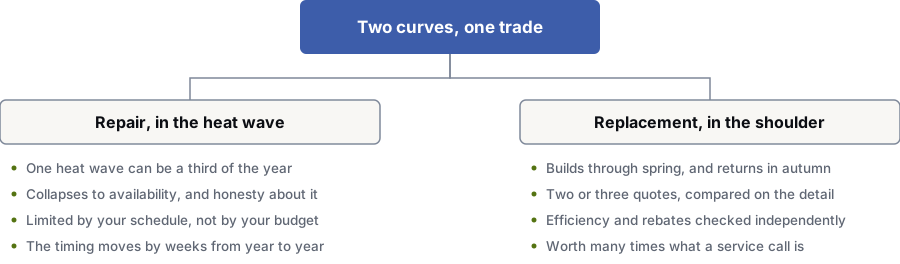
Repairs, in the heat wave
- One heat wave can be a third of the year
- Won on availability, stated accurately
- Limited by your schedule, not your budget
- Timing moves by weeks from year to year
Replacements, in spring and autumn
- Builds through spring, and returns in autumn
- Two or three quotes, compared on the detail
- Buyers check efficiency and rebates themselves
- Worth many times a service call
What people search
What people type, like “how much does a new air conditioner cost”
Planning a replacement
Spring and autumn searches from careful buyers, worth many times a service call.
- how much does a new air conditioner cost
- how long do air conditioners last
- ac replacement cost with installation
- best time of year to replace air conditioner
- central air vs ductless mini split
Efficiency, rebates and heat pumps
The comparison stage, where buyers decide who knows their stuff.
- heat pump rebate
- seer rating explained
- is a heat pump worth it in cold climates
- ductless heat pump installation cost
- energy efficient ac tax credit
Heat-wave repair searches
Spiky and pricey, and limited by your schedule more than your budget.
- ac not cooling the house
- air conditioner blowing warm air
- ac repair same day near me
- air conditioner leaking water inside
- how to keep a house cool without ac
Sizing and installation questions
Technical questions from buyers close to deciding.
- what size air conditioner do i need
- how long does ac installation take
- do i need new ductwork with a new ac
- is a permit required for ac installation
These are example searches from keyword research and public search data. Before we suggest anything, we check how often people search for them in your area.
Where to spend
Why the website comes before organic search
In the order we'd put them. Start at the top.
A website built for replacement buyers
Your website has to support a big, careful purchase: sizing explained, efficiency levels compared, rebates and warranties covered, financing shown early and photos of your own installs. For firms with enough repair calls, this is usually what holds them back.
Spring and autumn content that fills the calendar
People research replacements in the months either side of summer, and content that answers them brings enquiries while clicks are cheapest. Rebate, efficiency and heat pump pages are the biggest opening, because most competitors won’t keep up with the changes.
Turn research into booked home assessments
Replacement buyers don’t want to phone anyone. Offer a home assessment with a clear description, a real time slot and no obligation; it beats a generic quote form and is usually the quickest win on a cooling site.
Report repairs and installs separately
Average repair calls and install quotes together and the number describes neither. Split them by campaign, page, conversion and value, so the case for spring and autumn budget rests on numbers.
Measuring results
Results you can check
These numbers show if your marketing brings in customers. Website visits alone don't.
- Install quotes sent, tracked separately from service calls
- Quote-to-close rate on replacements, and average time to decide
- Average job value by type, and how the mix shifts month to month
- Cost per booked assessment in spring and autumn versus peak summer
- How full the install calendar is four and eight weeks ahead
- Share of enquiries that mention rebates or heat pumps
- Peak-week cancellations and no-shows, read as a capacity warning
The rules
Stay inside the ad rules
Utilities and governments set rebate, tax credit and incentive programmes, which change on their own schedule and sometimes close without notice. Explain how a programme works and link to the official source, but don’t say a customer will receive a set amount or be approved. Check current terms before publishing.
Efficiency and energy-saving claims are advertising claims. Showing the equipment’s rating is fine; turning it into a promised bill cut isn’t, because results depend on the building, household and tariff. Credit any figure to the manufacturer or official rating.
Refrigerant handling is regulated separately in most places, and older refrigerants are being phased down. Describe the certifications you hold, don’t suggest equipment or refrigerants will stay available past their scheduled phase-out, and check requirements with your environmental regulator.
Sources
See each rule in full
Each rule above, linked to the body that publishes it. Which ones apply depends on where you work. Rules change, so check the latest version.
- Requires EPA certification for technicians servicing stationary equipment that could release refrigerant.
- Clean Air Act § 608
- Source: US EPA, Section 608 refrigerant management (US)
- EPA’s programme under the AIM Act to phase down HFC refrigerants, including sector-based restrictions.
- AIM Act HFC phasedown
- Source: US EPA, Protecting our climate by reducing use of HFCs (US)
- Sets the EnergyGuide labelling rules for central air conditioners, heat pumps and furnaces.
- FTC 16 CFR 305.20
- Source: FTC Energy Labeling Rule, 16 CFR 305.20 (US)
Questions
What to ask before you pay for air conditioning marketing
Should we cut our advertising during a heat wave?
Don’t cut it completely, but stop increasing it. At the peak your schedule is full, clicks cost the most and each extra booking may be a customer waiting a week.
Keep spend roughly steady, switch the message to clear availability and replacement quotes, and move the money you’d have added into the four to six weeks before summer.
How do we fill the spring with installations?
Market to people who already know they have a problem: anyone whose system struggled last summer, who paid for a big repair in August or whose system is over fifteen years old. Most are already in your records.
Your research content also has to be live before they look. Cost, sizing, efficiency and rebate pages published in February catch March searches at a fraction of a July click.
Are heat pump enquiries worth chasing?
Yes. In most markets they’re a cooling contractor’s most valuable enquiries: the job usually replaces heating and cooling, and incentives often nudge buyers towards better equipment.
They ask more of you: cold-weather performance, running costs and the existing furnace. Answer clearly and you win work from competitors who treat it as a normal quote.
How should we handle rebates on the website?
Explain how it works and name the programme, but never state an amount as if promised. Which programmes apply, what qualifies, who does the paperwork and how long it takes are all safe to publish.
Keep the page current, dated and linked to the official source. Rebate pages go stale fastest, and an old figure hurts trust more than none.
We already get plenty of repair calls. What would change?
The mix of jobs would change more than the volume. Repair calls are frequent, low-value and packed into your busiest weeks; installs are rarer, worth far more and sold when crews have time.
That means separate pages, campaigns, goals and reports. You don’t need to take anything away from the repair side.
Want more customers from Google?
Start with the free checkup. It shows what to fix first on your website, with no sign-up. Want the full plan for your air conditioning business? Book a call, and we'll look at your market, your competitors and the searches that bring in customers.
Prefer to talk it over? Book a free call
Your BOOSTD score improves within 90 days, or your next month is free. After 6 months, more traffic or leads, or we keep working free (up to 6 free months in any 12 months). Read our guarantee
References
Sources for air conditioning marketing agency
The official documents and research this page is based on. Platform rules change, so check the source before you act on a detail.
Related
More on air conditioning marketing
- HVAC company website designsEmergency no-cool calls, maintenance plans and financing wording.
- marketing for heating and cooling companies
- cutting your cost per lead
Guides for air conditioning
Other home services businesses
Last updated · Published by Zubair Afzal, responsible editor