
Furnace Repair marketing
Furnace repair marketing that catches the late-night no-heat calls
Furnace repair marketing that catches the late-night no-heat calls: answer fast, get there fast and handle repair or replace fairly.

Timing
How long they take to decide
Demand follows the temperature about a day later. The first hard freeze brings a big spike, because systems idle since March fail under their first heavy load.
Within a cold snap the pattern is predictable: most calls in evenings and early mornings, weekends worse than weekdays, and on days three and four the systems that limped along finally stop.
Between cold snaps it’s quiet enough for tune-ups and replacement quotes, so marketing has to switch between catching calls and building a pipeline within weeks.
From breakdown to booking
Nobody fills in a form when the heat has gone
They phone, and stop the moment someone answers. So the third result is as good as the first, as long as someone picks up.
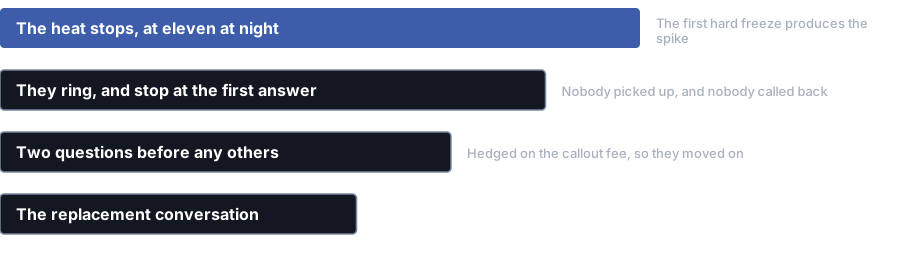
- 1The heat stops at 11pm — Calls follow the temperature about a day later. In a cold snap, evenings and early mornings bring most.The first hard freeze brings the spike
- 2They phone until someone answers — Nobody fills in a form. The third result is as good as the first if you pick up.Nobody picked up, and nobody called back
- 3Two questions first — How soon can you get here, and what does the visit cost? Answer both clearly and you book the job.Vague about the callout fee, so they moved on
- 4The replacement conversation — If the repair is pricey for the system’s age, a second company gets invited in, and certification matters.
How they choose
How the shortlist gets made
Know how they choose and you know where to show up.
- They phone and fill in nothing, and stop calling the moment someone answers. The third result is as good as the first if the first two don’t pick up.
- They ask two questions first: how soon can you get here, and what does the visit cost? Answer both clearly and you book the job.
- Recent reviews count for a lot in winter. A homeowner can tell a review from last February from one written three years ago.
- For a repair, people assume you hold a licence and gas certification and rarely check. Once a replacement quote comes up, those details decide the job.
- If the repair is expensive for the system’s age, it becomes a replacement decision. A second company usually gets invited in.
Common problems
The furnace repair marketing traps to avoid
Furnace repair customers choose while they’re cold. The house is cooling, it’s dark and they’ll read about three business names.
The weather creates the demand for you. What matters is whether you answer, send someone out and turn the call into a job.
- The late-night call rings out.
- A no-heat call at 11pm is worth more than the same call at 11am: the caller has fewer options and less patience, and it’s the call most likely to hit voicemail. Fix it with a rota, shared on-call cover or a well-briefed answering service, or money spent showing up overnight buys calls for a competitor.
- Nobody knows how many calls get answered.
- Most heating companies know their call volume. Almost none know what share got answered, how many rang out in the last cold snap or how many callers tried again. It’s the cheapest number to start tracking, and often shows your biggest single loss.
- A cold snap turns into a queue, then into bad reviews.
- When the temperature drops, calls arrive faster than you can add technicians. Pushing ads that week means jobs you can’t reach for three days, cancellations and angry reviews. Give realistic time windows, triage sensibly and say what counts as an emergency.
- The replacement conversation gets made up on the basement floor.
- A technician by a failing furnace has to explain a repair cost, the system’s remaining life and a replacement option to someone who wasn’t planning to spend anything. Without written options, financing details and what the repair buys, they say they’ll think about it, then buy from whoever advertises next week.
What people search
Searches such as “furnace stopped working no heat”, grouped by intent
Late-night and no-heat searches
Most urgent, least patient, and worth answering at any hour.
- furnace stopped working no heat
- emergency furnace repair tonight
- 24 hour heating repair near me
- house freezing furnace not working
- furnace wont turn on
- heating repair open sunday
Fault and error searches
People trying to fix it themselves, minutes before they give up and call.
- furnace flashing red light meaning
- pilot light keeps going out
- furnace making a banging noise
- furnace running but house not warming up
- where is the furnace reset button
Cost and fee questions
Usually asked before the call. A clear answer wins it.
- furnace repair cost
- how much does a heating service call cost
- is it worth repairing a 20 year old furnace
- emergency hvac call out fee
Safety questions
Answer these carefully and calmly. The danger is serious.
- carbon monoxide detector going off
- furnace smells like gas
- cracked heat exchanger symptoms
- is it safe to keep running my furnace
These are example searches from keyword research and public search data. Before we suggest anything, we check how often people search for them in your area.
Where to spend
Local SEO first, then follow-up and tracking
In the order we'd put them. Start at the top.
Be the listing that shows “open now”
A no-heat caller picks whoever looks available. Correct hours, holidays included, a clear emergency service description, recent reviews and the right category get you onto that short list, at no ad cost.
Answer calls, send techs, follow up
The biggest wins in this trade happen at the phone. Track answered and missed calls by hour, check what happens to late-night callers, and build the follow-up that turns a repair visit into a quoted replacement.
A page that works in a cold, dark house
Give people a number to tap, say clearly what’s available tonight and show the diagnostic charge. Fault pages must load instantly on one bar of signal; every extra step loses a job that already chose you.
Reviews collected after the worst nights
Winter reviews matter most, and a technician who just restored heat at midnight is best placed to ask for one. Collect them during the season so your profile looks current.
Your website
What a good site does
- A tap-to-call number that works with cold hands and a weak phone connection
- What’s available tonight, given as a time window, not a slogan
- The diagnostic or callout charge, and whether it comes off the repair
- Gas certification and licence details, named, current and traceable
- Fault pages for the specific breakdowns people search for at night
- Carbon monoxide and gas smell advice that tells people to leave and call the utility
- A repair-or-replace guide with clear age and cost thresholds
- Financing linked from the repair pages as well as the installation pages
Measuring results
Track the leads that pay
These numbers show if your marketing brings in customers. Website visits alone don't.
- Share of calls answered, broken down by hour
- After-hours calls caught, tracked through the winter
- Booked jobs per available technician hour during a cold snap
- Average time from call to arrival, and how it changes when busy
- Repair visits that led to a written replacement quote
- Quote-to-close rate on replacements that started as a repair call
- Cost per booked job, kept separate from cost per call
The rules
Claims to avoid
In most places, gas appliance work is certified separately from general heating work, often held by named people, not the company. Describe the certifications held under the correct programme name and don’t imply work you aren’t registered for. Requirements differ by province, state and country; check your standing with the certifying body.
Carbon monoxide and gas safety content is risky if written casually. Tell readers to leave the building first and contact the gas utility or emergency services, link to recognised safety guidance without loosely rewording it, and avoid anything that reads like a diagnosis to try alone.
Emergency and after-hours claims have to be literally true. A 24-hour service that goes to an unmonitored voicemail at 2am is a consumer protection problem as well as a business one. Describe what’s available and when.
Sources
Go to the source
Each rule above, linked to the body that publishes it. Which ones apply depends on where you work. Rules change, so check the latest version.
- Restricts gas work to competent people and, for businesses, to members of an HSE-approved class (Gas Safe).
- Gas Safety Regs, reg. 3
- Source: Gas Safety (Installation and Use) Regulations 1998, reg. 3 (UK)
- Treats giving false or misleading information about a product or trader as a misleading action.
- DMCC Act 2024, s. 226
- Source: Digital Markets, Competition and Consumers Act 2024, s. 226 (UK)
Questions
Short answers on furnace repair marketing
We already have more winter calls than we can handle. Why market?
Because enough calls and the right calls are different problems. A business swamped with small diagnostic calls in January and quiet in April needs a better spread of work, and a replacement pipeline built from visits it already makes.
It helps to know which calls you’re missing. Busy companies often miss lots of late-night calls without knowing, and those callers care least about price.
Is an after-hours answering service worth paying for?
Usually, if it’s briefed to book or triage calls, not just take messages. Compare the monthly cost with the value of late-night calls now going to voicemail.
A badly briefed service is worse than none: if they can’t say when someone could come or what it costs, the caller rings the next company.
Should we advertise harder during a cold snap?
Rarely by just raising the budget. In a big cold snap you run out of technician hours first, and buying calls you can’t attend turns ad money into cancellations and poor reviews.
Change the message: realistic time windows, what counts as an emergency and next-available booking for calls that can wait. The week after the snap is often a better time to spend, when competitors have stopped and homeowners are thinking about replacement.
How do we win more replacements from repair calls?
Make it a process. On every visit, record the system age, fault history and repair cost next to the replacement option, and leave the customer something in writing.
Then follow up. Someone who says no in January is often ready by September, so a scheduled follow-up on flagged systems is your cheapest installation pipeline.
Should we publish our diagnostic fee?
Yes, and say whether it comes off the repair. It’s one of the two questions every caller asks, and answering it on the page removes a reason to keep looking.
It also prevents doorstep arguments. Fee disputes nearly always come from a customer who was never told, and become the reviews that cost you jobs all season.
Get your free checkup
Start with the free checkup. It shows what to fix first on your website, with no sign-up. Want the full plan for your furnace repair business? Book a call, and we'll look at your market, your competitors and the searches that bring in customers.
Prefer to talk it over? Book a free call
Your BOOSTD score improves within 90 days, or your next month is free. After 6 months, more traffic or leads, or we keep working free (up to 6 free months in any 12 months). Read our guarantee
References
Sources for furnace repair marketing
The official documents and research this page is based on. Platform rules change, so check the source before you act on a detail.
Related
More on furnace repair marketing
Guides for furnace repair
Other home services businesses
Last updated · Published by Zubair Afzal, responsible editor