
Paid search
Google Ads vs Meta Ads: which one suits your business?
Published by Zubair Afzal, responsible editor
First published Updated 9 min readWe check this page every three months. Next check: .
The main difference
Google Ads reaches people who have searched for what they want, and you pay to be the answer. Meta Ads reaches people who might be interested, and you pay to interrupt them. Almost every other difference follows from that.
Search advertising captures demand. The need already exists and someone has typed it in words; the auction sets the price of that intent, which is why search clicks cost what they do.
Paid social creates demand. Nobody was looking, so your ad has about two seconds to show that a problem exists, that a fix exists, and that yours is worth stopping for.
The deciding question
Do people already search for what you sell?
Settle this first. Some categories clearly have search volume: emergency plumbing, replacement parts, accountants in a named city, a specific product model. Others get almost no searches, because the customer doesn’t know the category exists, what to call it, or to look for it.
If the searches exist, Google Ads is usually the first place to spend, because you reach people at the moment they have decided to act. If they don’t, Google will still sell you clicks from broader, vaguer searches and partner sites, as poorly matched as the searches behind them. This is the most common way a search budget disappears.
If the searches don’t exist, Meta Ads is the more sensible starting point, because it is built to reach people who weren’t looking. Everything then depends on your offer and your ads, which media buying can’t fix.
In the middle case, people search for your category but not for what makes you different. Those businesses often need both channels in time: Google Ads catches the general searches, and Meta explains why people should pick you over the other seven results.
Google Ads vs Meta Ads compared side by side
No scores or averages. Each row is a trade-off where one channel gives up something the other keeps.
| Dimension | Google Ads | Meta Ads |
|---|---|---|
| Who starts the interaction | The customer. They typed something, and you compete to be the answer. | You do. Nobody asked. Your ad has to make people stop before it can sell anything. |
| What you are buying | People who already want something, priced in an auction against everyone else who wants them. | Attention in a feed, priced by how well your ad holds it against everything else in that feed. |
| What decides results | Choosing the right searches and excluding the wrong ones, careful match types, a relevant landing page, and conversion data worth bidding on. | Your ad ideas and your offer, tested in volume. Targeting is now mostly automated, so it makes little difference. |
| Ongoing production | Low. A few ad variations per group, refreshed now and then. Most of the effort goes into the account settings. | High, and it never stops. Ads wear out as the same people see them, so making new ones is a running cost. |
| How reliable the tracking is | Fairly good. The search is recorded, the click can be traced, and the search terms report shows what you paid for. | Fairly poor. Browser and app privacy changes cut the data, and some reported conversions are estimated. |
| Minimum budget | Set by click prices in your category. In expensive markets a small budget buys too few clicks to learn anything. | Set by how much you need to test different ads. A budget that only covers one idea can’t find the one that works. |
| How it fails | Expensively, and without much warning. A handful of irrelevant clicks at a high price, often from broad match and partner sites. | Cheaply and visibly. Lots of cheap responses that look good in the dashboard and never turn into a sale. |
| Typical time to know if it works | Weeks, if your category gets enough searches. You can read the search terms and enquiries as they arrive. | Longer. You are judging a steady flow of new ads, and one ad proves nothing. |
| Where it is the wrong choice | Categories with little search demand, and businesses whose difference can’t be put into a search. | Big, rare, carefully considered purchases with a long buying cycle, and businesses that can’t keep producing new ads. |
Before you compare results
Why reports favour Google Ads over Meta Ads
Reports favour Google Ads because its results are easier to credit. A search is typed in words and shows up clearly in a report. Paid social wins attention that often shows up later, under another name. Most reports count the first and miss the second.
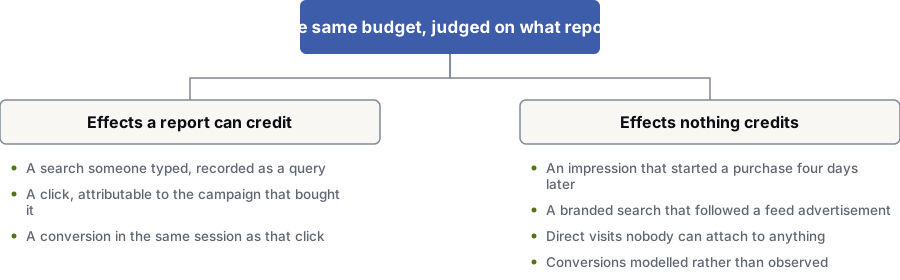
Results a report can credit
- A search someone typed, recorded as a query
- A click, traced to the campaign that paid for it
- A conversion in the same visit as that click
Results nothing credits
- An ad view that led to a purchase four days later
- A brand search that followed an ad in the feed
- Direct visits nobody can link to anything
- Conversions the platform estimated
By type of business
Which to use for four common types of business
Patterns, with exceptions, but they get you to a shortlist faster than comparing features.
An urgent problem with a known fix
A boiler has failed, a tooth hurts, a lock is broken. The customer knows what they need and is searching for it now, so Google Ads wins clearly. Paid social spends money on people whose boiler works fine.
A product people want once they see it
Visual, a treat or a nice-to-have, often bought on impulse. Nobody searches for it because they don’t know it exists. Meta Ads earns its place here: the feed can show the product in a way a text ad can’t.
A considered business purchase
A long buying cycle, several decision-makers, and few active buyers at any one time. Google Ads catches the few who are looking now; social and other paid channels do the slower job of making you known before anyone searches.
A local service people choose with care
A dentist, a law firm, a gym. People do search, but maps and reviews dominate the results, so paid search competes with local organic results as much as with other advertisers. Social makes you familiar before someone starts comparing options.
Decide for yourself
Eight questions to help you choose between Google Ads and Meta Ads
These usually point you to one channel before any agency quotes you a fee.
- Can you write down five things a customer would type that describe what you sell?
- Would someone buy this the first time they saw it, or does it need thought?
- Can your business produce several different ads every month, with no end date?
- Do you know what a new customer is worth to you, as well as what a lead costs?
- Can you record which enquiries turned into revenue, and trace each one back to its source?
- Is the purchase visual, or does it need to be explained in words?
- Is there urgency in the buying process, or do you have to create the reason to buy now?
- If the answer is "both", is your budget big enough to run each channel above its learning threshold?
Running both
How to add a second channel without hurting the first
Two-channel budgets most often disappoint when both start together and nobody can tell which did what.
Set up tracking before you spend
Decide in writing which system counts a conversion, and make sure it records where each one came from. Otherwise you spend six months refereeing two platforms that both claim the same sale.
You get: One agreed source of truth, and tracking that follows the customer from ad to sale
Get the first channel to a known cost per customer
The cost of each paying customer, checked against revenue, not a cost per click or a platform-reported conversion. Until one channel has produced that number, a second only makes the maths harder to untangle.
You get: A cost per customer for one channel that you can back up
Add the second channel with new money
Don’t halve the first channel’s budget to pay for the second. Splitting a working budget usually drops both below the level their automated bidding needs, and you conclude that neither works. If new money isn’t available, wait.
You get: An added budget with its own measure of success
Give each channel its own job and judge it on that
Google Ads captures existing demand, so judge it on cost per customer. Social creates demand, so judge it over a longer period, accepting that some of its effect shows up as brand searches and direct visits.
You get: A written goal for each channel, agreed before spending starts
Test how the two channels affect each other
Once both are stable, switch one off for a set period and watch the other channel and total revenue. It is the only practical way to see how they interact, and the result often changes how you split the budget.
You get: A recorded pause period, and what changed during it
Questions
Common questions about Google Ads vs Meta Ads
Which one should we start with?
Start with Google Ads if people already search for what you sell, using words you can list easily. Start with Meta Ads if people would want your product once they see it but would never think to search for it, including visual, impulse purchases.
To test it, check the search terms report of any account you already have, or run a small search campaign for a month purely as research.
Facebook ads didn’t work for us last time. Why try again?
Because "didn’t work" usually means one of three problems: the offer wasn’t strong enough to stop someone scrolling, there were too few creative ideas to find one that worked, or your tracking never credited the channel for what it did.
None of these proves the platform is wrong for you. Check all three before you write off the channel, especially the tracking.
Is Google Ads more expensive?
Per click, almost always. Per customer, often not, because the person clicking has already told you what they want. A cheap click from someone with no interest is a worse deal than it looks in a report.
Compare cost per customer, using tracking that follows the customer from ad to sale. Two platform dashboards that both claim the same sale won’t give you that.
Can we run both on a small budget?
Usually not well. Each platform’s automated bidding needs a certain number of conversions to learn from, and splitting a small budget often leaves both below that level.
Get one channel working to a known cost per customer, then add the second with extra money rather than halving the first. If your budget can’t support one channel properly, two won’t help.
Why do Meta and our own analytics disagree so badly?
They count conversions in different ways. Meta credits itself with any conversion it can link to an ad view or click within its own time window, including estimated ones. Your analytics credits the last thing that sent the visit, often a search for your brand name.
Neither is the whole truth. Pick one internal source for decisions, treat the platform numbers as a rough guide, and check both against the revenue in your own records.
How much creative does Meta need?
More than most businesses expect, and on a steady basis. Meta’s automation now handles most of the targeting, leaving your images, videos and copy to drive results, and ads wear out as the same people see them again and again.
If your business can’t keep up a steady flow of new ideas, put the budget where the ad itself carries less weight.
References
Sources for Google ads vs meta ads
The official documents and research this page is based on. Platform rules change, so check the source before you act on a detail.
- Google Ads Help: about the search terms report
- Google Ads Help: about keyword matching options
- Google Ads Help: search partners definition
- Google Ads Help: about conversion measurement
- Meta Business Help Center: about attribution models and attribution settings
- Apple: user privacy and data use (App Tracking Transparency)
Related
Keep reading on Google ads vs meta ads
- why Google Ads stop convertingThe problem this choice runs into most often.
- SEO vs PPC for the same budgetIf the question is whether to advertise at all.
- landing page designThe page the click lands on is the most common reason either channel falls short.
- when your cost per lead is too high
- setting up conversion tracking first
Start here
Not sure which one suits your business?
Tell us what you sell and what a customer is worth, and we will recommend the channel to start with. Sometimes neither is the priority yet.
Rather check it yourself? Try our free SEO tools
Your BOOSTD score improves within 90 days, or your next month is free. After 6 months, more traffic or leads, or we keep working free (up to 6 free months in any 12 months). Read our guarantee