
SEO
SEO vs PPC: how to choose between organic and paid search
Published by Zubair Afzal, responsible editor
First published Updated 8 min read
SEO or PPC: which gives a better return?
It depends on how long you can wait. PPC buys customers now, at whatever price the auction sets, and leaves nothing behind when you stop. SEO builds pages that bring customers in over time, with a return you can’t forecast exactly.
Three things decide which fits. Your gross margin sets how much click cost you can absorb. Your sales cycle sets how fast you’ll learn whether anything worked. And how long you’ll own the business matters, because rankings often pay back in year two.
At a glance
Where ads and organic results show up
One search shows both on the same screen. You get into each one in a completely different way.
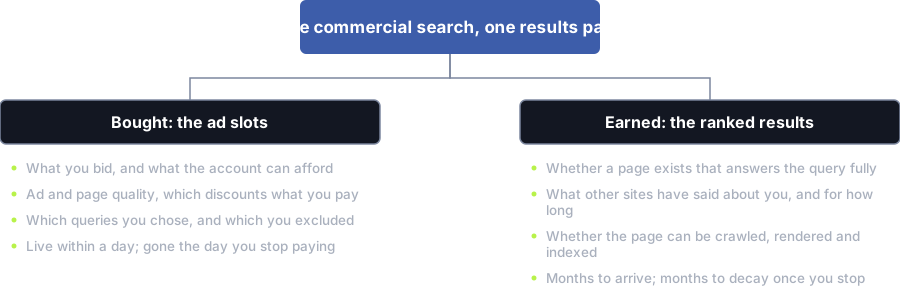
Paid: the ad slots
- What you bid, and what the account can afford
- Ad and page quality, which lowers what you pay
- Which searches you target and which you exclude
- Live within a day, gone when you stop paying
Organic: the ranked results
- Whether a page fully answers the search
- What other sites say about you, and for how long
- Whether Google can crawl, render and index the page
- Months to arrive, months to fade once you stop
How do SEO and PPC compare?
PPC is fast and stops when you stop paying. SEO is slow and keeps working.
| Dimension | SEO / organic search | PPC / paid search |
|---|---|---|
| Time to first meaningful result | Months. Faster on a healthy site with some authority, slower on a new domain or after a bad migration. | Days. You can show up the afternoon your account is approved. |
| How cost changes over time | Programme cost stays roughly flat. Cost per customer falls as the same pages bring in more traffic. | Cost per click rises as competitors spend more. Cost per customer tends to creep up unless your conversion rate improves. |
| What happens when you stop paying | Rankings fade slowly. Pages that earned their place often hold it for months or longer. | Traffic stops the same day. Nothing carries on. |
| How fast you learn | Slowly. A content or site change can take a quarter to prove itself. | Quickly. You get keyword-level conversion data in weeks, which also helps the SEO plan. |
| Control over what you appear for | Indirect. You influence it, and Google decides. | Direct. You choose the searches, the budget and when ads run. |
| How it usually goes wrong | Months of spend on terms that never turn into customers. | A profitable account slowly turns unprofitable as the auction gets more expensive. |
| Effect on business valuation | Positive. Customers who find you without ads are an asset a buyer will pay for. | Neutral to negative. A business that depends on ad spend has a variable cost built in. |
| How much your margin matters | Less. The programme costs the same whatever your unit economics. | A lot. With thin margins, market click prices can make the whole channel unprofitable. |
Common mistakes
Four mistakes to avoid when you compare them
Most bad results come from a bad comparison, not from picking the wrong channel.
- Comparing a mature paid account to a three-month-old SEO programme.
- The ads have had years of budget and testing; the SEO has had one quarter. Judged on this quarter, paid wins every time, which tells you nothing about the next three years.
- Both channels claiming the same sale.
- Someone clicks your brand ad and buys, so paid search records a sale. If they came back later through an organic link, organic claims it too. Without one way of measuring, the totals won’t match your bank account.
- Calling SEO an investment and ads a cost.
- Both are cash out of the same account in the same month. Only the timing of the return differs. Call one an investment and it gets easier to keep funding it when it isn’t producing anything.
- Splitting a budget that only covers one programme.
- Below a certain level, half a paid budget gets you outbid on your best terms. Half an SEO budget buys too little to move anything. Two half-funded channels is the surest way to conclude that neither works.
Decide it yourself
Not sure which to pick? Answer these eight questions
If your answers pull different ways, let your tightest limit decide the split.
- How many months can you fund SEO before it has to pay for itself? Fewer than six points firmly to paid search.
- What’s your gross margin per customer? If click prices in your market eat most of it, paid search loses money before you start.
- How long from first enquiry to signed customer? With a long cycle, paid search takes longer to prove itself and its early cost per sale looks worse than it is.
- Do you plan to own this business in three years? If not, you’re paying for an asset someone else will enjoy.
- Can your website ship a change this month? If not, an SEO budget gets spent on advice nobody acts on.
- Who is on page one for your best terms today? If it’s national publishers and marketplaces, plan for a long SEO campaign or a paid one.
- Is demand for what you sell steady, seasonal or urgent? Urgent demand rewards being there at the moment of need. Paid search can buy that straight away.
- Do you already know which searches turn into customers? If not, paid search will show you in weeks, for less than finding out the slow way.
If you can fund both
How to run SEO and PPC together
Make each channel feed the other, in five steps.
Agree one way of measuring first
Before either channel spends anything, decide how a sale gets credited, whether brand searches count, and which number both are judged on. Otherwise you get two reports that both look good while your bank balance says otherwise.
You get: A written attribution rule both channels report against
Use paid search to learn what converts
Run ads on a wide set of keywords for a fixed period, as research: which searches bring enquiries that become customers? Without ads, that can take a year to learn.
You get: A list of searches that brought customers (beyond a click report)
Aim SEO at the searches that converted
Build the SEO plan around the searches that brought paying customers. Search volume estimates would often have picked different terms, many of them wrong.
You get: An SEO priority list backed by revenue, with volume as a secondary check
Cut ad spend where organic takes over
Once you hold an organic position for a term, lower your bids on it. Watch total conversions for that search, paid and organic together. If the total holds, you’ve turned a variable cost into a fixed one.
Keep ads on terms SEO will never win
Marketplaces, comparison sites and long-established brands own some searches for good. Ads are the only affordable way onto those pages, so keep them running there while they pay.
Questions
SEO vs PPC: common questions
Is SEO or PPC better value?
It depends on how long you can wait. PPC has a known cost per customer and no lasting value once you stop. SEO’s cost per customer is uncertain at first, but it keeps paying while your pages hold their positions.
If you can fund twelve months of SEO before it has to pay for itself, organic is usually the better long-term buy. If you need results this quarter, only paid search can deliver.
Can I do SEO instead of PPC to save money?
Only if you can wait. SEO isn’t cheaper, it’s slower: you pay out in the same months and the returns arrive later.
Switch off paid search to fund SEO and you often hit a gap where neither brings in much. If your ads are profitable, leave them alone and fund SEO from growth or from a channel that isn’t working.
When is PPC clearly the right choice?
When demand is urgent, when you need to test a market, or when you’re launching something with a deadline. It also wins when publishers and comparison sites own the organic results and you can’t realistically beat them.
It fits best when your margin can absorb the click cost and your sales cycle is short enough to show quickly whether it worked.
When is SEO the wrong investment?
When you plan to sell or close the business within about two years: the payback lands after you’ve gone. It also struggles when your product is so new that nobody searches for it yet, and a small budget split two ways gives you two underfunded programmes.
It’s also wrong when nobody can change the website. If a template change takes six months to ship, SEO can’t act on what it finds.
Should I run both at once?
Yes, if the budget covers both. The big win is data: paid search shows you within weeks which keywords turn into customers, so your SEO plan can aim at the terms that convert.
Run them as one plan with one way of measuring. Run separately, they bid against each other on your brand name and both claim the same sales.
Does ranking organically mean I can stop bidding on my own brand name?
Sometimes, but test it first. Turn brand bidding off for a set period and watch all brand conversions, paid and organic together. If the total holds, the ads were buying clicks you’d have got anyway.
Keep bidding when competitors advertise on your name, when ads push your organic listing down, or when your top organic result isn’t the page you want people to land on.
References
Sources for SEO vs PPC
The official documents and research this page is based on. Platform rules change, so check the source before you act on a detail.
Start here
Want a second opinion on your split?
Send us your numbers. Our specialists will tell you which channel fits your business. Sometimes that’s paid search and no SEO for now. No obligation.
Rather check it yourself? Try our free SEO tools