
SEO
How long does SEO take? It depends on what’s holding your site back
Published by Zubair Afzal, responsible editor
First published Updated 7 min read
Why there is no single answer
Ask how long SEO takes and you’ll usually hear "three to six months". That isn’t exactly wrong, but it isn’t about your site. It sits near the middle of a very wide range, and happens to match the shortest contract an agency can run at a profit.
SEO is several jobs, each running at its own speed. Fixing a rule that stopped pages being indexed can show up after the next recrawl. Merging four pages that competed for the same search takes a month or two to settle. Becoming a trusted source where three established competitors have published for a decade takes years.
So ask which of these is your situation. A good diagnosis can tell you in the first few weeks, and any supplier should tell you before the plan, the price or the timeline.
Find out what’s holding your site back, and you’ll get a useful timeline. A crawling problem and an authority problem run at very different speeds.
What sets the pace
Technical problems and authority problems move at different speeds
Most useful answers about timing start by working out which of these two is holding your site back.
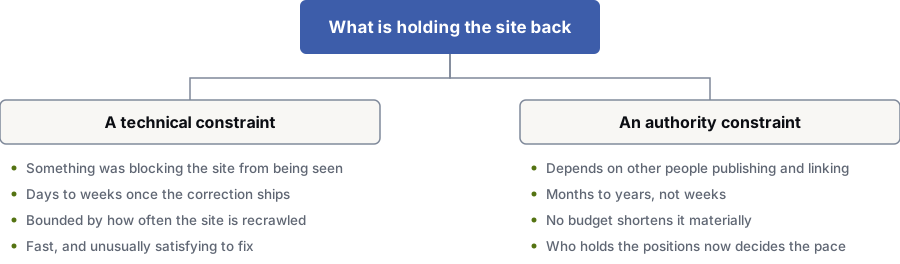
A technical problem
- Something was stopping the site being seen
- Days to weeks once the fix goes live
- Limited by how often the site is recrawled
- Quick, and satisfying to fix
An authority problem
- Depends on other people publishing and linking
- Months to years
- More budget barely shortens it
- Whoever ranks now sets the pace
Different speeds
How long SEO takes for each kind of task
Rough ranges, not promises. Work out which row you’re in; that row sets your expectations.
| Dimension | Typical pace | What decides it |
|---|---|---|
| Removing an indexing or crawl block | Days to a few weeks after the fix goes live | How often Google recrawls the site, which depends on its size, its history and how often it changes |
| Titles, headings and on-page relevance | Two to six weeks, if relevance was the problem | Whether the page was already being shown. Impressions can turn into clicks quickly, but a page with none has further to go. |
| Consolidating pages that compete with each other | Roughly one to three months to settle | How long the duplicates have existed, and how many outside links point at the page being retired |
| A new page on an established site | Weeks to be assessed, and longer to reach its level | How much authority the site already has, and how competitive the search is |
| A new page on a new domain | Months, and it starts slower than anyone expects | There is no history to build on, so everything starts from zero |
| Building authority in a competitive market | Six months to well over a year | Who ranks now, how much they are still investing, and whether what you publish is worth citing |
| Being recognised as an entity in your category | The longest of all, and the hardest to control | Consistent mentions of your brand, backed up across sources you don’t own or control |
What changes it
Five things that affect the timeline more than effort
What your site has already earned
An eight-year-old domain with good links and existing impressions starts well up the hill; a domain registered last month starts at the bottom. In the short term, no budget replaces it.
Who you are competing with
Look at who ranks now, not how hard a keyword tool says the phrase is. Three national brands with in-house teams are a different problem from four local firms with brochure sites, even for the same search.
Whether the problem is technical or authority
Technical problems are usually quick: something was blocking the site, it stops, and things move. Authority problems are slow because they depend on other people. Find out which you have before you agree any timeline.
How fast your business can approve and publish
Nobody puts this in the proposal, yet it often decides the outcome. If a page takes six weeks to clear legal, compliance and a founder’s inbox, your own process sets the publishing schedule, and only you can change that.
How much needs undoing first
Some sites carry an old migration with broken redirects, three generations of duplicate pages and content written for search engines in 2016. They spend the first quarter clearing problems before adding anything new, with little visible movement.
What to watch
Early signs SEO is working at 30, 60 and 90 days
Rankings move late, so they make a poor early signal. These move first; agree on them before anything starts.
First 30 days: baseline and indexing
Agree the baseline in writing and check the tracking is accurate. Then watch indexing: are the pages you care about indexed, is the number of valid pages heading the right way, and are crawl errors on your key page types clearing? You’re checking that pages can appear; performance comes later.
You get: A written baseline and a clean indexing report
Days 30 to 60: impressions before clicks
People have to see you before they can click. Count the non-branded searches where you appear at all, and watch impressions on the pages you worked on. New searches showing up is the earliest sign that relevance has improved, well before any ranking worth celebrating.
You get: How many non-branded searches you appear for, and their impressions
Days 60 to 90: non-branded clicks and average position
Now look at clicks, keeping branded and non-branded apart, because branded traffic rises whenever you run other marketing. Average position on the pages you worked on should be improving. Small moves on pages just below the visible results can bring a big jump in clicks.
You get: Non-branded click trend, split by page type
Months 3 to 6: conversions
Track enquiries, calls, bookings or sales from organic search, using the definitions you agreed rather than platform defaults. This shows whether SEO is bringing traffic without bringing customers, which reporting on sessions alone would hide.
You get: Organic conversions against the agreed definitions
Month 6 onward: the number that settles it
Compare the revenue or pipeline from organic search with what you have spent. Every earlier sign stands in for this number until it arrives. Then the conversation moves from "is it working?" to "where do we invest next?"
You get: A cost per result you can compare across channels
Questions
Common questions about SEO timelines
How long does SEO take to work?
It depends on what’s holding your site back, which you can usually find out within the first month. Indexing and crawl problems can clear within a recrawl cycle; relevance and structure problems usually move over weeks; authority problems in competitive markets take many months, sometimes more than a year.
Three checkpoints are more useful than a date: within thirty days you should know the main problem, within sixty to ninety days the early signs should move, and leads and sales follow.
Why does everyone say three to six months?
Partly because it’s roughly true for a typical site, and partly because it matches the shortest contract an agency can run at a profit.
Treat it as a starting guess. A site with a technical block and a strong brand can move much faster; a new domain in a competitive market won’t.
How soon will I know if it isn’t working?
Sooner than most people expect, if you agreed what to watch before you started. New pages not getting indexed, flat impressions on non-branded searches after sixty days, or no technical fixes going live each mean the plan has a problem, and waiting won’t fix it.
Don’t agree to wait six months before asking what should have changed. By then, the evidence of what went wrong has usually gone.
Does spending more make it faster?
Up to a point. More budget lets more happen at once: more pages, more technical fixes in a quarter, more outreach side by side. That shortens parts of the schedule.
It can’t shorten the time Google takes to recrawl and reassess a site, or speed up the trust that builds as other sites cite you. Past a certain point, extra money buys more activity and the results arrive no sooner.
Is it faster to fix an old site or start a new one?
Usually faster to fix the old one. An established domain has links, history and existing impressions; a new site starts without any of that.
The exception is a site whose platform makes the changes impossible, or one with a serious penalty history. Even then, the usual answer is a rebuild on the same domain with careful redirects, not a new domain.
References
Sources for how long does SEO take
The official documents and research this page is based on. Platform rules change, so check the source before you act on a detail.
Related
Keep reading on how long does SEO take
Start here
Find out what’s holding your site back
How long SEO takes depends on what’s holding you back today. A proper diagnosis finds that out, and it’s the first thing we’d look at on a call.
Rather check it yourself? Try our free SEO tools