
Local search
SEO vs Google Ads for a local business: how to decide where to spend
Published by Zubair Afzal, responsible editor
First published Updated 7 min readWe check this page every three months. Next check: .
Start here
Urgent jobs and planned jobs need different plans
Start with the kind of jobs you sell. Urgent jobs and planned jobs behave so differently that the same budget can give opposite results.
An urgent job is a burst pipe, a lockout or a broken boiler in February. The person decides in seconds and calls two or three businesses until someone picks up. Ranking and answering decide who wins.
A planned job is orthodontics, a kitchen refit or choosing an accountant. The search happens weeks before the decision, and your website, reviews and content do most of the persuading. Each click is worth more, because each job is.
Most local businesses have both, so don’t run one plan for everything. Emergency jobs need visibility and speed; planned jobs need credibility and follow-up.
One more check before you spend anything: do calls get answered? It’s the only thing here you can fix this week for free.
How they look in search
How to spot urgent and planned searches
Example searches, with no claims about their volume. Sort your own service searches into these groups before you decide on budget.
Urgent: be visible and answer the phone
Quick decisions, and people move on fast. If you don’t show up and answer straight away, you lose the job.
- emergency plumber near me
- locksmith open now
- 24 hour electrician [city]
- boiler not working who to call
- emergency dentist today
Planned: build trust and follow up
Weeks of research and several decision-makers. Your website and reviews win the job more than your ranking alone.
- invisalign cost [city]
- best accountant for small business [city]
- kitchen fitters reviews [area]
- dental implants vs bridge
- how to choose a conveyancer
Brand and reassurance: cheap and often ignored
People who already know you and are checking. They’re cheap to win, and easy to lose to a competitor's ad.
- [business name] reviews
- [business name] opening hours
- is [business name] any good
These are example searches from keyword research and public search data. Before we suggest anything, we check how often people search for them in your area.
The first question
Urgent jobs vs planned jobs at a glance
Answer this before comparing channels. The same budget gives opposite results depending on which kind of job you sell.
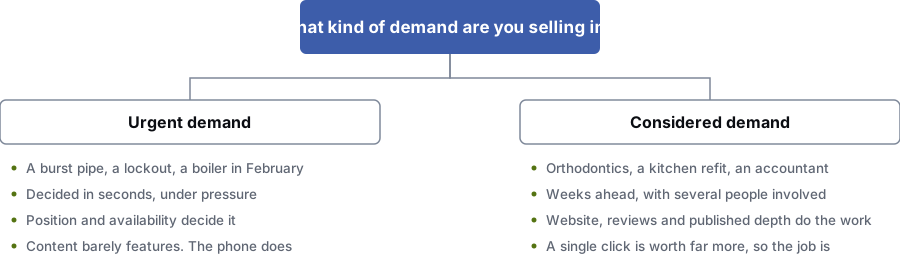
Urgent jobs
- A burst pipe, a lockout, a boiler in February
- Decided in seconds, under pressure
- Ranking and answering decide it
- Content barely matters. The phone does
Planned jobs
- Orthodontics, a kitchen refit, an accountant
- Weeks ahead, with several people involved
- Website, reviews and content persuade
- Each click is worth more, as each job is
Map pack, ads or organic results: how does each one work?
A local results page holds three separate contests, and you win each one differently.
| Dimension | Map pack | Google Ads | Organic listings |
|---|---|---|---|
| How you get there | You can’t buy it. Relevance, distance and how well known you are decide it. | Bid, budget and ad quality. Live the same day. | Content, site quality and authority, earned over months. |
| Time to first enquiry | Fast once profile errors are fixed, often weeks. | Immediate. | Months. |
| How it costs you | Your time and effort. No charge per click. | Per click, rising as competition grows. Stops the day you stop paying. | Fixed programme cost, with cost per enquiry falling over time. |
| Best for | Urgent jobs and anything where being close matters. | Filling gaps, launches, and high-value planned treatments or services. | Planned jobs, questions people ask before buying, and keeping costs down long term. |
| What turns a visit into an enquiry | Reviews, photos, opening hours, and whether you answer. | A landing page that matches the search, and a clear offer. | Depth, credibility and clear next steps. |
| Where money gets wasted | Wrong primary category, duplicate listings, missed calls. | Ads running out of hours, broad match on unwanted jobs, and sending clicks to the homepage. | Content aimed at readers nowhere near you. |
Two examples
A plumber and a dentist need very different plans
Both are local service businesses that take calls. Their sensible plans have almost nothing in common.
A plumber
Mostly urgent jobs of modest value. Priorities: an accurate profile and categories, steady reviews and fast responses. Schedule ads only for hours you can cover, with tight negative keywords. SEO should target higher-value planned jobs such as bathrooms and boiler replacement; leave emergencies to ads and the map pack.
A dentist
Mostly planned treatments of high value. Priorities: treatment pages with useful detail and reviews that help people decide. Run ads on specific high-value treatments where the margin covers the click price, and follow up on enquiries that take weeks. General "dentist near me" traffic is rarely worth heavy bidding.
What to do first
Got one local marketing budget? Start here
Fix your business profile before spending anything
Check verification, primary category, services, hours and photos, and remove duplicates. It’s the cheapest fix a local business can make, on the part of the page that gets the most local clicks.
You get: A correct, verified profile you control
Set up call tracking before you scale
Use a separate number for ads, dynamic number insertion on the site, and review the profile's call data monthly. Without this you can’t tell which channel brings in work, and every later decision is a guess.
You get: Calls you can trace to a source
Schedule ads for the hours you can answer
Run ads when someone can pick up the phone. If you want overnight emergency work, arrange the answering first, then buy those hours. Paying to send calls to voicemail helps your competitors.
Split urgent and planned ad spend
Use different campaigns, different landing pages and different success measures. Judge an implant campaign by the same cost per call as an emergency campaign and you’ll switch off the more profitable one.
Build SEO around the jobs worth having
Aim content and service pages at planned, higher-value jobs; emergency terms are better bought with ads than earned. This is the part that lowers your cost per customer over years.
You get: Service and area pages that bring enquiries without ad spend
Questions
Local SEO vs Google Ads: common questions
Should a local business start with SEO or Google Ads?
Start with ads if you need work this month. Schedule them for the hours you can answer the phone. If you can wait three to six months and your profile and site are in decent shape, local SEO usually costs less per enquiry over time.
For most local businesses, this order works: fix your Google Business Profile first, because it’s cheap and fast; run ads to cover the gap; build up SEO while the ads pay the bills.
Why does the map pack matter so much for local searches?
On a phone, the map pack fills much of the first screen for local service searches and puts a call button in front of someone who wants to call. For urgent jobs, that is a shorter path than any website.
You can’t buy a place in it. Google's help page says local results are mainly based on relevance, distance and popularity, meaning how well known a business is. That’s why an accurate profile and steady reviews are worth so much.
How do I know which channel produced a phone call?
Use call tracking: a separate number on your ads, dynamic number insertion on your website (so the number shown changes with where the visitor came from), and the call data in your business profile for calls from Maps.
Set this up before you spend more on anything. Without it, budget decisions rest on whatever the person who answered guessed.
Should a plumber and a dentist run the same strategy?
No. A plumber mostly sells emergency jobs, where the decision takes seconds and the winner is usually whoever shows near the top and answers. Profile, reviews, fast responses and tightly scheduled ads matter most.
A dentist mostly sells planned treatments that people choose over weeks, each worth enough to pay competitive click prices. The website, reviews and treatment pages do more of the convincing.
Is it worth bidding on searches I already rank for locally?
Test it before you decide. Pause the overlapping ads for a set period and watch total calls, paid and organic together. If the total holds, the ads were buying calls you’d have got anyway.
Keep bidding where the map pack sits low on the page, where competitors advertise on your brand name, or where an ad can show an offer or availability message your listing can’t.
What is the most common waste in local ad accounts?
Running ads when nobody can answer, and bidding on jobs you don’t want. You can fix both in an afternoon with ad scheduling, a tighter keyword list and a proper negative keyword list.
A close third is sending every ad click to the homepage. If someone searched for one service, they should land on a page about that service.
References
Sources for SEO vs Google ads for local business
The official documents and research this page is based on. Platform rules change, so check the source before you act on a detail.
Related
Keep reading on SEO vs Google ads for local business
Start here
Not sure where your calls are coming from?
Answer that before any budget moves. Our specialists can look at your profile, your ads and where your enquiries come from, and tell you what we find.
Rather check it yourself? Try our free SEO tools