
Get more leads
Want to get more leads? Find where your leads are leaking
To get more leads, find where they leak first: too few visitors, visitors who don’t enquire, or leads that go nowhere. Each needs a different fix.

Why it happens
Three reasons you’re not getting enough leads
Money goes out and not enough conversations come in. That looks the same every time; the cause isn’t. The one that sounds familiar is usually yours.
- Not enough people find you.
- Your pages don’t show up for the searches buyers make, or your ads don’t reach them. The sign is a low visitor count with a normal conversion rate: people who find you behave normally, there just aren’t many. Check this before you assume it.
- People visit and don’t enquire.
- Visits look healthy but enquiries don’t move, so something on the page is failing: an unclear offer, no proof, a dodged price question, a long form or a slow mobile page. More traffic here just means more people leaving.
- Leads come in and go nowhere.
- Either they’re the wrong people (out of area, out of budget, after a service you dropped) or nobody calls them back, and the Friday enquiry gets opened on Monday. Wrong-fit leads usually mean your ads or message invite everyone. Slow follow-up costs nothing to fix and no marketing spend makes up for it.
Find the leak
Where leads leak out on the way to a sale
These problems sit in order along one path. A leak at any point wastes everything you spent before it.
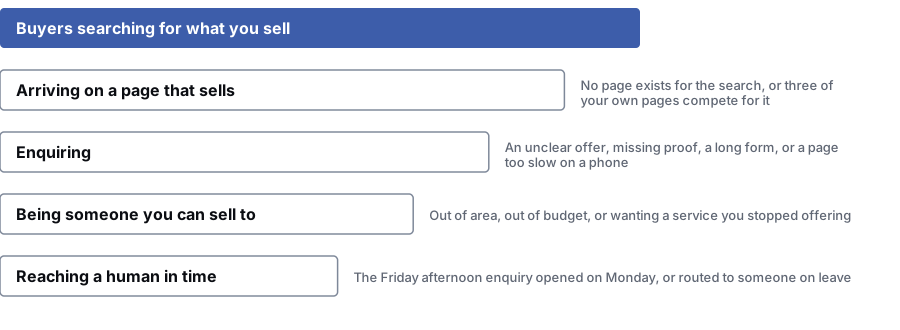
- 1Buyers searching for what you sell — There’s a limited number in your area, and you can roughly measure it. Some businesses already win most of them. That’s worth knowing.
- 2Arriving on a page that sells — The only true traffic problem. Check the conversion rate before you assume it.No page for the search, or three of your pages compete for it
- 3Enquiring — Buying more traffic here sends more people to the same page, so more of them leave.Unclear offer, no proof, long form or slow mobile page
- 4Being someone you can sell to — Usually a setup problem. Fixing it lowers the lead count and makes each lead worth more.Out of area, out of budget, or after a service you dropped
- 5Reaching your team in time — Often the biggest leak. It costs nothing to fix, and no earlier spend makes up for it.The Friday enquiry opened on Monday, or sent to someone on leave
Which one is it?
How to tell which lead problem you have
Each cause has its own warning sign and its own fix. Run these checks before you spend more.
| Dimension | Not enough traffic | Visitors don’t convert | Wrong-fit enquiries | Leads not followed up |
|---|---|---|---|---|
| The warning sign | Low visits, normal conversion rate on the pages that matter | Healthy visits, enquiries flat whatever the traffic does | Plenty of enquiries, sales team unhappy with them | Marketing and sales report different lead numbers for the same month |
| Where to look | Where you show up for buying searches, your share of ad impressions, what competitors cover | Enquiries divided by visits on service pages only | The reasons sales give for turning leads down | Time from form to your first call or email back |
| Most common cause | No page for the search, or three pages compete for it | Unclear offer, no proof, long form, slow mobile page | Ads aimed at an action that isn’t a sale | No owner, no agreed response time, no rule for who gets which lead |
| The expensive wrong fix | More blog posts no buyer searches for | Bigger ad budget on a page that already loses people | Looser targeting to push the lead count back up | Paying for a website redesign |
| Time to improve | Weeks for paid ads, six to twelve months for competitive SEO | Two to six weeks to test and ship the first changes | One to two reporting cycles once ads aim at the right action | Days, and it usually costs nothing |
How we fix it
How we find the leak, step by step
You can do this yourself in an afternoon. You need your analytics and someone from sales in the room.
Agree what counts as a lead
Marketing counts form fills. Sales counts people worth calling. Agree one definition, including what rules an enquiry out, and write it down.
You get: One written definition both teams sign off
Count last month properly
Count forms, calls, chats and emails. Check the platform numbers against what reached your team. The gap is often the whole story.
You get: One agreed lead count
Check your service pages
Divide enquiries by visits on your service and location pages only. Leave the blog out. This shows whether you have a conversion problem or just lots of blog readers.
You get: Conversion rate for service pages only
Ask sales why they said no
Take the last fifty enquiries and note why each was turned down. Out of area, no budget, wrong service, never answered. The spread tells you if it’s quality or follow-up.
You get: A tally of rejection reasons
Time your own follow-up
Send an enquiry through your own site from a phone, using an email nobody knows. How long until someone gets back to you? Try it on a Friday afternoon.
You get: A measured response time
Then decide where the money goes
With those five results, the cause is usually obvious. If two show up at once, fix the cheaper one first. That’s nearly always follow-up.
You get: A budget decision backed by evidence
Your cheapest lead is the one you already had and didn’t call back.
A project about Google rankings can spend its first two weeks fixing who picks up enquiries from a shared inbox, because that’s where the money leaks and it pays back fastest.
We’ll point it out before we sell you six months of content.
Next step
The right fix for each cause
If not enough people find you
If people visit and leave
Questions
Common questions about getting more leads
How do I tell whether I have a traffic problem or a conversion problem?
Divide enquiries by visits on the pages meant to bring in enquiries. If that rate is normal for your industry and the total is small, it’s traffic. If the rate is very low, it’s conversion, and more traffic just costs more.
Don’t work out the rate across the whole site. Blog visits drag it down and hide service pages that convert fine.
Sales says our leads are junk. Is that a marketing problem?
Usually yes, and you can fix it. Poor-fit leads mostly come from ads aimed at an action that isn’t a sale, a message that’s too broad, or a form that asks nothing to rule out a bad fit.
The catch: fixing it lowers the lead count on the report. If the business is judged on lead volume, agree that before you start.
How long before a lead problem starts to improve?
It depends on the cause. A broken form or slow follow-up can be fixed in days. Page changes usually show something within a few weeks. Paid search can bring enquiries almost at once if people are already searching.
SEO is the slow one: clear movement on competitive searches usually takes six to twelve months. Anyone giving you a firmer number is guessing.
Can you tell me which cause applies without access to our data?
Not reliably. From outside, we can usually narrow it to two causes by looking at where you show up, your competitors and your landing pages. Telling conversion from follow-up needs your enquiry data.
On a call we’ll show you which four numbers to pull and what they mean, so you can run the check yourself whether or not you work with us.
Is it possible that the answer is that there is no demand?
Yes, and it happens more often than agencies admit. Only so many people search for a service in an area, you can roughly measure it, and some businesses already win most of those searches.
Then spending more on search is the wrong move. Growth has to come from a wider area, a broader offer, another channel, or winning and keeping more of the people you already reach.
Where to get help
Services that solve this
SEO & Organic Growth
Phone not ringing while competitors show up above you? Our SEO services fix your site, write the pages buyers search for and show you every call and form it brings in.Conversion Rate Optimisation
Conversion rate optimisation that gets you more enquiries from the traffic you already have. We fix what stops visitors, and A/B test only when your traffic supports it.Marketing Analytics & Attribution
Marketing analytics and attribution you can trust, with a written account of where the data is blind and tests for what attribution can’t answer.Local SEO
Our local SEO services get you onto Google Maps and into "near me" searches. We fix your Business Profile, area pages and reviews, for one location or forty.
Find out what’s costing you leads
Bring your enquiry numbers and last fifty leads to a strategy call. We’ll run these checks with you and show you the cause, even if the fix is something we don’t sell.
Prefer to talk it over? Book a free call
Your BOOSTD score improves within 90 days, or your next month is free. After 6 months, more traffic or leads, or we keep working free (up to 6 free months in any 12 months). Read our guarantee
Last updated · Published by Zubair Afzal, responsible editor