
Improve lead quality
Improve lead quality: fewer junk enquiries, no lost good buyers
To improve lead quality, decide how much volume you can lose, then filter where it costs least: your message and targeting first, the form last.

The big decision
Qualify leads in the form, or after it?
Neither is always right. It depends what you’re short of: sales time or enquiries.
| Dimension | Qualify in the form | Qualify after the form |
|---|---|---|
| Effect on volume | Fewer enquiries, but more worth working | Volume kept, but more thrown away later |
| Where the cost lands | On marketing: lower conversion rate, higher cost per lead | On sales: time on calls that go nowhere |
| What you learn | Tidy, comparable data on everyone who completed it | Rich detail on everyone, if someone writes it down |
| Who you lose | Cautious buyers who won’t share their budget with a stranger | Nobody at the form, but good leads go cold in the queue |
| Best when | Sales time is short and enquiries are healthy | Enquiries are thin and people are free to call quickly |
| How it goes wrong | Too much filtering: the form becomes an application nobody finishes | Too little: the team burns out rejecting leads and stops calling quickly |
The trade-off
Who a qualifying question removes
A qualifying question sorts people willing to answer from people who aren’t. That’s not the same as good and bad leads.
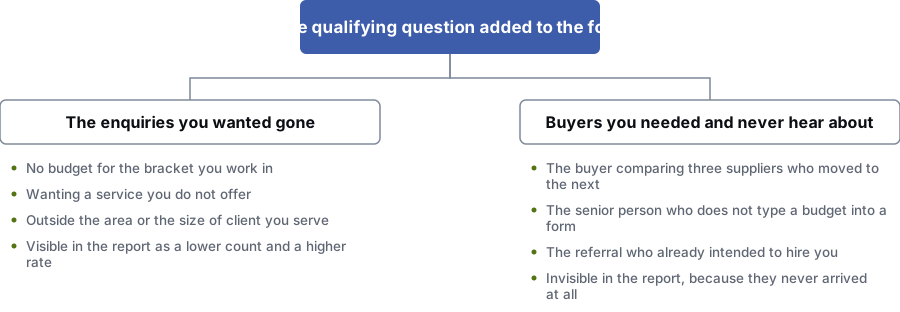
Enquiries you wanted gone
- No budget for your price range
- Wanting a service you don’t offer
- Outside your area or client size
- Shown as fewer leads and a higher rate
Buyers you lose and never see
- The buyer comparing three suppliers
- The senior person who won’t type a budget
- The referral who already planned to hire you
- Missing from the report entirely
Why it happens
Why you get unqualified leads
Most businesses change the form first, because it’s easy. It’s rarely where the problem starts.
- Your message invites the wrong people.
- If your page sounds cheaper, faster, broader or more junior than you are, your enquiries will match. With no hint of price, everyone enquires, including people who could never afford you. The page converts well; it’s just describing a business you don’t run.
- Your targeting is too broad.
- Broad match, wide audiences and automated campaigns buy reach by loosening relevance. That’s fine when your offer suits everyone and expensive when it’s specialist. The enquiries aren’t bad leads so much as leads for a different business.
- Nobody agreed what "qualified" means.
- Without a written definition, "bad lead" is just a way to vent. Some enquiries were poor fits; others were fine and got called back three days late. You can’t tell which, so you can’t fix either.
How we fix it
Four ways to filter, in the order to try them
Ordered by how many good leads each costs you. The cheapest work before anyone reaches the form.
Say who you’re for
The cheapest filter there is. Say the client size, project type and problems you handle well. The wrong people leave early, and the right people know they’ve found you.
Give a sense of price
Show a starting price or typical range. It filters harder than anything else, and openly. The enquiries you lose are mostly ones you’d lose twenty minutes into a call.
Fix the targeting
Use negative keywords, tighter match types, audience exclusions and better channel choices. This changes who arrives, so your conversion rate holds. Try it before touching the form.
Add form questions last
Add one or two fields, like timeline, budget range or service needed, after contact details. Add them one at a time and track qualified enquiries, so you know what each field cost.
Our approach
What we will and won’t change to improve lead quality
What we do
- Get both teams to agree a written definition of "qualified" first
- Report qualified enquiries as the main number, with totals beside it
- Try targeting and message changes before adding hoops to a form
- Add one filter at a time so you see what each costs
- Check how fast sales responds before blaming the leads
What we don’t do
- Add six qualifying fields at once and call the drop a success
- Claim you can improve quality with no effect on volume
- Use a form question in place of saying clearly what you sell
- Tune a form on traffic too thin to mean anything
- Leave the definition of a good lead unwritten
The hidden risk
You can filter your way out of business
Filtering too hard is harder to spot than filtering too little, and costs more. When a form asks too much, the people who quit are the ones with options: the buyer comparing three suppliers, the senior person who won’t type a budget, the referral who already planned to hire you.
None of that shows in your reports. A higher qualification rate and fewer enquiries both look like the plan working, and it can run for a year before anyone notices the pipeline has thinned.
Change one thing at a time and watch qualified enquiries per month. If that falls while the rate rises, the filter is too tight. Take it out.
Questions
Common questions about improving lead quality
Will adding qualifying questions reduce our enquiries?
Yes. Every extra field means fewer completed forms, and not only from poor fits: cautious buyers, people on their phone between meetings and anyone unwilling to tell a stranger their budget drop out too.
Choose filters worth what they cost, and measure qualified enquiries, not total enquiries.
Should we qualify in the form or on the call?
It depends what you’re short of. Short of sales time? Qualify in the form and accept fewer enquiries. Short of enquiries, with time to call? Keep the form short and qualify in the first two minutes of the call.
A good middle ground is a short form plus optional fields. Serious buyers usually fill them in anyway.
Should we publish prices to filter out people who cannot afford us?
A starting price or typical range is the strongest filter you have. It works before anyone spends time, and it builds trust with the buyers you want.
Competitors already know what you charge. The cost is losing some people you might have won round on a call, which is a trade-off worth weighing.
How do we tell a bad lead from a badly handled one?
Check how fast leads are contacted before you judge them. An enquiry called back three days later tells you about your follow-up, not the lead.
Then check both teams use the same written definition of "qualified". Many "bad lead" complaints are disagreements about the definition.
Can better targeting fix this without touching the form?
Often, yes, and it’s the first place to look. If your ads and pages describe a cheaper or broader service than you sell, the form is attracting the people your message invited.
Rewrite the page to say who you’re for. You’ll usually get fewer enquiries and more good ones, with no extra hoops.
Where to get help
Services that solve this
Conversion Rate Optimisation
Conversion rate optimisation that gets you more enquiries from the traffic you already have. We fix what stops visitors, and A/B test only when your traffic supports it.Landing Page Design
Landing page design for paid campaigns starts with message match: each page repeats what the ad promised and asks for one action. Everything else supports that or goes.SEO & Organic Growth
Phone not ringing while competitors show up above you? Our SEO services fix your site, write the pages buyers search for and show you every call and form it brings in.B2B SEO
B2B SEO for low-volume, high-value markets. We build pages for everyone on the buying committee, from the champion to finance, security and procurement.Marketing Analytics & Attribution
Marketing analytics and attribution you can trust, with a written account of where the data is blind and tests for what attribution can’t answer.
Decide how much volume better leads are worth
Bring a month of enquiries and mark the ones you wish you’d never had. We’ll show you which filter would have removed them, and what else it would have removed.
Prefer to talk it over? Book a free call
Your BOOSTD score improves within 90 days, or your next month is free. After 6 months, more traffic or leads, or we keep working free (up to 6 free months in any 12 months). Read our guarantee
Related
More ways to fix this
Last updated · Published by Zubair Afzal, responsible editor