
Generate B2B pipeline
B2B pipeline generation: turn marketing leads into signed deals
B2B pipeline generation stalls when sales and marketing count different things, a committee decides, and deals outlast your reports. Fix those before buying more leads.
Where enquiries leak
ExampleThe quote form fails on some phones. Fix this before buying more traffic.
Why it happens
Why leads go up while pipeline stays flat
Lots of B2B teams can show leads rising; few can show pipeline rising with them. Traffic is rarely the problem. These three usually are, often together.
- Sales and marketing count different things.
- Lead scores are built from what’s easy to track: opens, page views, downloads. They reward people who research for a living and miss the quiet buyer. After twenty bad calls, reps stop opening leads, and nobody says so. The sign: lots of handed-over leads with no CRM notes at all.
- One person enquired. Six people decide.
- The person who asks for information usually isn’t the one who signs, and several others can say no. That’s why deals stall at "we need to discuss this internally": your contact has to sell you inside their company with nothing to sell with.
- Deals take longer than your reports.
- If deals take nine months and you review every quarter, you judge this quarter’s spend by last year’s pipeline. Last-click reporting then credits the brand search at the end and starves the campaigns that created the demand. Slow channels get cut first, and brand searches fall a year later.
The definition gap
How marketing and sales define the same words
Before any campaign is worth running, both teams must agree what these words mean. The argument this table starts is the useful part.
| Dimension | What marketing counts | What sales counts | Where the gap shows up |
|---|---|---|---|
| A lead | Any form fill, download or event sign-up | A named person at a company that could buy | Lots of "leads" never get entered into the CRM |
| Qualified | A score threshold crossed based on behaviour | A stated need, a budget and a timeline they can name | MQL-to-opportunity conversion in single digits and nobody checks why |
| A good month | More leads than target, at or below target cost | Enough new qualified opportunities to hit the number | Both teams hit target in a quarter with no revenue growth |
| What gets counted | A person | A company | Six people from one company counted as six wins |
| Credit for the deal | First touch, or whatever the ad platform reports | Whatever the buyer said on the first sales call | Two numbers in the same board pack that don’t match |
The buying committee
Buying committees don’t fill in forms
The usual funnel assumes one person moving through stages. In B2B buying a group forms, each member with a different question and a different reason to say no, and the person who contacts you is often the most junior.
So make content people can pass on, like a page your contact can send to their finance director. Put it behind a form and it never gets shared.
Answer the objections that kill deals on pages your contact can point to, because the people raising them rarely visit your site.
And count companies, not people. Four people from one target company reading six pages each is one strong prospect. Forty strangers downloading a template is forty leads and nothing.
After the form fill
Where B2B deals are lost inside the buyer’s company
One person enquired. Several decide. None of them fills in a form, and your contact has to make your case in a room you’re not in.
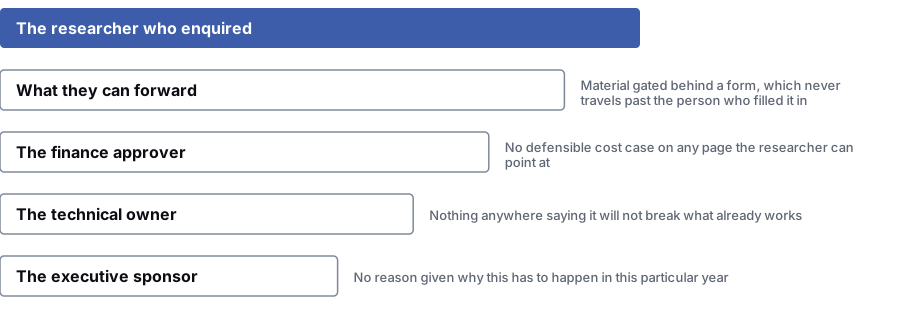
- 1The researcher who enquired — Often the most junior in the group, sent to gather options. The form fill is the visible tip of a bigger conversation.
- 2What they can pass on — A page they can send to their finance director matters more here than any earlier campaign.Content behind a form, so it never gets passed on
- 3The finance approver — Never visits your site, yet raises the objection that kills the deal. Answer it where your contact can point.No cost case on any page your contact can share
- 4The technical owner — A no here stalls the purchase before your sales team ever hears about it.Nothing saying it won’t break what already works
- 5The senior sponsor — Where deals go to sit. You hear "we need to discuss it internally", and no form can reach it.No reason why this needs to happen this year
How we fix it
Agree the definition first, then build demand
Run campaigns before the definition is agreed and you just make more of what sales ignores. Order matters more than tactics.
Work backwards from closed deals
We take your last twelve to twenty-four months of closed deals and trace what happened before each: which pages, which channels, how many people, how long. It’s slow, and it shows what a buying signal looks like in your business.
You get: Buying signals built from your own closed deals
Get one definition signed by both teams
Write down what marketing hands over, what sales does with it, and what happens when they disagree. One page. Specific enough to settle any disputed lead.
You get: A one-page handover agreement both teams sign
Map the committee
Work out who else has to agree, what each needs to believe, and where they spend their time. That decides which pages you need and which channels to pay for. It usually shows two or three roles your content ignores.
You get: A committee map with the content each role needs
Build demand on the right timescale
Use SEO for the problems the committee researches. Use paid social to reach the right roles before they search. Use press coverage where credibility holds you back. Run them side by side.
You get: A channel plan with a realistic timeline for each
Report over your sales cycle
Review early signs monthly. Review pipeline over a window that matches your deal length. Agree how credit is shared before the numbers come in.
You get: A reporting model sales will read
Next step
Services behind each part of B2B pipeline
Creating the demand
Questions
Common questions about B2B pipeline
What is the difference between an MQL and pipeline?
An MQL is marketing’s view of a person. Pipeline is sales’ view of a company, with a deal value and a close date. Treating one as the other is where most B2B reporting goes wrong.
Quick test: did a rep log anything in the CRM after the handover? If lots of MQLs lead to no CRM activity, the definition is broken.
Should we stop counting MQLs altogether?
No, but give them less weight. An MQL is a useful early sign that a campaign reaches the right people when pipeline data comes too late to steer anything.
Don’t pay marketing bonuses on it. Once a volume target sits on a number sales doesn’t use, the definition starts to slip.
Our sales cycle is over a year. How do we measure marketing before then?
Track early signs that came before revenue in the past, and agree in advance which count: engagement from target accounts, how many people from one account visit, meetings booked, deals moving between stages.
And stop reviewing slow channels every quarter. Judge a nine-month campaign on three months and it gets cut before it can work.
How do you market to a buying committee when only one person fills in the form?
Write for the people who never fill in a form. The researcher needs to know you can do the job. Finance needs a cost case. The technical owner needs to know nothing will break. The senior sponsor needs a reason it matters this year.
That means content made to be shared inside the company, with no form in the way, and paid ads aimed at the job titles the researcher has to win over.
How long does B2B SEO take to produce pipeline?
Longer than most plans allow: the time to rank plus your sales cycle. Ranking for buying searches in a competitive B2B market often takes six to twelve months, then the deal takes as long as your deals take.
So run SEO and paid ads together. Paid buys visibility now, at a cost that never drops. SEO costs more at the start, then keeps working.
Do we need LinkedIn ads if search is already working?
Only if the people you need aren’t searching yet. Search reaches buyers who know they have a problem. It misses those who don’t, and the approver, who rarely searches.
If search already brings more demand than sales can handle, spend on conversion and qualification. Adding a channel to a broken definition just makes the argument louder.
Where to get help
Services that solve this
B2B SEO
B2B SEO for low-volume, high-value markets. We build pages for everyone on the buying committee, from the champion to finance, security and procurement.SaaS SEO
SaaS SEO judged on trials and demos, not traffic. We build comparison and alternatives pages first, then category pages, then early-stage content.Content, Digital PR & Authority
A content marketing agency that writes from what only your business knows, so people mention and link to you. We earn coverage with good stories and never buy links.Marketing Analytics & Attribution
Marketing analytics and attribution you can trust, with a written account of where the data is blind and tests for what attribution can’t answer.Conversion Rate Optimisation
Conversion rate optimisation that gets you more enquiries from the traffic you already have. We fix what stops visitors, and A/B test only when your traffic supports it.
Bring the number sales doesn’t believe
On a strategy call we’ll look at your lead definition, your MQL-to-opportunity rate and what your last ten closed deals did first. Then we’ll tell you where we think the gap is.
Prefer to talk it over? Book a free call
Your BOOSTD score improves within 90 days, or your next month is free. After 6 months, more traffic or leads, or we keep working free (up to 6 free months in any 12 months). Read our guarantee
Last updated · Published by Zubair Afzal, responsible editor