
Content, Digital PR & Authority
Content marketing agency and digital PR that get people talking
A content marketing agency that writes from what only your business knows, so people mention and link to you. We earn coverage with good stories and never buy links.

In every planIncluded in Local or Growth, from $149 a month. Every plan has every feature; they differ by size.
Compare plansWhat makes the difference
Where good content marketing comes from
Most content agencies write from the first page of Google. The result sums up what already ranks and gives nobody a reason to link to it. AI tools now write that kind of page instantly, for free.
We write from what Google can’t see: your own data, the questions your sales team answers every week, what your team notices on the job, and why customers say they switched to you.
Every business has this material. It feels routine from inside, but it is often new to everyone else. Our job is to draw it out and make it worth publishing.
Two starting points
Copy what ranks, or write what only you know?
This choice decides what your content marketing brings back. You make it when you write the brief, before anyone starts writing.
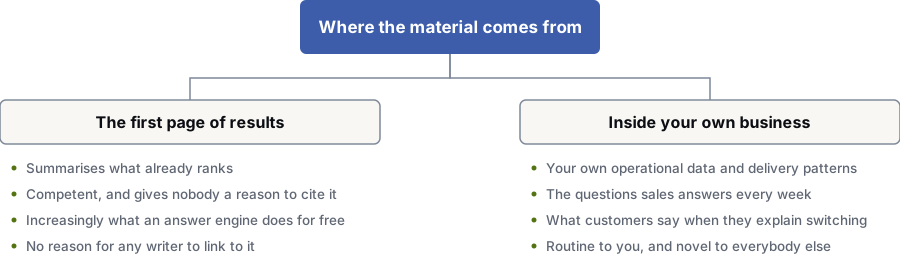
The first page of results
- Sums up what already ranks
- Fine, but nobody has a reason to quote it
- What AI tools can now write for free
- No reason for anyone to link to it
Inside your own business
- Your own data and what you see on the job
- The questions sales answers every week
- Why customers say they switched to you
- Routine to you, and new to everyone else
Find your problem
Why your content stopped bringing in results
When content stops working, publishing more rarely helps. Find which of these four you have first, because the fixes point in opposite directions.
- The library kept growing and nothing was removed.
- Years of posts leave several pages chasing the same search, and Google often picks the wrong one. The fix is to merge and remove pages. It’s the most reliable win on an older site, and the hardest to get approved.
- The brief was a keyword, with no question behind it.
- Give a writer a phrase and a word count and you get a page about a topic. Give them a question, who asked it and what they’ll do with the answer, and you get a page for a reader. It costs no more to write, only more effort to brief.
- The expert never took part.
- If nobody who does the job contributed, anyone could have written it about any company. A reader who knows the subject can tell within a paragraph, and so can a journalist.
- Nothing ever gets updated.
- Old content fades without warning. The page still loads, but the search results changed, your product changed and the figures went stale. Pages that brought in enquiries slowly stop, and no calendar notices.
What we make
Three types of content, three jobs
Content that meets demand
Pages that answer a buying search better than what ranks now. We judge them on rankings and enquiries, and update them when they slip.
Content that builds authority
Original research, benchmarks, methods and expert views. Slower to make and harder to copy. This is what journalists, competitors and AI tools quote.
Content that helps close sales
Pages that answer one objection at one point in a sale. They rarely get much traffic, but they often convert best.
How a campaign runs
How we run a digital PR campaign
Find the material
We look through what you already have, such as your data, quote patterns, support tickets and seasonal demand, and record interviews with the people closest to the job.
You get: A shortlist of story ideas only you could supply
Plan the method before collecting data
We write down the sample, sources, definitions and what “no result” would look like, all in advance. A method picked after seeing the numbers isn’t a method.
You get: A written method and the limits of what it can claim
Build it, then try to break it
We fact-check everything, link and date every source, and get someone in your business to approve any figure with your name on it, because journalists check.
You get: A checked piece with sources and limits stated
Pitch to the right few
We build a list for this one story and time it around what those journalists cover, with no mass sends. Most pitches get no reply, so we run PR as an ongoing programme.
You get: Targeted pitching and daily checks for journalist requests
Measure what changed
We report the publications, the new linking websites and the changes on the pages the campaign was meant to help. Then we pick the next story.
You get: A coverage report and a plan for the next campaign
Our standards
Our content and digital PR rules
How we work
- Brief every piece around a question someone asks, with a clear reason to exist
- Record and credit expert input where the topic needs expertise
- Source, link and date every figure
- Check every piece for accuracy before it carries your name
- Pitch stories because they’re good stories, whatever the link is worth
- Merge and remove old pages before we write anything new
What we don’t do
- Buy links, swap links or use private blog networks
- Publish statistics we can’t source
- Treat volume targets as a measure of success
- Write guest posts just to place a link
- Write content only because a keyword tool suggested it
- Report estimated audience reach as if it were a result
Questions
Common questions about content marketing and PR
Do you buy links?
No. Paid links that pass ranking signals break Google’s spam policies. The risk stays with your website, long after the agency that bought them has gone.
We earn coverage by making something a publication wants to run. It’s slower and brings fewer links, but nothing done in your name comes back later.
Our experts have no time. How does this work?
We record a short interview, so nobody has to write. Thirty minutes with the right person usually gives us enough for several pieces.
Then we write and they review. Reviewing takes far less time than writing, and it keeps the content credible.
What makes content rank now?
Content ranks when it answers the exact question better than anything else, on a site people trust: it covers what the searcher needed and says something the current results don’t.
Publishing lots of average pages stopped working a while ago. More weak pages tend to drag a site down.
How do you measure content and digital PR?
Three things you can check yourself: the publications that ran the story, the new websites linking to you, and what happened to the pages and searches the campaign was meant to help.
We don’t report “estimated audience reach” or “potential impressions”. Those numbers multiply a publication’s traffic by a guess, and nobody can check them.
Should we publish more, or fix what we already have?
Fix first, for most sites that have published for a few years. Older pages with some authority usually respond faster to a good update than a new page does to launch. Merging pages that compete for the same search fixes a problem more publishing would make worse.
New content earns its place in two cases: a buying question none of your pages answer yet, or material nobody else could publish, such as your data, expertise or method.
Does this help us appear in AI answers?
Yes, more than anything else we do, but nobody can promise it. AI assistants tend to use sources that other places back up: quoted by publications, linked by other sites, described the same way everywhere. Press coverage and original research build that.
We won’t sell you markup or a special file as a shortcut into AI answers. For how these tools pick sources, see our AI search service.
Services in this area
What content & digital PR covers
Content Strategy
Content strategy services that give you a written plan: what to publish, which pages to fix, merge or remove, and which topics to skip.Digital PR
A digital PR agency that earns coverage in the publications your buyers read, with new data and timely expert comment. We never pay for placements.Copywriting
Copywriting that starts with your reader’s problem, not your company. We research what’s true about your business, then write it so specifically no competitor could claim it.Original Research & Data Studies
Original research and data studies designed method first, so journalists and AI tools can check and cite them. We publish what the data says, limits included.
What does your business know that’s worth publishing?
On a short call we’ll find the know-how inside your business that nobody outside has. It’s usually something you think is ordinary.
Prefer to talk it over? Book a free call
References
Sources for content marketing agency
The official documents and research this page is based on. Platform rules change, so check the source before you act on a detail.
Related
More on content & digital PR
- digital PR and link building, comparedWhich of the two you’re buying, and what each costs.
- what we hand to software and what we do notSoftware helps prepare the brief. Our writers write the piece.
- organic search strategyThe search plan this content supports.
- original research and data studiesThe content that keeps getting quoted longest.
- earning coverage on the storyHow we pitch a campaign, and to whom.
- deciding what not to publishIncluding which pages to merge or remove.
- AI search visibilityMentions on other trusted sites help you show up in AI answers too.
- content built for a specific search
- our editorial standards
- how we fact-check what carries your name
Where we offer content & digital PR
Problems content & digital PR can fix
Last updated · Published by Zubair Afzal, responsible editor