
Original Research & Data Studies
Original research built to be checked, not built to get a headline
Original research is the one content asset that keeps earning citations for years, and the one most likely to embarrass you if the method is weak. We design the method first, disclose the sample and the collection, state the limitations, and publish the conclusion the data supports.
Prefer to talk it through? Book a strategy call
The premise
Citation follows the method, not the headline
Marketing teams commission research hoping for a striking number. Journalists and editors are doing something else entirely: deciding whether they can put a figure in print and defend it if someone rings up to argue. That decision is made on the method, and it is made in about thirty seconds.
So the questions that decide whether a study gets used are unromantic. How many people were surveyed. Who were they and how were they found. When was the fieldwork. What exactly were they asked, word for word. Was the sample drawn from a panel, from your own customer list, or from people who happened to see a link. A study that answers all of those is usable even when the finding is modest. A study that answers none is unusable even when the finding is remarkable.
The same applies to AI systems, for related reasons. A model reproducing a statistic is reproducing a claim it can attribute. Figures that are stated plainly in text, dated, tied to a named source and sitting beside a described method are the ones that travel. Figures locked inside a designed report, expressed only in a chart, or floated with no basis are the ones that do not.
This is why the methodology page is not paperwork attached to the end of a study. It is the part that makes the rest of it worth anything, and we write it before fieldwork rather than after.
How it runs
From a question to a published dataset
The order is deliberate. Everything that could bias the result is decided before any data exists, which is the only point at which those decisions can be made.
Define a question that can be answered
Most research briefs arrive as a topic rather than a question. We narrow it until it is something a specific group of people could be asked, or a specific dataset could show, and we test whether the answer would be interesting whichever way it came out. If it would only be interesting one way, it is a campaign idea rather than a study.
You get: A stated research question with both outcomes considered
Design the method and write it down first
Sample definition, recruitment route, target size, field window, weighting if any, and how the data will be analysed — all documented before collection begins. Writing it in advance is what prevents the quiet post-hoc decisions that turn a sound study into a persuasive one.
You get: A pre-registered methodology document
Review the questionnaire for the ways it could lead
Leading phrasing, double-barrelled questions, missing answer options that force a respondent into agreement, and ordering effects where one question primes the next. Few draft questionnaires survive this review unchanged, including our own.
You get: Reviewed question set with the changes and reasons logged
Collect the data through a documented route
An independent panel with a stated recruitment method, or your own operational data with a stated extraction window and anonymisation applied. Either is defensible. What is not defensible is a link posted to your own audience and described afterwards as a survey of the industry.
You get: Raw dataset with collection route documented
Analyse, then write the limitations
Base sizes reported for every figure, including the ones too small to support a claim. Differences that are not meaningful are described as not meaningful. The limitations section names who is under-represented, what the sample cannot speak for, and which questions turned out to be ambiguous.
You get: Findings with base sizes and a written limitations section
Publish so it can be checked and reused
Findings as text on a real page, each figure a complete sentence with its basis attached. A methodology page at its own address. The question wording available. Charts that repeat the numbers rather than replacing them, because a figure that exists only inside an image cannot be quoted.
You get: Published study, methodology page and accessible figures
Two real routes
Records you already hold, or a commissioned survey
Both can produce a study a newsroom will use, and both are defensible. What separates them is what each can support, and that is settled before a single question is written.
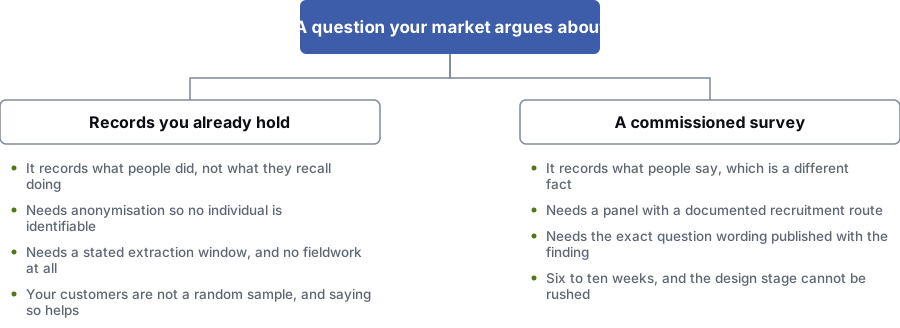
Records you already hold
- It records what people did, not what they recall doing
- Needs anonymisation so no individual is identifiable
- Needs a stated extraction window, and no fieldwork at all
- Your customers are not a random sample, and saying so helps
A commissioned survey
- It records what people say, which is a different fact
- Needs a panel with a documented recruitment route
- Needs the exact question wording published with the finding
- Six to ten weeks, and the design stage cannot be rushed
Non-negotiable
The rules we apply to any study with our work in it
Research is the one asset where a shortcut is discovered publicly, usually by someone who disagrees with the finding. These rules exist because the cost of breaking them lands on the client’s credibility rather than ours.
What we commit to
- Write the methodology before collection starts, and publish it at its own address
- Disclose sample size, recruitment route, field dates and exact question wording
- Report base sizes with every figure, including the ones too small to support a claim
- State the limitations plainly, including who the sample cannot speak for
- Publish the finding the data supports, even when it is not the one anyone wanted
- Anonymise and aggregate any operational data so no individual is identifiable
- Correct a published figure openly and dated if an error is found later
What we refuse
- Run a study whose conclusion has already been decided in the brief
- Write questions designed to produce a particular answer
- Drop inconvenient questions from the published results after seeing them
- Present a poll of your own audience as a survey of an industry
- Publish a percentage without the base it was calculated from
- Claim significance for a difference the sample cannot support
- Promise press coverage, citation counts or appearances in AI answers
Two things called research
A study built to be cited, and a survey built to make a headline
| Dimension | Built to be cited | Built to make a headline |
|---|---|---|
| When the conclusion is decided | After the data is analysed | In the brief, before anyone is asked anything |
| What the questionnaire looks like | Reviewed for leading phrasing, with the full wording published | Written to produce a quotable percentage, and never shown |
| Who was asked | A defined sample with a documented recruitment route | Whoever clicked the link, described afterwards as the industry |
| How figures are reported | With base sizes, field dates and caveats attached | As a rounded percentage with no denominator anywhere |
| What happens to awkward results | Published alongside the rest, with the limitation noted | Quietly omitted from the report |
| How long it stays useful | Years, because later writers can verify and reuse it | One news cycle, if it lands at all |
Questions
What to ask before commissioning a study
What if the data does not say what we hoped?
Then we publish what it says, or we do not publish. Those are the only two options, and we agree them in writing before fieldwork begins so nobody is surprised.
This happens often enough to be worth planning for. An unexpected finding is frequently more interesting than the expected one, and a study that contradicts its sponsor’s assumption is unusually credible. Where a result would damage you, we shelve it — what we will not do is reframe it until it says something else.
Can we use our own internal data?
Often yes, and it is usually stronger than a survey because it records behaviour rather than recollection. It needs care: anonymisation, aggregation thresholds so no individual customer is identifiable, a stated collection window, and a clear account of who is in the dataset and who is not.
The limitation to state plainly is that your customers are not a random sample of the market. That does not invalidate the finding, it defines it — and saying so is what makes the rest of the study believable.
How long does a study take?
For a commissioned survey, typically six to ten weeks from question definition to publication: two on design, two to three in field, and the remainder on analysis, writing and review. Rushing the design stage is the most expensive saving available.
Studies built on existing internal data can move faster, because there is no fieldwork, but they usually spend longer on anonymisation and on establishing what the dataset can support.
What makes a study citable by a journalist?
A visible method. Sample size, who was surveyed, how they were recruited, when fieldwork ran, and the exact wording of the questions behind the headline figure. A newsroom that cannot see those things will not risk the number.
Beyond that: a finding that is new rather than a restatement of something already published, a named person available to comment, and the underlying figures accessible rather than locked inside a designed document.
Will this get us into AI answers?
Nobody can promise that, and anyone who does is guessing. What we can say is that the material most reliably reused is stated plainly, attributed to a named source, dated, and sitting next to a description of how it was produced.
Practically, that means findings live on a real page as text, each figure written as a complete sentence with its basis attached, and the methodology published at its own address rather than as an appendix nobody can link to.
Do you have existing research we can look at?
We publish our own research under the standards set out on our research pages, and we will not point you at a study we did not run or imply a back catalogue we do not have.
What we can show you before you commit is the method: the questionnaire review checklist, the disclosure template, and the limitations section format. Those tell you more about how a study will be run than a finished report does.
Find out whether you already have a dataset worth publishing
Most businesses are sitting on operational records that would answer a question their market argues about. On a strategy call we look at what you already hold, and tell you whether it can be published responsibly or whether a survey is the straight route.
Prefer to talk it through? Book a strategy call
If we don't deliver the work we agreed to deliver for reasons within our control, you don't pay for the undelivered work. Read our guarantee
References
Sources
The primary documents and published research this page relies on. Platform rules change, so check the source before acting on a detail.
Related
Where to go next
- digital PR and link building, comparedWhich of the two you are buying, and what each one costs.
- the standard our own research pages hold toThe same methodology rules apply to anything we publish for a client.
- how we source and check figuresEvery published number needs a traceable origin.
- who signs off before publicationWe review research before we release it, not after.
- taking a finished study to journalistsResearch is the strongest material a PR campaign can be built on.
- making findings machine-readableHow a figure is marked up affects whether it can be reused.
- being quoted rather than summarised
More to explore
Problems this helps with
More in content & digital pr
Last updated · Published by Zubair Afzal (responsible editor), on owner authorisation