
Get cited in AI answers
How to get your business cited as a source in AI answers
To get cited in AI answers, be where a fact comes from: publish first-hand claims that can be quoted cleanly, with a date and an author. Nobody can guarantee a citation.
An AI answer
ExampleWho fixes burst pipes near me tonight?
Your Business Plumbing offers 24-hour emergency call-outs and lists its service area and prices on its site.
- yourbusiness.comCited
- a local directory
- a review site
Why AI quotes someone else
Three reasons experts never get quoted in AI answers
This page assumes AI tools already mention you and describe you correctly. The question is narrower: why is the material they quote always someone else’s?
- You repeat facts others produced.
- Your best pages quote an industry figure from a trade body, a vendor study or a consultancy report. That makes your page a signpost to the original, not a source, and anything drawing on it has an obvious reason to skip you. No layout change fixes this, because the problem starts before the writing.
- Your expertise can’t be quoted.
- The knowledge is sound, but it’s spread across two thousand words: the subject in one paragraph, the number in another, the caveat in a third. Nothing can be quoted without piecing it together, and pieced-together text is a paraphrase that loses your name. It’s easy to fix.
- Nobody can tell when it was published, who wrote it, or that it’s really yours.
- There is no publish date, review date, named author or clear owner. Or the same material republished in four places with a byline that leads nowhere. A claim like that can’t be judged as current or credited to anyone, which makes an excellent page weaker than an average one that gets these right.
Said up front
What we can’t promise about AI citations, and what we do instead
Read everything after this knowing that the result isn’t ours to promise.
What we will do
- Find something you know first-hand that nobody in your field has published
- Publish it with how you know it, who or what it covers, and a date on the page
- Write each main claim so it still makes sense when quoted on its own
- Link every claim clearly to a named person and to your business
- Set review dates and update openly, noting what changed and when
- Tell you when what you have isn’t interesting enough to publish
What we will never do
- Promise, guarantee or hint that any AI tool will cite you
- Make up a statistic to be quoted, when it isn’t true
- Claim that markup, a file or a technical change causes citations
- Report a citation count as if it were a ranking
- Treat one run of a prompt as proof that anything changed
Two different results
A mention in an AI answer versus an AI citation
Most content aimed at AI tools is built to get a mention, then judged on whether it gets a citation.
| Dimension | A mention | A citation |
|---|---|---|
| What gets used | Your name, as one option among several | A specific claim that started with you |
| What causes it | Being present in the sources that discuss your field | Holding something first-hand the answer needs to be complete |
| Whether a link is likely | Often not. A recommendation rarely needs a source | More likely, because a specific figure or definition invites one |
| What it’s worth to the business | Being considered while people draw up a shortlist | Becoming the reference point your whole field argues with |
| What it takes | Coverage, presence, consistent facts, visibility in your field | Original material, claims that stand alone, regular updates, clear authorship |
| How it goes wrong | You’re missing, or described from out-of-date sources | You’re quoted without credit because the claim was paraphrased |
The steps
How to become a source AI answers can cite
Find what you already know first-hand
List what your business sees that nobody records: how long jobs take, how often things fail, what customers ask before buying, what work costs in your market this year. You want one thing that’s true, specific and not yet published.
You get: A shortlist of possible first-hand claims
Back it up properly
Work out how you know it, how many cases it’s based on, over what period, and what would prove it wrong. Write that method down before the finding. A number with a method is a source; without one, it’s an opinion with a decimal point.
You get: A written method and a description of what it covers
Write the claim so it can be quoted
Put the subject, the figure, the unit, the time period and the source in one sentence, then add context around it. Paste that sentence somewhere else and read it cold. If it needs the paragraph to make sense, it will be paraphrased, not quoted.
You get: A stand-alone sentence for each finding
Tie it to a named author and your business
Name the author who did the research, with their credentials, on a page that clearly belongs to you. Make sure the same claim isn’t floating around in three reposted versions, which would remove the credit you’re trying to earn.
You get: One main, credited home for each claim
Date it and commit to keeping it current
Add a publish date, a review date and a visible note of what changed at each update. Only publish what you’ll keep current: a source that quietly goes out of date is worse than none, because people still use it.
You get: A review schedule with named owners
Give people outside the business a reason to use it
Send it to the journalists, trade publications and commentators who cover your field. People and AI tools quote from overlapping places, so a claim no person has referenced is unlikely to become an AI reference either.
You get: A list of who you sent it to and who used it
The first sign
People quote you before AI tools do
The result everyone wants arrives last and is the least reliable. The earlier signs are clearer and need no special tools. A claim no person has ever referenced rarely reaches the last stage.
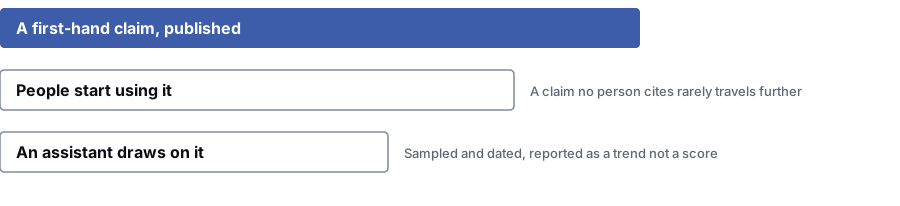
- 1A first-hand claim, published — One thing you know that nobody has published, with a method, a description of what it covers, a date and a named person behind it.
- 2People start using it — Quoted back to you on sales calls, linked by other sites, used by journalists covering your field. You can see all of this.A claim nobody quotes rarely goes further
- 3An AI tool draws on it — Never promised and never a ranking. Checked by running a fixed set of prompts and noting whether your material shows up as a source.Sampled and dated, reported as a trend, not a score
Where citations appear
Questions where AI answers show a source
Not every question leads to a citation. These kinds do, because the answer is weaker without one.
These are examples, not volume figures. Swap in your own field, run them yourself, and watch whether a source is shown and whose it is.
Questions that need a number
The best opportunity. If no good public figure exists, the first believable one published with a method tends to become the reference.
- how much does [service] cost in [market] this year
- what percentage of [category] projects run over schedule
- average time to complete a [process]
- how many businesses in [sector] still use [older approach]
Questions that need a definition
Whoever writes the clearest, most quotable definition tends to set the terms your whole field then argues about.
- what is the difference between [term a] and [term b]
- what does [industry term] mean
- is [common practice] the same as [related practice]
Questions about how things are done
Know-how that’s rarely written down. The easiest area for a hands-on business to own outright.
- how do you decide whether [decision] is worth it
- what is the correct order to do [multi-step process]
- how do professionals check [specific thing]
Questions about what changed
Being up to date decides these. A dated, maintained page beats a better-written one that stopped being updated two years ago.
- what changed in [regulation or platform] this year
- is [older advice] still true
- what are the current requirements for [thing]
These are example searches from keyword research and public search data. Before we suggest anything, we check how often people search for them in your area.
Questions
Questions about getting cited in AI answers
Can you guarantee we will be cited?
No, and nobody can. AI tools decide what to cite in ways that change without notice, their answers differ between runs of the same question, and no agency has a deal that gets anyone special treatment.
What we can do is make you the kind of source these tools have a reason to use. It’s worth doing anyway, because it’s the same thing that gets journalists, analysts and buyers to quote you.
We have no data of our own. What can we be the source of?
More than you’d think. Anything you see again and again that nobody else records counts: the questions customers ask most, how long a job takes, the common ways things go wrong, what a type of work costs in your market this year.
You don’t need a research team. Write down something you already know, with how you know it and a date, in a form that can be quoted.
What makes a claim easy to cite?
It stands on its own. It gives the subject, the number, the unit, the time period and the source in one sentence, so it can be lifted without the paragraph around it. It also has a date and a named person behind it.
A simple test: copy one sentence from your best page and read it alone. If it doesn’t make sense, it will be paraphrased, not quoted, and paraphrases usually lose the credit.
Does structured data or markup cause citations?
No. Structured data helps machines understand what’s on a page, and it’s worth adding carefully. But no markup makes an AI tool cite you.
Markup describes something that already exists. If the page has no original claim, describing it more precisely won’t create one.
How would we know whether any of this worked?
Roughly, and never as a ranking. Run a fixed set of questions your buyers are likely to ask on a schedule, and record whether your material shows up as a source, which isn’t the same as your name appearing in the text.
Watch the signals outside AI tools too, because they move first. Do journalists use your figure? Do other sites link to it? Do prospects quote it back to you? If no person quotes a claim, an AI tool is unlikely to either.
Is old content a problem here?
Undated content is a problem; out-of-date content presented as current is a bigger one. A claim about a market with no date can’t be judged, and a source that has drifted out of date hurts you more than never publishing it.
Set a review date for anything you want cited. Update it openly, noting what changed, and remove anything you won’t keep current. It’s one of the few things here fully in your control.
Where to get help
Services that solve this
AI Search Optimisation
AI search optimisation helps your business get named, and described correctly, when people ask ChatGPT, Google’s AI Overviews, Copilot, Gemini or Perplexity.Original Research & Data Studies
Original research and data studies designed method first, so journalists and AI tools can check and cite them. We publish what the data says, limits included.Entity & Knowledge Optimisation
Entity optimisation helps Google and AI tools recognise your business as one clear company, not three weak versions described three different ways.Content SEO
Our SEO content services start with the pages you already have. We decide which to update, rewrite, merge or remove, and fix the links between them.Content, Digital PR & Authority
A content marketing agency that writes from what only your business knows, so people mention and link to you. We earn coverage with good stories and never buy links.
Find out what you know that nobody has published
Bring us the things your team notices and never writes down. We’ll tell you which could stand as a first-hand claim, what method it needs, and how to write it so it can be quoted. We won’t promise it will be cited.
Prefer to talk it over? Book a free call
Your BOOSTD score improves within 90 days, or your next month is free. After 6 months, more traffic or leads, or we keep working free (up to 6 free months in any 12 months). Read our guarantee
References
Sources for get cited in AI answers
The official documents and research this page is based on. Platform rules change, so check the source before you act on a detail.
Related
More ways to fix this
- work aimed at AI-generated answersWhere we turn the steps on this page into an ongoing plan.
- becoming the origin of a numberThe only reliable way to stop pointing people to someone else.
- tying a claim to the business that made it
- writing so a single claim can be quoted on its own
- what a citation means in SEO and AI searchThe plain definition, including how local citations differ.
- when AI leaves you out or gets you wrong
- what generative engine optimisation covers
- AI search optimisation across every AI toolThe wider service that becoming a source sits within.
- measuring AI search visibility without pretending it is a rankThe longer answer to how you’d know any of this worked.
Last updated · Published by Zubair Afzal, responsible editor · We check this page every three months. Next check: .