
Entity & Knowledge Optimisation
Entity optimisation: make sure search engines and AI know who you are
Entity optimisation helps Google and AI tools recognise your business as one clear company, not three weak versions described three different ways.
An AI answer
ExampleWho fixes burst pipes near me tonight?
Your Business Plumbing offers 24-hour emergency call-outs and lists its service area and prices on its site.
- yourbusiness.comCited
- a local directory
- a review site
In every planIncluded in Local or Growth, from $149 a month. Every plan has every feature; they differ by size.
Compare plansCommon problems
Four ways a company gets split into several entities
Entity problems build up from small differences. Each seems harmless, but together they make it hard for a machine to be sure who you are.
- Another company has a name close to yours.
- A similar name in the same country, or the same name in another industry, can split your record and credit mentions to the wrong company. The fix is to spell out the differences in machine-readable form: legal name, registration number, industry, location, founding date and leadership.
- The rebrand is only half done.
- The website changed straight away; registries, directories, industry bodies, old press coverage, event programmes and partner pages did not. Years of mentions stay linked to your old name while the new one has little behind it. This is the most costly version of the problem.
- You describe yourself four different ways.
- The homepage says one thing, the about page something broader, the footer is three years old and a former employee wrote the LinkedIn description. Together they make your category unclear, and an AI tool choosing businesses for an answer needs to place you in one.
- The markup claims more than the page shows.
- Structured data listing awards, ratings, prices or services that appear nowhere on the page breaks Google’s guideline that markup should describe visible content. At best it is ignored; at worst it leads to a manual action.
How it works
Entity optimisation in four parts, in the order they pay off
One agreed company description
One paragraph saying what your business is, what it does, who it serves and where. We write it once, get it approved, then roll it out to every profile, listing, registry entry and press note. It is cheap, routine work and often the biggest single improvement available.
Clear separation from similar names
We spell out how you differ from anyone with a similar name (legal name, registration number, founding date, leadership, industry and location), state it the same way everywhere, and add markup where the page shows it.
Links to profiles you own
The sameAs property links your business to pages that clearly identify it: official profiles, registry entries and verified accounts. It helps machines tell you apart; it does not boost rankings. Pointing it at pages you don’t control makes your record less clear.
Mentions you don’t control
Independent websites describing you the same way. This is the slowest part, and it decides whether machines treat you as well established, so this service puts more time into earning press coverage than into markup.
Knowledge panels and Wikipedia
What you can and cannot do about knowledge panels and Wikipedia
The two things businesses most often ask for in entity work are a knowledge panel and a Wikipedia page. Nobody can sell either.
Google builds a knowledge panel from information it has gathered and trusts. There is no form to apply, and no markup can create trust the sources don’t support. Where a panel shows something wrong, an authorised representative can suggest a correction through official channels, and we use them.
Wikipedia is stricter. An article needs significant coverage in independent, reliable sources. Its rules discourage editing about an organisation you have a financial link to, paid editing must be disclosed under its terms of use, and undisclosed paid editing gets accounts blocked and articles deleted.
So we don’t edit Wikipedia for a business we work with, we don’t pay anyone else to, and we never list a Wikipedia article as a deliverable. We help make sure the independent coverage exists; if it does, an editor may write about you one day.
Wikidata is an openly editable database with its own notability rules. Fixing a factual error on an existing item, openly and with references, is reasonable. Creating items that state unsupported facts is not.
What you can do
What you can do about a knowledge panel or a Wikipedia page
You can’t apply for a knowledge panel or a Wikipedia article. Both depend on the same thing, which is independent coverage. A quick look at that coverage tells you which path you are on.
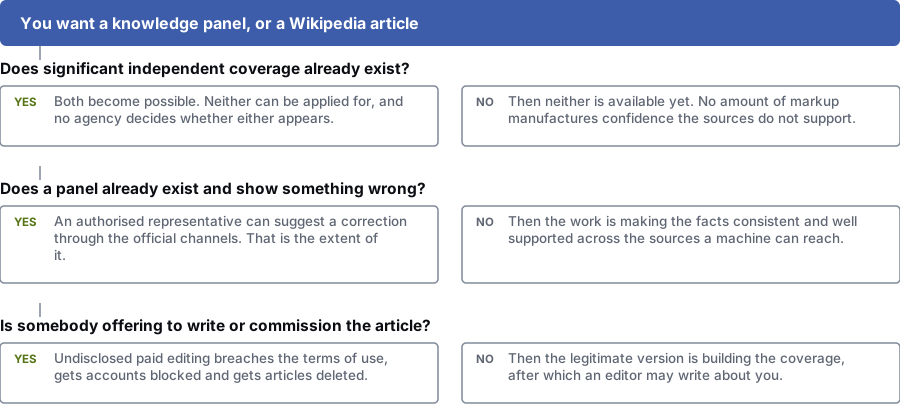
Does significant independent coverage already exist?
Yes: Both become possible. You can’t apply for either, and no agency decides whether they appear.
No: Then neither is possible yet. Markup can’t create trust that the sources don’t support.
Does a panel already exist and show something wrong?
Yes: An authorised representative can suggest a correction through official channels. That is all.
No: Then the job is making your facts consistent and well supported everywhere machines look.
Is someone offering to write or pay for the article?
Yes: Undisclosed paid editing breaks the terms of use, gets accounts blocked and gets articles deleted.
No: Then the right path is building coverage. After that, an editor may write about you.
Our rules
What we will and will not do with your company information
What we do
- Write one company description and roll it out to every profile you control
- Fix wrong or out-of-date facts on the website that publishes them
- Mark up organisation, location and people details that the page shows
- Use sameAs only for profiles you own or that clearly identify you
- Use official correction channels where a knowledge panel exists and is wrong
- Build the independent coverage that makes your business recognisable in the first place
- Tell you early if a knowledge panel is not realistic for your business
What we won’t do
- Edit Wikipedia articles about a business we work for, or pay anyone else to
- Create Wikidata items that state facts no published source supports
- Mark up awards, ratings, prices or services the page does not show
- Invent a schema type, or claim that any markup causes an AI citation
- Sell llms.txt, or any other file, as a way to get rankings or mentions
- Promise a knowledge panel, a Wikipedia article or a specific description in any AI tool
Questions
Common questions about entity optimisation
What is an entity, in plain terms?
An entity is a thing with an identity: your company, founder, product or office. Search engines and AI models work out which organisation a mention refers to, then attach what they learn to that record.
Everything said about you either builds up on one record or gets split across several. A split record is weak, easy to leave out of an answer or mix up with someone else.
Can you get us a Wikipedia page?
No, and we won’t arrange one through anybody else. Wikipedia needs significant coverage in independent, reliable sources, discourages editing by anyone with a financial link, and blocks accounts and deletes articles for undisclosed paid editing.
We can help you earn independent press coverage. If there is enough, a Wikipedia editor may write about you. If there isn’t, no agency can change that.
What about Wikidata? Can we add ourselves there?
Sometimes. Wikidata has its own notability rules: an item generally needs a page on a Wikimedia project, or must be a clearly identifiable thing described by serious, referenced sources.
If your business qualifies, fixing factual errors on an existing item, openly and with references, is reasonable. We won’t create items stating facts no published source supports, or treat Wikidata as a back door to a knowledge panel.
Can you guarantee a knowledge panel?
No. Google builds knowledge panels from information it has gathered and trusts. There is no form to apply, and without enough supporting sources no panel appears.
We make your facts consistent and well supported across the sources Google draws on, and use official channels to correct a wrong panel. If a panel isn’t realistic for you, we say so early.
Is this not just adding schema markup?
No. Markup is about a fifth of the job. Structured data helps a machine read what is already on the page; it can’t make a claim true, and Google’s guidelines say it should only describe visible content.
Most of the job happens away from your site: registries, directories, profiles, press coverage and other descriptions of you all need to agree. That is where most of the improvement comes from.
We rebranded two years ago. Is that still a problem?
Usually, yes. Your website changed on day one. Registries, directories, industry bodies, old press coverage, event listings and partner pages did not.
So years of reputation are still linked to a name you no longer use. Finishing a rebrand means working through each source with a tracked list, and it is often the most valuable entity project you can do.
See how many versions of your company are out there
We will collect every description of your business a machine could find and put them side by side. You may find more versions than you expected, and some may be years out of date.
Prefer to talk it over? Book a free call
References
Sources for entity optimisation
The official documents and research this page is based on. Platform rules change, so check the source before you act on a detail.
Related
More on entity optimisation
- what AEO means in practiceA plain explanation of the idea behind this service.
- local SEO and business profilesWhere your location details live, and where they often go wrong.
- reputation managementWhat other people write about you counts as entity data too.
- generative engine optimisationThe service that depends most on this one.
- our content review policy
- how schema markup describes an entity to machines
Where entity optimisation matters most
Problems entity optimisation can fix
More AI search optimisation services
Last updated · Published by Zubair Afzal, responsible editor · We check this page every three months. Next check: .