
AI search
What is answer engine optimization (AEO)? A plain definition
Published by Zubair Afzal, responsible editor
First published Updated 7 min readWe check this page every three months. Next check: .
Definition
AEO in plain terms
Answer engine optimization (AEO) means making your content easy for an answer engine to quote as the single, correct answer, with credit to you. An answer engine is any system that replies to a question with a direct answer instead of a list of links: AI Overviews and featured snippets in Google, voice assistants, and the answer boxes built into search and chat products.
Two words matter most. "Quote", because the system lifts something you wrote. "Single", because AEO covers the case where one source supplies the answer. When an answer is pieced together from several sources, you’re into generative engine optimization.
In practice, you work on passages more than pages. A page can be accurate and well structured for search, and still be no use to an answer engine because the answer is spread across four paragraphs and a caveat. It needs stating once, cleanly, in a form that can be lifted without losing its meaning.
Scope
What AEO covers
Five areas. Anything else sold as AEO is ordinary SEO, ordinary editing or guesswork.
Content built around questions
Organise content around the questions people ask, in their words, with the question in a heading and the answer straight underneath. A page that only gets to the question in its fourth section won’t be used.
Structure that can be lifted
Give a direct answer of two or three sentences before the detail. Use proper lists, tables marked up as tables, and headings that describe the section.
Accurate, up-to-date facts
Use specific figures, named sources and clear dates, and show when the page was last checked. Answer engines avoid ambiguity, so a hedged sentence is a poor candidate for quoting.
Clear entities
Make it obvious what and who the page is about: the organisation, the product, the person or the place, so a system can link the answer to something it already knows. This is where structured data earns its place.
A credible source
Is the claim backed up elsewhere? Can readers see who wrote it? Does the site have a record of being right on this subject? A system decides whether to trust you before it looks at formatting.
Boundaries
How AEO differs from classic SEO
| Dimension | Classic SEO | Answer engine optimization |
|---|---|---|
| What counts as a win | A ranked page that earns a click | Being the source of the answer, whether or not anyone clicks |
| What you work on | The page, and the site around it | The passage: a paragraph, list or table that answers one question |
| What the system wants from you | The most useful page for a search | The clearest correct statement to quote for a question |
| Role of structure | Helps readers scan and helps crawlers understand the page | Decides whether an answer can be lifted from its context without breaking |
| How it is measured | Rankings, impressions, clicks and conversions, tracked all the time | Presence in answers, checked by sampling, because no complete record exists |
| Typical failure | A page that ranks well and converts nobody | A correct page with the answer buried in prose that nothing can lift |
Boundaries
What answer engine optimization isn’t
Six common claims, none of them accurate.
- It isn’t a separate channel. It has no traffic source, budget or audience of its own, and the content still has to be found in the usual way.
- It isn’t schema markup. Structured data helps systems understand a page, but doesn’t cause your text to be quoted.
- It doesn’t replace SEO. If a page can’t be found, crawled and indexed, nothing can quote it.
- It isn’t prompt engineering. Writing pages to talk to a chatbot, or hiding instructions for a model, isn’t how retrieval works, and isn’t defensible.
- You can’t buy it. There is no paid placement in an organic answer; any offer of one is an advertising product, or nothing at all.
- Rank tracking alone can’t measure it. Position data shows where a link appeared, not whether your text was used in an answer.
The trade-off
Which questions are worth owning as the answer
Winning here can cost you clicks, because the question gets settled on the results page. Whether that matters depends on which question you choose.
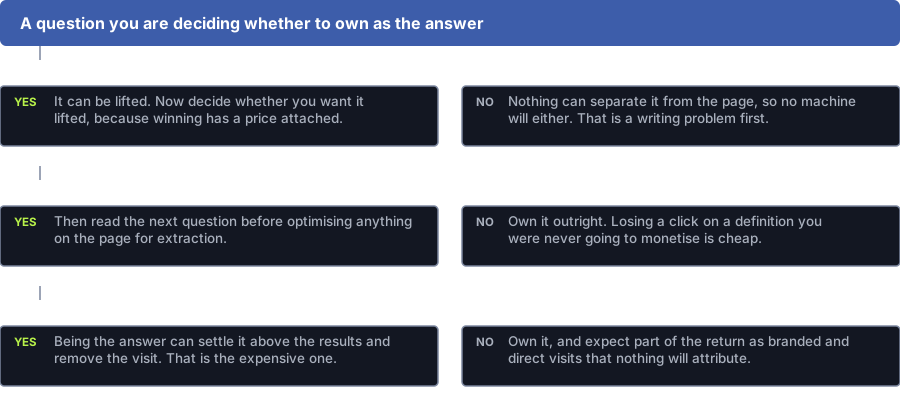
Can one paragraph state the whole answer correctly?
Yes: It can be quoted. Now decide whether you want it quoted, because winning has a cost.
No: Nothing can separate it from the page, so no machine will quote it. Fix the writing first.
Was the visit that question produced ever worth money?
Yes: Check the next question before you change anything on the page.
No: Go for it. Losing a click on a definition you were never going to earn from costs little.
Is it the question asked at the point of purchase?
Yes: Being the answer can settle the question above the results and remove the visit. That is the costly case.
No: Go for it, and expect some of the return as branded and direct visits that no report will credit.
Caveats
Where AEO is still unsettled
Measurement is the weakest part. There is no full record of the answers you appeared in, and the systems that produce answers change their behaviour without notice. Anyone who calls AEO reporting complete is showing you a sample and calling it the whole picture.
Attribution is the second gap. Someone reads an answer, doesn’t click, and three days later types your brand name into a browser. Some of the value of being the answer shows up as direct and branded traffic that no model will credit correctly.
Answers also come and go: the same question can gain or lose an answer box within weeks. So treat AEO as a way of writing, not a one-off campaign. Passages that are easy to quote are also clearer for your readers, and that benefit lasts.
Questions
Common questions about answer engine optimization
Is AEO different from SEO?
Yes, in one important way. AEO is part of SEO with a different goal: SEO aims for a page to rank and get clicked; AEO aims for a passage to be quoted as the answer.
They overlap a lot, because nothing can quote a source it can’t find. What changes is what you work on (the passage, not the whole page) and how you measure success.
Does structured data make you the answer?
No. Structured data helps a machine understand what a page is about and makes some result types possible. It doesn’t cause an answer to be taken from you, and no markup guarantees an appearance.
It makes things clearer; it won’t force a result. A page with perfect markup and a vague answer will lose to a page with no markup and a precise one.
How is answer engine optimization measured?
Only partly, by sampling. There is no complete log of every answer you appear in, so you run your important questions repeatedly across the relevant systems and record whether you are used, how you are described and who else is cited.
On question-style searches, steady impressions with falling clicks usually mean answers are being settled on the results page, rarely that you’ve lost visibility.
Does being the extracted answer cost you clicks?
Sometimes, so factor it into the decision. If the results page answers a question fully, some people who would have visited no longer need to.
Losing a click on a definition you were never going to earn from costs little. Losing one on a comparison search at the point of purchase costs a lot. Choose the questions you want to own with that in mind.
Is AEO the same thing as GEO?
No. AEO is about being the single source an answer is quoted from. Generative engine optimization is about being one of several sources a longer answer is built from, where no single page controls the wording.
The tasks differ. Quoting rewards a clean statement on your own page that can be lifted. A built-up answer rewards consistent, backed-up evidence about you across sources you don’t control.
References
Sources for answer engine optimization
The official documents and research this page is based on. Platform rules change, so check the source before you act on a detail.
Related
Terms related to answer engine optimization
Start here
See how AI and search engines read your pages
Look at your own content: which questions you answer cleanly, which you bury, and where a competitor gets quoted in your place. It’s a short, practical conversation.
Rather check it yourself? Try our free SEO tools