
Answer Engine Optimisation (AEO)
Answer engine optimization: be the answer, not the fourth link under it
Answer engine optimisation is the work of making a page extractable: a direct answer near the top, structure a machine can parse, and claims that survive being lifted out of the paragraph around them.
Prefer to talk it through? Book a strategy call
The actual discipline
Extractability is a writing problem, not a technical one
An answer engine has to be able to take a passage from your page and present it as a self-contained response. That single requirement drives everything AEO consists of, and most commercial content fails it in the first sentence.
The typical pattern is a heading that poses a question, followed by two sentences of throat-clearing — why the topic matters, who it affects, what this article will cover — and then the answer somewhere in the third paragraph. A reader tolerates that. An extraction process takes the passage under the heading, finds no answer in it, and moves to a competitor who led with one.
So the work is largely editorial: answer first, context second. Descriptive headings instead of clever ones. Claims that remain true when separated from the paragraph they sit in. Sources attached to figures, because an unsourced number is not usable by anything that has to stand behind it.
What has to survive extraction
A passage is used or discarded in five steps, and most fail at the third
Extraction does not read your page the way you wrote it. It takes the passage under a heading and asks whether that fragment stands up alone, which is why the failure happens two sentences in.
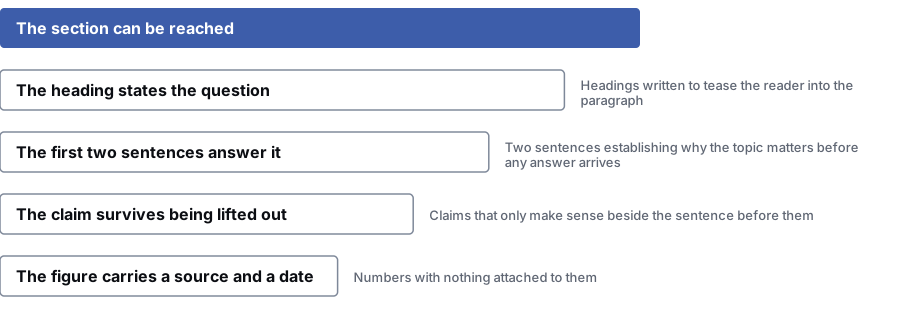
- 1The section can be reached — Everything here assumes the ordinary fundamentals underneath it: a page that can be crawled and read.
- 2The heading states the question — Descriptive rather than clever. A heading nobody would type is a heading no fragment gets matched against.Headings written to tease the reader into the paragraph
- 3The first two sentences answer it — The most reliable predictor of whether a section gets used, and the point at which most commercial writing fails.Two sentences establishing why the topic matters before any answer arrives
- 4The claim survives being lifted out — It has to remain true and complete once the paragraph around it is gone, because that is how it will be used.Claims that only make sense beside the sentence before them
- 5The figure carries a source and a date — An unsourced number is not usable by anything that has to stand behind what it says.Numbers with nothing attached to them
The work
What an AEO engagement involves
Nothing here is exotic. It is routine editorial and structural work applied consistently, which is exactly why so little content passes the test.
- Build the real question inventory — from Search Console, from sales calls, from support tickets, not from a keyword tool alone
- Identify which questions have a good existing answer and which have nothing worth reading
- Rewrite priority pages answer-first, so the first two sentences under each heading resolve the heading
- Replace teasing headings with descriptive ones
- State definitions plainly, once, in a form that can stand alone
- Attach a source and a date to every figure on the page
- Use tables and lists where they aid comprehension, and remove them where they were decoration
- Validate structured data against what is visibly on the page, and delete anything the page does not support
- Map the follow-up questions competitors have not answered, and answer them
- Re-measure quarterly against a fixed question set, and report on what moved
The trade-off nobody mentions
Where AEO helps, and where it costs you
Optimising a page to be extracted and optimising it to be visited are different objectives. Applying AEO across a whole site is a mistake most people only notice after their commercial traffic drops.
| Dimension | Informational content | Commercial pages |
|---|---|---|
| Goal | Be the cited source | Be found, then convert |
| Answer-first structure | Yes, aggressively | Selectively — for FAQs and objections, not for the whole page |
| Effect on clicks | Some loss is expected and acceptable | Loss is not acceptable and signals over-application |
| What success looks like | Presence in answers and brand mentions | Enquiries, not impressions |
| Common failure | Thin answers that get ignored | Giving away the reason to contact you |
Questions
What people ask about AEO
Is AEO different from SEO?
It is a subset of it, focused on one thing: whether a passage of your page can be lifted out and used as an answer. The inputs are the same fundamentals — crawlable, accurate, well structured, corroborated.
What is new is the writing discipline. Content optimised to be read top to bottom and content optimised to be extracted mid-page are structured differently, and most commercial writing is the former.
If we become the answer, do we lose the click?
On informational queries, often yes, and anyone claiming otherwise is selling something. Someone who got their answer had no reason to visit.
That is an acceptable trade for top-of-funnel content, where the value is being the cited source rather than the visit. It is a bad trade for commercial pages, which should be written to be found rather than extracted. We treat the two differently rather than applying AEO across the whole site.
What changes on a page?
The first two sentences under every heading answer that heading directly, before any context. Headings describe rather than tease. Definitions are stated plainly. Figures carry a source and a date. Lists and tables are used where they aid comprehension rather than for visual variety.
None of that is exotic, and all of it makes the page better for a human reader too — which is the test we apply before making any of these changes.
Does schema markup make a page more likely to be used?
It helps machines understand a page and it should be valid and match what is visibly on it. That is the whole of the defensible claim.
There is no markup type that causes extraction, and an agency whose AEO offering is mostly a schema checklist is selling the appearance of a service.
Find out which of your pages are extractable
We will take a handful of your key pages and apply the test above, then show you what is answering the question and what is clearing its throat.
Prefer to talk it through? Book a strategy call
References
Sources
The primary documents and published research this page relies on. Platform rules change, so check the source before acting on a detail.
Related
Where to go next
- what answer engine optimisation meansThe definition this service works to, written plainly.
- optimising for AI answersThe hub this sits under.
- generative engine optimisationThe synthesis side of the same problem.
- organic searchAEO does not work without the fundamentals.
- content that earns citations
- AEO vs GEO vs SEOHow the three overlap and where they differ.
More to explore
Markets where answer engine optimisation is a priority
Problems this helps with
More in ai search optimisation
Last updated · Published by Zubair Afzal (responsible editor), on owner authorisation · Reviewed quarterly — next review: