
Generative Engine Optimisation (GEO)
Generative engine optimization: being included when an answer is assembled from many sources
Generative engines do not pick a page — they synthesise a response from several. That changes the objective from ranking to being one of the sources worth drawing on, and consistency across the open web starts doing most of the work.
Prefer to talk it through? Book a strategy call
The objective has changed
You are no longer competing to be the page that gets picked. You are competing to be one of the sources worth drawing on when an answer is assembled.
That sounds like a semantic distinction and it is not. Ranking is a contest between pages; synthesis is a question about entities. A model composing an answer about your category is deciding which businesses are clearly, consistently and independently established as being that thing.
Which means most of the work is not on your website.
What moves it
Three inputs, in order of how much they matter
Consistency
Your name, what you do, who you serve and where you operate, described identically everywhere a machine could look — your site, your profiles, directories, coverage, third-party descriptions. Businesses routinely have three versions of themselves in circulation, and an entity that cannot be resolved confidently is easy to leave out of an answer.
Corroboration
Independent sources saying the same thing about you. Coverage, mentions, citations, real reviews. This is the slowest input and the hardest to fake, which is exactly why it carries the most weight when a system is deciding what to trust.
Specificity
Being clearly a narrow thing beats being adequately a broad one. A model reaching for examples in a category reaches for businesses that unmistakably are that category, which makes positioning and vocabulary do more work here than volume of content ever will.
Reading the baseline
Three findings a first run across the assistants produces
We fix a question set your buyers ask and run it across the major assistants. What comes back sorts into three situations, and each one points at a different piece of work.
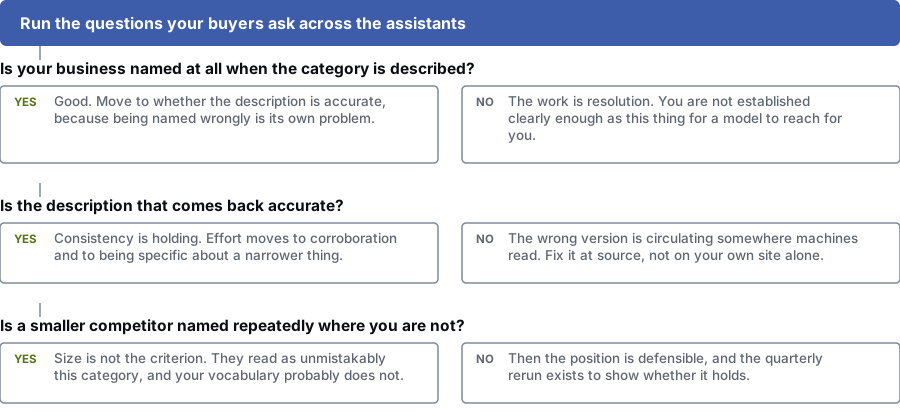
Is your business named at all when the category is described?
Yes: Good. Move to whether the description is accurate, because being named wrongly is its own problem.
No: The work is resolution. You are not established clearly enough as this thing for a model to reach for you.
Is the description that comes back accurate?
Yes: Consistency is holding. Effort moves to corroboration and to being specific about a narrower thing.
No: The wrong version is circulating somewhere machines read. Fix it at source, not on your own site alone.
Is a smaller competitor named repeatedly where you are not?
Yes: Size is not the criterion. They read as unmistakably this category, and your vocabulary probably does not.
No: Then the position is defensible, and the quarterly rerun exists to show whether it holds.
The engagement
What we do, in order
We start with a baseline. A fixed set of questions your buyers ask, run across the major assistants, recording how your business and your category are described. This produces the uncomfortable part of the engagement — businesses frequently discover they are described inaccurately, or not at all, while a smaller competitor is named repeatedly.
Then the entity audit: every place a machine could find a description of you, and every inconsistency between them. Different company names, different service descriptions, outdated locations, contradictory claims. This is routine cleanup and it is usually the largest single improvement available.
Positioning comes next, because vocabulary determines which categories you can plausibly be included in. A business describing itself in language nobody else in its category uses is difficult to place, and being difficult to place is being left out.
Corroboration is last because it is slowest. Earned coverage aimed at agreement rather than link volume, and where the business can support it, original data that gives other people a reason to cite you specifically.
Questions
Fair questions about GEO
What is the difference between GEO and AEO?
AEO is about one page: can a passage be extracted and used as an answer. GEO is about your business as an entity: when a model composes an answer about your category from several sources, are you one of them.
That difference matters practically. AEO work happens on your pages. Most GEO work happens off them — in how consistently you are described elsewhere and whether independent sources corroborate what you claim.
Can you guarantee we get mentioned?
No. These systems are non-deterministic, they change without notice, and the same question produces different answers to different people on the same day.
We work on the inputs that make inclusion possible and easy. We do not sell an outcome we do not control, and we will not quote a citation-share figure we cannot source.
How is this measured?
Imperfectly, and we say so before the engagement rather than in a footnote. We fix a question set your buyers ask, run it across the major assistants, and record how your business and your category are described — who is named, who is not, and what is inaccurate.
Repeating that quarterly gives a directional picture of movement. It is not rank tracking and we do not present it as though it were.
Is any of this different from just having a good brand?
Less than the acronym implies. A business that is clearly positioned, consistently described and independently corroborated was already going to do well here.
What is new is that inconsistency now has a specific, mechanical cost. Describing yourself three different ways used to be untidy; it now makes you harder to resolve as a single entity, and an entity a system is unsure about is easy to omit.
See how assistants currently describe your business
We run your company and your category through the major assistants before the call and bring you what comes back. It is frequently the most useful forty minutes a marketing team spends this quarter.
Prefer to talk it through? Book a strategy call
References
Sources
The primary documents and published research this page relies on. Platform rules change, so check the source before acting on a detail.
Related
Where to go next
- how answer engines decide what to quoteThe definition this service works to, written plainly.
- being cited in AI answers
- answer engine optimisationThe extraction side of the same problem.
- what generative engine optimization isThe definition and its limits.
- AEO vs GEO vs SEOHow the three overlap and where they differ.
More to explore
Problems this helps with
More in ai search optimisation
Last updated · Published by Zubair Afzal (responsible editor), on owner authorisation · Reviewed quarterly — next review: