
Perplexity Visibility
Perplexity visibility: get your pages cited as a source
Perplexity visibility comes from being cited. We help your pages become the original sources Perplexity footnotes in its answers.
An AI answer
ExampleWho fixes burst pipes near me tonight?
Your Business Plumbing offers 24-hour emergency call-outs and lists its service area and prices on its site.
- yourbusiness.comCited
- a local directory
- a review site
In every planIncluded in Local or Growth, from $149 a month. Every plan has every feature; they differ by size.
Compare plansHow a citation-first search engine works
Every claim in a Perplexity answer comes with a footnote. Your goal is to be that footnote, which means being the place the information comes from.
Because it shows its sources, Perplexity is the most useful AI answer engine to work on. You can see which websites your category gets cited from, for which questions, and compare that with what you have published.
It also makes gaps obvious. If your best page is a well-written summary of four other articles, there is nothing on it that is yours to cite.
What we know and what we don’t
How Perplexity seems to choose its sources
Perplexity does not publish how it picks sources. What we can see is the pattern in its answers, which is steady enough to work with.
Answers usually draw on several websites, with one or two pages from each. Recent pages are preferred for anything that changes. Specific, checkable statements get cited more than general ones. And Perplexity uses passages, so a claim spread over three paragraphs is harder to use than one written in full in one place.
That describes what happens, not why. We work from what we can observe and from search engines’ published advice on clear, original, helpful content.
The spread across websites has a practical effect: your fifth article on a topic competes with your own four. Going deep on one narrow topic beats covering a wide one thinly.
The trade-off
Whether a citation helps you depends on what you sell
Sometimes a reader gets the answer and a footnote, and never visits your page. For one business that is a cost. For another it is almost pure gain. Work out which one you are before deciding anything else.
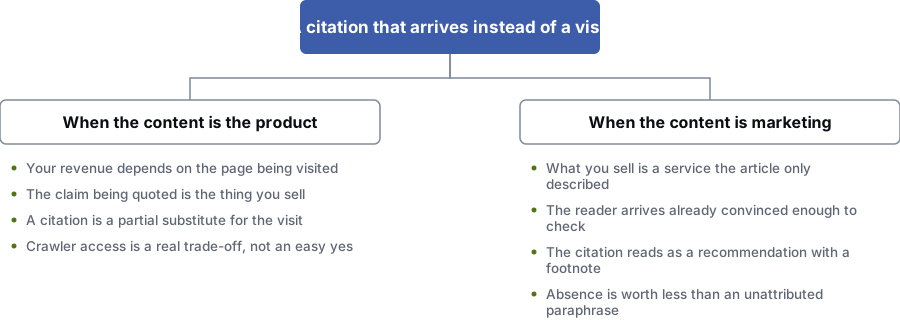
When your content is the product
- Your income depends on people visiting the page
- The quoted claim is the thing you sell
- A citation can replace some of your visits
- Letting AI crawlers in is a trade-off to weigh
When your content is marketing
- You sell a service the article only describes
- Readers who click are ready to check you out
- The citation works like a recommendation with a link
- Being left out is worth less than being paraphrased
What gets cited
Four things that improve your Perplexity visibility
We check your existing pages against these four points before writing anything new.
It is the original source
The page is where the claim starts: data from your own projects, a documented method, a survey you ran, or a pattern only you can see. A summary of other people’s research gives Perplexity no reason to cite you.
It can be checked
Use a specific number, a stated range, a named method or a defined sample. "Our kitchen fits take eight to fourteen weeks, based on our last forty jobs" can be quoted. "We work quickly" can’t, because an AI tool has to stand behind what it quotes.
It shows its date
Add a publish date, a review date and a short note on what changed. For anything that changes, an undated page is a risk, and Perplexity can pick a dated competitor.
Each claim makes sense on its own
Keep the figure, its conditions and its source together, so the claim still works when lifted out of the page. A number in one paragraph with its caveat two paragraphs later can’t be used safely, however good the article.
Where citations come from
The kinds of question that bring up a source list
People mostly use Perplexity to research and check facts. These kinds of question produce a source list, so they are worth having a page for.
We build a fixed set of them for your category, run it regularly, and record which websites get cited as well as whether you appear.
Questions that expect evidence
The most valuable group. A specific number with a stated method is what gets cited here.
- what percentage of [audience] [behaviour]
- is it true that [claim]
- what does the research say about [topic]
- sources for [claim] with dates
Cost, timeline and scope research
Buyers checking what to expect before they get in touch. Published price ranges get cited. Hidden pricing does not.
- typical cost of [service] in [country]
- how long does [project type] usually take
- what is included in a [service] engagement
Comparisons and checks before buying
Where a documented method or a fair pros-and-cons page earns a place in the list.
- compare [approach] and [approach] with pros and cons
- what goes wrong with [project type]
- alternatives to [product] and why teams switch
- what should i check before hiring a [service]
Definitions and how things work
Crowded ground, unless you can explain how something works better than anyone does now.
- how does [process] work
- what is the difference between [term] and [term]
- explain [concept] with a worked example
These are example searches from keyword research and public search data. Before we suggest anything, we check how often people search for them in your area.
Questions
Questions about getting cited in Perplexity
If Perplexity answers the question, why would anyone visit our site?
Some people won’t, and that is a cost. But a citation sits next to a claim the reader has already accepted, so they click to check it, learn more, or contact whoever produced the number.
It depends on what you sell. If your product is the article, a citation can replace some visits. If you sell a service and the article is marketing, a citation works like a recommendation with a link.
We have no original data. Are we out of the running?
No, but it is harder. Summarising what others published is what Perplexity already does, so a site that only restates other sources offers nothing to cite.
Most businesses have more original material than they think: patterns from your own projects, problems you fix again and again, how you work, price ranges by job type and timelines by scope. None of it needs a research budget.
Should we allow or block PerplexityBot?
It depends on what your content is for. Blocking the crawler stops your content being used without a visit, but also stops Perplexity citing you at all.
If your content exists to win customers, allowing access is usually better: being left out is worth less than being paraphrased. If the content is your product, the maths is different. We will work through it with you and write the decision down.
What makes a page citable?
Four things. It says something specific enough to check, ideally a number or stated method. Each claim is complete in one place, with figure, conditions and source together. It shows a date. And it is where the claim first appeared.
All of it makes the page better for human readers too, and that is the test we apply before changing anything.
Can you guarantee we will show up in the source list?
No. Perplexity chooses its sources, the same question can bring back different ones each time, and nobody outside the company knows exactly how it ranks them.
We work on what makes a page eligible and useful: reachable, current, specific, checkable and original.
Find out what your category gets cited for
We will run a set of research questions from your market and bring you the source lists, so you can see what the cited websites have that you don’t.
Prefer to talk it over? Book a free call
References
Sources for Perplexity visibility
The official documents and research this page is based on. Platform rules change, so check the source before you act on a detail.
Related
More on perplexity visibility
- answer engine optimisation explainedA plain explanation of the idea behind this service.
- content strategyDeciding what is worth publishing before deciding how to write it.
- earned media and digital PRYour own data only helps if people find it.
- entity optimisationPerplexity needs to know which company you are before it can cite you.
- how we source and date our content
More AI search optimisation services
Last updated · Published by Zubair Afzal, responsible editor · We check this page every three months. Next check: .