
AI Search Audit
AI search audit: how AI tools find, read and describe your business
Our AI search audit is a fixed-price, four-week check of what AI assistants say about you and what AI crawlers can reach, ending in a ranked fix list.
An AI answer
ExampleWho fixes burst pipes near me tonight?
Your Business Plumbing offers 24-hour emergency call-outs and lists its service area and prices on its site.
- yourbusiness.comCited
- a local directory
- a review site
In every planIncluded in Local or Growth, from $149 a month. Every plan has every feature; they differ by size.
Compare plansThe audit
How the AI search audit runs over four weeks
We test access before content, because there is no point judging a page that AI crawlers can’t reach.
Week one: scope and question set
We agree your competitors, the buyer questions that matter and the AI assistants worth testing. From that we write 30 to 60 questions, each with a written reason, and lock the set so future runs can be compared.
You get: A locked question set with reasons, plus the testing rules
Week one: crawler access checks
We test every relevant crawler against every important section of your site: search crawlers plus GPTBot, PerplexityBot, ClaudeBot, Google-Extended and user-triggered fetchers. We record the response each gets, because reading robots.txt alone is not enough.
You get: A crawler access table with recorded response codes
Week two: run the questions
We ask each question several times in fresh sessions, with personalisation and memory off where the tool allows, recording model version, region and date. Each answer is scored: cited, named, described wrongly, or left out while a competitor was named.
You get: Scored answers with the full, unedited transcripts
Week three: how you are described
We find every place a machine could read a description of your business, and where they disagree: name variations, service descriptions, locations, ownership, and old services still listed elsewhere. Wrong claims from week two are traced to their sources.
You get: A consistency table with sources and who can fix each one
Week three: quotable text and markup
We check whether passages on key pages make sense on their own, whether claims have a date and source, and whether structured data matches what the page shows. Markup the page does not back up is flagged for removal.
You get: A page-by-page list of findings with the exact edit for each
Week four: prioritise and hand over
We order the findings by what unblocks the rest, marking the effort and whether your own team can do each one. We walk you through the report on a call, and you keep the question set, testing rules and raw data.
You get: A ranked fix list, a one-page summary and the full appendix
Two problems, one symptom
Two different reasons AI tools leave you out
From the outside, both look the same. You are left out while someone else is named. But they need different fixes, cost different amounts and belong to different people. Many audits mix them into one list.
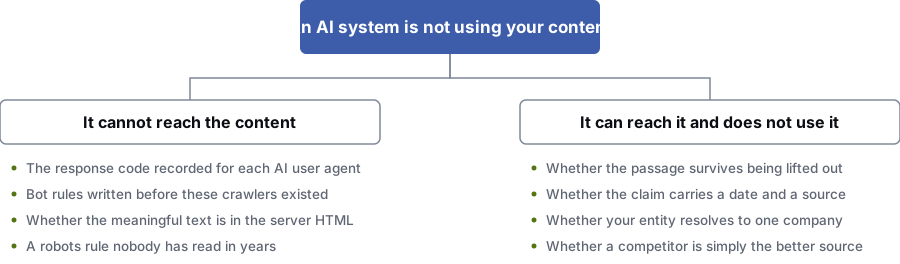
It cannot reach the content
- The response code each AI crawler gets
- Bot rules written before these crawlers existed
- Whether the main text is in the server HTML
- An old robots rule nobody has checked in years
It can reach it but does not use it
- Whether the passage makes sense on its own
- Whether the claim has a date and a source
- Whether AI tools know which company you are
- Whether a competitor is the better source
What you get
Everything included in the audit
We publish the full list so you can compare it with any other quote.
- The written method: question set, run count, models and versions, region and dates
- The full, unedited answers
- A scored results table: cited, named, described wrongly or left out, with accuracy and tone for each answer
- Competitor share from the same questions and runs, so the comparison is fair
- The normal swing between runs for each question, which any future change has to beat
- A crawler access table: every relevant crawler against every important section, with response codes
- Checks on key page templates comparing the server HTML with the finished page
- Structured data findings, including markup the visible page does not show
- A consistency table of every conflicting description, where it appears and who can change it
- A ranked fix list with effort marked and in-house jobs identified
- A one-page summary for anyone who won’t read the rest
A common question
AI search audit compared with a technical SEO audit
They overlap on technical findings and differ on almost everything else. If your site has never had a standard SEO audit, do that first.
| Dimension | Technical SEO audit | AI search audit |
|---|---|---|
| The question | Can search engines crawl, render, index and rank this site? | Can AI tools reach this content, and what do they say when asked? |
| Evidence | Crawl data, server logs, Search Console, Core Web Vitals | AI crawler access tests plus scored AI answers with full transcripts |
| Crawlers checked | Googlebot and Bingbot, including how they render pages | Search crawlers plus GPTBot, PerplexityBot, ClaudeBot, Google-Extended and user-triggered fetchers |
| Content review | Titles, headings, duplicate pages, internal links, unneeded indexed pages | Whether passages make sense on their own, whether claims have dates and sources, and whether AI tools can tell which company you are |
| Off-site review | Links and the websites linking to you | How consistently other websites describe your business |
| What you get | A ranked list of technical fixes | A ranked fix list plus a starting measurement you can repeat |
| Limits | It can’t tell you whether the content is any good | It can’t tell you why an AI gave a particular answer, or what it will say next month |
Scope
What the audit can and cannot tell you
We publish both lists before you buy. The second matters as much as the first.
What it tells you
- Which AI crawlers can and can’t reach each part of your site, with response codes as evidence
- How often your business is named across a set list of questions, and how often a competitor is named instead
- Whether you are cited with a source or only described, reported as two separate figures
- Which statements about your business are wrong, and which website we think they came from
- Which pages fail a quotability test, and the exact edit that fixes each one
- Where descriptions of your business disagree with each other across the web
- Whether an ongoing programme is worth it for you, even when the answer is no
What it cannot tell you
- Why an AI gave a particular answer, because these tools don’t reveal that
- Whether any future answer will name you, in any assistant, at any time
- A single blended AI visibility score, because averaging across models and questions hides the findings
- How much revenue an assistant sent you, when the tool strips out where the visit came from
- What an AI model was trained on, which can’t be seen from outside the AI company
- Whether a change will work before it has been made and measured again
Questions
Questions to ask before booking an audit
How is this different from the SEO audit we had last year?
It asks a different question. A technical SEO audit asks whether search engines can crawl, render, index and rank your site. This audit asks whether AI tools can reach your content, and what they say about your business and category.
The evidence differs too: crawl data, logs and Search Console for SEO; AI crawler access tests and scored AI answers with full transcripts here. Only the technical findings overlap.
What stops this being generic advice with our logo on it?
Every finding links to evidence in the appendix: a recorded response code, or the answer where a description appeared and the website we think it came from.
If we can’t trace a finding to something specific on your site or in an answer, it stays out of the report.
How long does it take and what do you need from us?
Four weeks is standard, mostly spent running the questions properly. We need read access to Google Search Console and Bing Webmaster Tools, a contact who can answer questions about the business, and your competitor list.
We don’t need access to your site itself. CDN or hosting access speeds up the crawler checks, but we can do everything from outside.
What happens at the end?
You get the report and the raw data, and you own both. We mark which fixes an in-house team can do without an agency, so they don’t end up bundled into a proposal.
If an ongoing programme isn’t worth it for you, the report says so. Where the technical and content basics need work first, fixing them is a better use of budget than a retainer.
Will the audit tell us why a model said something about us?
No, and no audit can. AI tools don’t reveal why they gave a particular answer, and anyone claiming to know is guessing.
We can often trace a wrong claim to a website still publishing it: an old directory listing, an out-of-date profile, old press coverage, or your own page about a dropped service. That can usually be fixed.
Start with the audit before any retainer
Fixed scope, fixed price, four weeks. You keep the question set and raw data, and if your budget would do more good elsewhere, the report says so.
Prefer to talk it over? Book a free call
Your BOOSTD score improves within 90 days, or your next month is free. After 6 months, more traffic or leads, or we keep working free (up to 6 free months in any 12 months). Read our guarantee
References
Sources for AI search audit
The official documents and research this page is based on. Platform rules change, so check the source before you act on a detail.
Related
More on AI search audit
- what AEO means for your businessA plain explanation of the idea behind this service.
- a standard SEO auditA different question, answered with different evidence. Often worth doing first.
- ongoing AI visibility trackingWhat the locked question set is built to support.
- AI Overviews and your click-through rateThe Search Console side of the same check.
- Bing and Copilot indexingIncluded as standard in the access review.
- how we run a project
More AI search optimisation services
Last updated · Published by Zubair Afzal, responsible editor · We check this page every three months. Next check: .