
LLM Visibility & Optimisation
LLM visibility service: see what AI assistants say about you
Our LLM visibility service tracks how often ChatGPT, Gemini, Copilot and Perplexity mention or cite you, with the full answers behind every number.
An AI answer
ExampleWho fixes burst pipes near me tonight?
Your Business Plumbing offers 24-hour emergency call-outs and lists its service area and prices on its site.
- yourbusiness.comCited
- a local directory
- a review site
In every planIncluded in Local or Growth, from $149 a month. Every plan has every feature; they differ by size.
Compare plansWhere to start
Why rank tracking does not work for AI answers
Rank tracking worked because search results were fairly stable. Two people in the same city, searching the same phrase, saw much the same ten links, so one check a day gave a position you could chart.
AI answers are different. Ask the same question twice and you can get different businesses, wording and sources. Change three words, the country, the session or the memory setting, and the answer can change completely.
So we drop the idea of a position. For any question there are four results: cited with a link, named without one, described without being named, or left out while a competitor is named. We count all four and never blend them into one score.
Some things can’t be measured at all. Nobody outside the AI companies can see the training data or why an answer was produced, and no tool can tell you what an assistant will say tomorrow.
What changes
Rank tracking compared with tracking AI answers
The two methods measure different things, need different sample sizes and support different conclusions.
| Dimension | Rank tracking in normal search | Tracking answers in AI assistants |
|---|---|---|
| What you measure | Your position for a keyword on a results page | A rate: how often you appear when the same question is asked many times |
| Repeatability | Two people in similar conditions usually see much the same results | The same question can return different businesses, sources and wording each time |
| Sample needed | One check per keyword per day is enough | One run tells you little. A useful rate needs many runs in fresh sessions |
| What the top result means | A set slot with fairly well understood click behaviour | There is no slot. You are cited, named, described or left out |
| Linking changes to your work | Changes can usually be traced to something you or a competitor did | A change may come from your work, a model update, a reworded question or chance. The report has to say when it can’t tell which |
| Agreement between tools | Different rank trackers mostly agree with each other | Different visibility tools often disagree, because they use different questions, models and run counts |
| Most useful finding | Where you rank against competitors for buying searches | What AI tools say about you that is wrong, and which website it comes from |
Two results, one number
Being mentioned and being cited are two different results
Most reports add these together. That hides how much more a citation is worth, and the fact that each one needs different work. We count and report them separately.
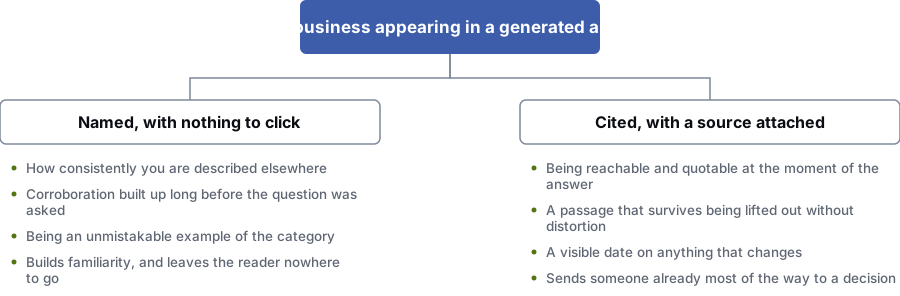
Named, with no link to click
- How consistently other websites describe you
- Mentions built up long before anyone asked
- Being a clear example of your type of business
- Makes people familiar with you, with no link to follow
Cited, with a link to your page
- Your page being reachable when the answer is written
- A passage that still makes sense on its own
- A visible date on anything that changes
- Sends a visitor who is close to a decision
How it works
How our LLM visibility service works, step by step
We publish the method so anyone can check it, repeat it or run it themselves.
Build the question set
We write 30 to 60 questions based on how your buyers ask: shortlisting suppliers, describing a problem, comparing options, expected prices and direct questions about your company. Each has a written reason, and the set is locked so later runs compare.
You get: A written question set with the reason for each question
Set the testing rules
We agree the assistants, model versions, region, runs per question, and whether memory and personalisation are on. Fixing this before the first run stops results drifting towards whatever produces the nicest chart.
You get: Testing rules another team could follow and repeat
Run and score every answer
We score each answer on four points: were you named, were you cited, was the description accurate, and which competitors appeared. We also record which websites were cited, which often tells you more than your own rate.
You get: Scored answers with the full transcripts attached
Separate true changes from normal swings
We measure how much results vary between runs of the same question. A change has to be bigger than that swing to count; anything smaller is reported as flat, not as an improvement.
You get: A starting measurement showing sample size and the normal swing
Fix what the tracking finds
A first run can turn up wrong information: a service you no longer offer, an old address, an out-of-date price, or a competitor credited with your work. Each traces back to a specific website, and correcting it there is the most valuable work here.
You get: A list of corrections by website, with who can make each one
Repeat on a fixed schedule
Every quarter we rerun the same questions with the same rules and scoring, recording model versions each time. If the numbers jump, we check whether the model changed before anyone claims credit.
You get: Quarterly repeat checks against the same question set
What we will not report
A score needs a question set, a run count, a model version and a date. Without all four, it is just a number on an invoice.
We don’t produce one blended AI visibility score. Averaging across models and question wordings hides the most useful information.
We don’t credit our work for a change smaller than the normal swing between runs, so a reported improvement can be trusted.
We don’t guarantee a mention or a citation in any assistant, on any timeline or budget. We work on the inputs; the AI companies control the output.
Questions
Common questions about AI visibility numbers
Can you measure whether ChatGPT or Gemini mentions us?
Yes, as a rate, not a position. We fix a set of questions, ask each one a set number of times in fresh sessions, and record how often you appear: for example, "named in 6 of 20 runs of this question, on this date, in this model version".
We can’t turn it into a ranking. AI answers have no slots and no leaderboard, so any report that shows one has made it up.
Why do two AI visibility tools give us completely different scores?
Tools use different question sets, AI models, regions and run counts, and count a mention differently. Change any one of those and the score moves.
Ask whoever reports a score for the question set, run count, model versions and date. Without those four, you can’t compare it with anything, not even last month’s score.
What is the difference between being mentioned and being cited?
A mention is the AI saying your name. A citation is the AI linking to you or naming your page as a source. They are worth very different amounts, so we never report them as one number.
A mention builds familiarity. A citation gives a ready buyer a link to click. They need different fixes: mentions mostly come from being described the same way across the web, citations from pages AI tools can reach and quote today.
How many runs do you need before a number means anything?
More than most reports admit to. One run shows what happened once; the next can list different businesses with nothing changed on your side.
We ask every question several times in fresh sessions, with personalisation and memory off where the tool allows, and state the run count. A change smaller than the normal swing between runs is reported as no change.
Can we see AI traffic in Google Analytics or Search Console?
Partly. Some AI assistants pass on where the visitor came from, so those visits show up as referral traffic you can track like any other source.
Much of it stays hidden. App-based assistants often strip that information, and Google reports clicks from its AI features inside normal Search performance data with no separate breakdown. So referral traffic shows the minimum effect, and we report it that way.
Can you make a model recommend us?
No. Nobody can. Answers change by user, wording, region and model version, and no agency controls any of that.
What you can control is being easy to reach, described the same way everywhere, backed up by other websites, and accurate. We work on those inputs. We don’t sell the output.
Get a starting measurement with the method attached
We will build a short question set for your category, run it properly, and send you the full answers with the numbers, so you can see how every figure was produced.
Prefer to talk it over? Book a free call
References
Sources for LLM visibility service
The official documents and research this page is based on. Platform rules change, so check the source before you act on a detail.
Related
More on LLM visibility
- what answer engine optimisation meansA plain explanation of the idea behind this service.
- a one-off AI search auditA fixed-scope option if you want a starting measurement without a monthly plan.
- what ChatGPT says about your categoryA closer look at one assistant.
- Perplexity and its citationsThe AI tool where it is easiest to tell a citation from a mention.
- analytics and reporting
- our standards for claims and results
More AI search optimisation services
Last updated · Published by Zubair Afzal, responsible editor · We check this page every three months. Next check: .