
ChatGPT Visibility
What ChatGPT says when someone asks about your category
People increasingly shortlist providers by asking an assistant. If your business is absent from that answer, or described wrongly, you are being filtered out before any search happens.
Prefer to talk it through? Book a strategy call
The behaviour that matters
Shortlisting now happens before the search
The significant shift is not people abandoning search engines. It is people asking an assistant for a shortlist, then searching for the two or three names it gave them. By the time you see the branded search in your analytics, the field was narrowed somewhere you cannot observe.
That makes absence expensive and invisible at the same time. There is no report showing the enquiries you did not get because a competitor was named and you were not, which is why most businesses have never checked.
Inaccuracy is the more common problem and often the more damaging one. We regularly find businesses described with services they discontinued, locations they left, or positioning several years out of date — information that is actively costing them deals and that nobody internally has ever seen.
The stage before your analytics
The shortlist is drawn before anybody searches for you
By the time a branded search appears in your reporting, the field has already been narrowed somewhere you cannot observe. This is the part of the sequence no analytics tool you own can see.
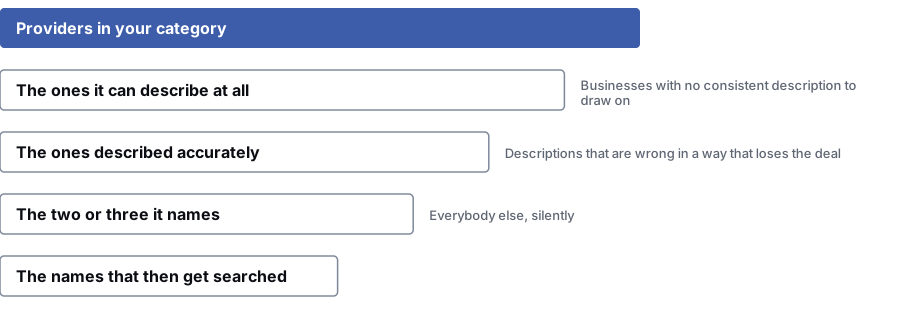
- 1Providers in your category — Everybody who could have been named when somebody asked an assistant to suggest a few options.
- 2The ones it can describe at all — A business described three different ways across the web is harder to place than one described the same way everywhere.Businesses with no consistent description to draw on
- 3The ones described accurately — We regularly find services that were discontinued, offices that were left, and positioning several years old.Descriptions that are wrong in a way that loses the deal
- 4The two or three it names — The shortlist. Nothing about this stage appears in any report you have, which is what makes absence so expensive.Everybody else, silently
- 5The names that then get searched — This is where your analytics starts. It records the branded search and none of the narrowing that produced it.
What people actually ask
The prompts that decide a shortlist
These are the shapes of question that produce a recommendation. We build a fixed set of them for your category, run it across assistants, and record what comes back — the same set every quarter, so movement is measurable rather than anecdotal.
Category shortlisting
The most commercially significant. You are either named or you are not.
- who are the best [service] companies in [city]
- recommend a [service] provider for a small business
- what agencies specialise in [niche]
- top rated [service] near [area]
Company-specific questions
Where inaccuracy shows up. Usually the fastest fix available.
- what does [company] do
- is [company] any good
- where is [company] based
- how much does [company] charge
Comparison prompts
Increasingly common, and revealing about how you are positioned.
- compare [company] and [competitor]
- what is the difference between [company] and [competitor]
- alternatives to [competitor]
Buying-process questions
Where useful published content becomes the reason you get mentioned.
- what should i look for when hiring a [service]
- how much should [service] cost
- what questions should i ask a [service] provider
- red flags when choosing a [service]
These are examples of how customers in this market search, drawn from keyword research and from the questions that come up on sales calls. They are illustrative, not a volume claim — the actual demand in your area is something we size before recommending anything.
Method
What we do, and what we refuse to do
What the work consists of
- Establishing a baseline across a fixed prompt set, and re-running it quarterly
- Correcting inaccurate information at the sources it comes from
- Making your business resolve as one consistent entity everywhere it is described
- A documented, deliberate decision on which AI crawlers to allow
- Publishing content that answers the questions people ask before shortlisting
- Earning corroboration from sources that carry weight
What we will not do
- Guarantee a recommendation, a mention or a citation
- Claim to influence model training
- Attempt prompt injection or any manipulation of a model
- Quote citation-share statistics we cannot source
- Sell this as a replacement for search visibility rather than an extension of it
Questions
What businesses ask about assistant visibility
Can you make ChatGPT recommend us?
No, and nobody can. Responses vary by user, by phrasing and by version, and there is no mechanism anyone outside OpenAI controls.
What we can do is make you accurate, reachable and well corroborated — the conditions under which inclusion becomes possible. If an agency offers you a guarantee here, that is the moment to end the conversation.
ChatGPT says something wrong about our business. Can that be fixed?
Often, yes, and it is usually the most valuable thing on this page. Inaccurate descriptions almost always trace back to sources that are still saying the wrong thing — an old profile, a stale directory listing, outdated coverage, your own site describing a service you no longer offer.
Correcting those at source is what changes the answer over time. It is not instant, because the information has to propagate, but it is tractable and it is worth doing regardless of assistants.
Is there enough traffic from assistants to justify this?
Measured as referral traffic, usually not yet, and we will not pretend otherwise. Measured as influence on a shortlist, frequently yes — and that influence is invisible in your analytics.
The honest framing is that this work is mostly the same fundamentals that serve you elsewhere: accuracy, consistency, corroboration and clear content. If it were a separate expensive programme with no other benefit, we would tell you to wait.
Should we allow or block GPTBot?
It depends on what your content is worth to you. Blocking reduces the chance of your material being used without attribution and also reduces the chance of being represented at all.
For most businesses selling a service, being findable is worth more than being unquoted. For publishers whose product is the content itself, the calculation genuinely differs. We work through the trade-off for your situation rather than applying a default.
Find out what assistants are telling people about you
We run the baseline before the call — your company, your category, your competitors — and bring you the transcript. Sometimes it is fine. Often something is wrong in a way worth fixing this month.
Prefer to talk it through? Book a strategy call
Last updated · Published on owner authorisation by Zubair Afzal